
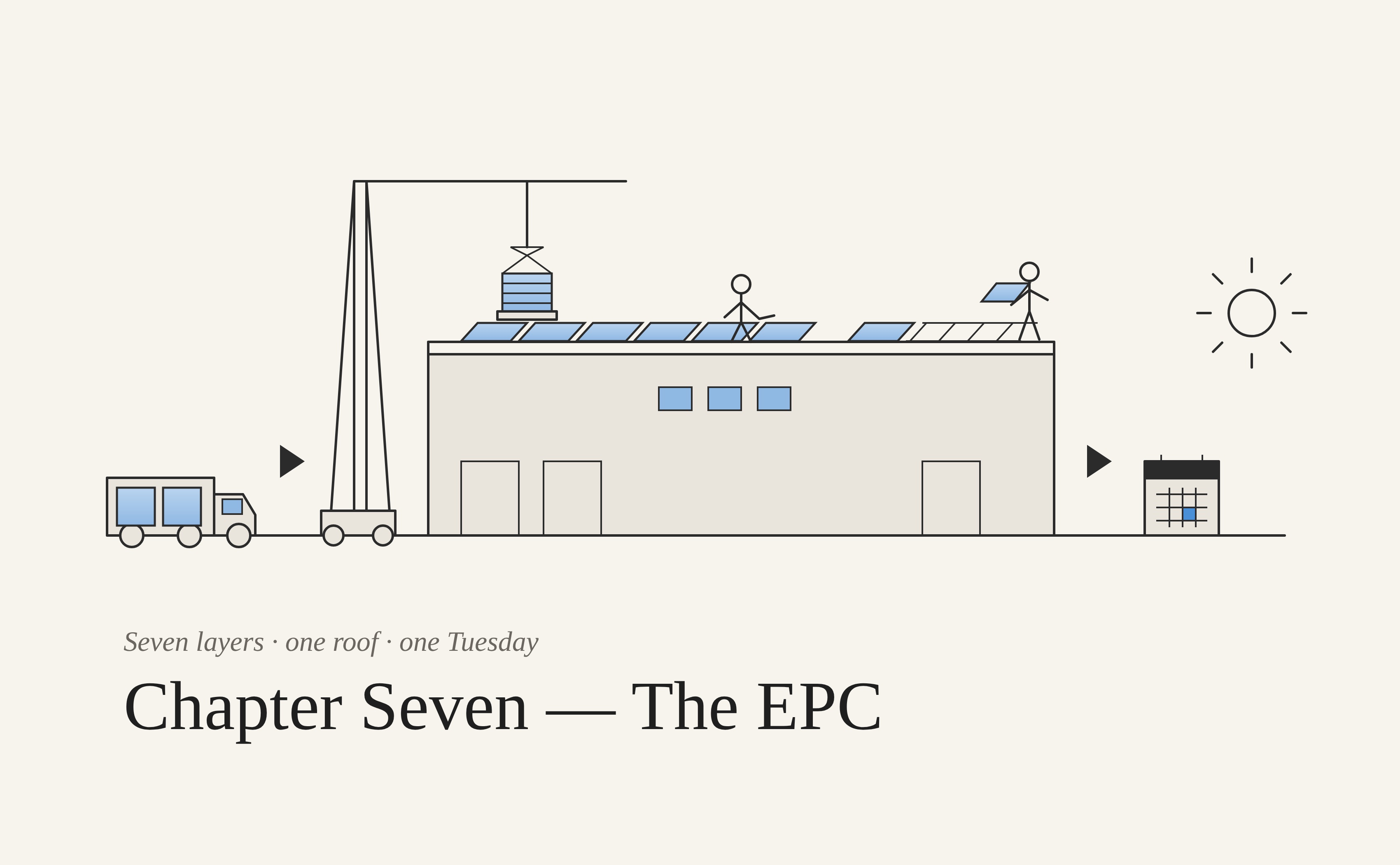
The Solar Value Chain Decoded · Chapter Seven
The EPC

An eight-part field guide to the people, places, and machines that stand between a vein of rock and the panel on your roof. In six chapters we have dug quartz out of an Appalachian valley, refined it, grown it into a crystal, sliced it, doped it, laminated it, shipped it across an ocean and parked it in a warehouse in Georgia. The panel is now a few miles from the roof. This chapter is about the people who carry it the rest of the way — and about why the last fifty feet are, in a sense the whole series has been building toward, the most expensive fifty feet of all.
In 1971, three engineers at the Atlantic Richfield oil company published a short paper in the Journal of Petroleum Technology with a title that gives away the ending: "Competitive Bidding in High-Risk Situations." Their names were Ed Capen, Bob Clapp and Bill Campbell, and they had noticed something that was puzzling their employer. The company kept winning auctions for offshore drilling leases in the Gulf of Mexico, and the leases it won kept losing money.
The explanation they worked out has since become one of the most useful ideas in economics, and it is called the winner's curse. When several bidders compete for something whose true value nobody knows for certain — a tract of seabed that may or may not contain oil — each of them makes an estimate. Some estimates will be too low and some too high. The auction does not pick the most accurate estimate. It picks the highest one. So the winner is, systematically, the bidder who was most wrong in the optimistic direction. Capen and his colleagues put it with the bleak clarity of men who had watched it happen: "He who bids on a parcel what he thinks it is worth will, in the long run, be taken for a cleaning."
The oil companies learned, eventually, to shade their bids down. Most of the economy has not. And nowhere, I think, is the winner's curse more faithfully reproduced, week after week, than in the layer of the solar industry that finally has to put the panel on the roof.
The three letters
The layer has a name that sounds like a government agency: EPC. Engineering, procurement, construction. The initials describe a kind of contract before they describe a kind of company — a single agreement under which one party promises to design the system, buy everything in it, build it, and hand over a working power plant on a date, for a price. One throat to choke, as project owners like to say, with a candor that tells you a good deal about the relationship.
In the solar world the EPC comes in every size. At the top are national contractors who build hundred-megawatt plants in the desert with a thousand workers and their own substations. At the bottom is a crew of six with two trucks who put forty panels on a garage before lunch and call themselves an installer. Between them sit the firms that build the kind of project this series has been quietly following all along: a few thousand panels on the flat roof of a warehouse outside Atlanta, a job that takes a few weeks, a crew of eight to fifteen, a crane for a day, and a contract whose price was fixed months before anyone climbed a ladder.
It is that fixed price that makes the EPC what it is. Everything upstream in this chain sells a thing — quartz, polysilicon, wafers, cells, modules, warehouse space and weeks. The EPC sells an outcome: a plant that works, on a day, for a number. And an outcome, unlike a thing, has to absorb every way the world can go wrong between the signing of the contract and the flipping of the switch.
Bolting it down
Let me describe the work first, because it is easy to talk about risk in the abstract and it is better to have a picture of what is actually at stake.
The engineering part begins months before the crew. Somebody has to establish that the roof can take the weight — a 590-watt bifacial module of the kind we assembled in Chapter Five weighs around seventy pounds, and with its racking and ballast a rooftop array can add several pounds to every square foot of a building that was designed, decades ago, for snow and air-conditioning units and nothing else. A structural engineer has to sign a letter. An electrical engineer has to design the strings — which panels are wired to which, at what voltage, through which inverters, to which point on the building's switchgear — in a way that satisfies the National Electrical Code, the local inspector, the utility, and the fire marshal, who will want clear pathways across the roof for a firefighter who may one day have to walk on it in the dark.
Then the permits. The city has to approve the plans. The utility has to approve the interconnection — the agreement that lets the building push power back onto the grid — and that approval can take weeks or months and can come back with conditions that change the design. Insurance has to be arranged. A crane has to be booked, because you do not carry three thousand panels up a ladder; you lift them onto the roof in pallets, and the crane and the operator cost money by the hour whether the pallets are there or not.
And then, finally, the crew. The racking goes down first: rails or ballasted trays, laid out in rows across a roof the size of three football fields, with the layout adjusted around every vent, skylight and drain. The panels come up. Each one is lifted, carried, laid in place, and clamped — two clamps per edge, a torque wrench for each, because a loose clamp means a panel that lifts in a storm and a tight one means a cracked frame. Each one is plugged to its neighbor. Each string is tested. A good crew on a clean commercial roof will set something like a hundred and fifty to two hundred and fifty modules in a day, and a fifteen-person crew will be paid for every one of those days whether or not the modules arrive.
Hold onto that last clause. It is the whole chapter.
The reverse relay
For six chapters I have described this industry as a relay race: each runner hands the baton to the next, and most of them have never met. The EPC is the last runner. But there is something about the last position that the metaphor obscures, and it is the reason the EPC's layer is unlike any of the others.
In a relay, if the second runner stumbles, the second runner loses time. In a supply chain with a fixed-price contract at the end of it, if the second runner stumbles, the last runner pays.
Think about what happens when something goes wrong upstream. Suppose the ocean stops being free, as it did in 2021, and freight on a container jumps from two thousand dollars to twenty. Who pays? The module factory has already sold the panels at a price agreed months earlier. The freight forwarder passes the cost straight through. The distributor, if it has stock, charges more for it; if it does not, it quotes a longer lead time. Each of those parties sells a thing, and a thing can be repriced.
Now follow the cost downhill to a contractor who signed, in January, to deliver a working rooftop plant in Atlanta in August for four million dollars. Modules were a third of that budget. They are now a good deal more. The contract has a number on it and the number has not changed. The difference comes out of the contractor's margin — which, in this industry, on a competitive commercial job, is often a single-digit percentage of the contract value to begin with.
Or suppose the border stops being predictable, as it did in 2022, and the panels that were due in June are sitting in a port in Savannah, physically present and legally unavailable, while someone in Washington decides what a document means. The crew is booked. The crane is booked. The roof is half-covered. The owner's bank has a date in its loan agreement. The contractor can stand the crew down — and pay them anyway, or lose them to another job and hire new ones later — or keep them on site doing less and less productive work. Either way, each day of delay has a price, and that price has a name in the contract: liquidated damages, a fixed sum per day past the agreed completion date, payable by the contractor to the owner. Nobody in Savannah, in Washington, or in Jiangsu is paying it. The last runner is.
This is the asymmetry at the heart of the EPC's layer, and once you see it you cannot stop seeing it. Every layer upstream can pass a shock along. The EPC can only pass it down — to the owner, if the contract allows, which it usually does not — or absorb it. Shocks in this chain flow like water, and the EPC is the low ground.
The planning fallacy, with a torque wrench
You might reasonably ask why anyone signs such a contract. Why would a contractor agree to a fixed price for an outcome that depends on an ocean, a customs officer, a utility engineer and the weather?
Part of the answer is competition: the owner wants a fixed price, and if you will not give one, someone else will. But part of the answer is something deeper and more human, and it was identified, in a completely different context, by Daniel Kahneman and Amos Tversky in the 1970s.
Kahneman tells the story in his own books. He and a group of colleagues set out to write a curriculum for teaching judgment and decision-making in Israeli high schools. After a year's work, he asked each member of the team to estimate privately how long the rest would take. The estimates clustered around two years. Then he asked the one member of the group who had watched other teams try to write curricula from scratch how long those had taken. The man thought, grew visibly uncomfortable, and said that a sizeable fraction of the teams had never finished at all, and that those that did had taken something like seven to ten years. Nobody in the room, including the man who had just said it, changed their plan. The curriculum took eight years.
Kahneman and Tversky called it the planning fallacy: the near-universal tendency to estimate a project from the inside — from the specific steps you can see in front of you — rather than from the outside, from the record of how such projects actually go. The Danish economist Bent Flyvbjerg, who has spent a career assembling that record for large construction projects, summarizes it in what he calls the iron law: over budget, over time, over and over again.
A fixed-price solar contract is the planning fallacy with a signature on it. Every bid is made from the inside — these panels, that crane, this crew, those weeks — against a world that, from the outside, delivers a shock to some link of the chain in most years. And the winner's curse makes sure that the bid that wins is the one that discounted those shocks most thoroughly.
I say this with no condescension whatsoever. I have sat on the manufacturing side of this industry for fifteen years, and I have watched our own delivery dates slip for reasons that were, each time, perfectly explicable and entirely invisible from the jobsite. The contractor who signed for our modules did not do anything wrong. The contractor did exactly what the structure of the chain required — and then the structure sent the bill.
Procurement is where the whole series lands
Of the three letters, the middle one is the one that this series has been circling since the first page.
Procurement sounds like the dull part. It is purchasing. It is purchase orders and delivery schedules and a spreadsheet of suppliers. But think about what the procurement manager on our Atlanta project is actually being asked to do. She has to buy, at a fixed price, for delivery on a date, a product whose cost is set by polysilicon prices in Sichuan, whose technology is being redesigned every few years in Jiangsu, whose legal status at the American border can change with a petition, whose freight cost can swing tenfold, and whose country of origin — a question on which a tax credit worth a tenth of the project may depend — is answered by a file rather than a sticker. She has to do this without ever having stood in a quartz mine or a diffusion furnace, and she has to be right, because if she is wrong the crew stands idle and the liquidated damages start.
Every lesson of the preceding six chapters arrives on her desk at once, compressed, as we saw in Chapter Five, into a single number per watt, and then — this is the EPC's special contribution — compressed one stage further, into a single date.
Because that is what the EPC's customer is really buying. Not panels; the owner could buy panels. Not labor; the owner could hire labor. What the owner cannot do, and will pay a contractor to do, is carry the risk that all of these things will come together on the same roof in the same week. The distributor, we said in the last chapter, sells time. The EPC sells certainty — or, more precisely, the EPC sells the absorption of uncertainty, which is the same product viewed from the side that has to pay for it.
There is a reason, then, that the experienced ones have become so careful about where the modules are. Ask a seasoned commercial contractor what they want to know about a module supplier, and you might expect the answer to be price, or efficiency, or brand. It is usually none of those. It is: where is the stock, right now, and can I see it? A panel that is in a warehouse in Georgia with a pallet count and a photograph is a panel that will be on the roof on Tuesday. A panel that is "available" from a factory with a twelve-week lead time is a panel that may be on the roof in August, or may be the reason the crew is idle in August. To a company that sells certainty, the difference between those two panels is not a few cents a watt. It is the margin on the job.
The crane that could not wait
Let me make this concrete with a composite story — the details are a blend of several projects, but every element of it will be instantly recognizable to anyone who has built a roof.
A contractor signs in the spring to build a 1.2-megawatt rooftop system, a little over two thousand panels, on a distribution warehouse near the airport. Completion by the end of September, because the owner's financing has a milestone there and the tax credit the owner is counting on has rules about when construction begins and when the plant is placed in service. Modules ordered from an overseas factory through an importer: good price, delivery in July, plenty of slack.
In June the importer calls. The factory has switched the line to a newer cell type — the sort of changeover we watched in Chapter Four, which happens, you will remember, at the speed of a procurement season. The modules the contractor ordered are no longer being made. The replacement is a slightly different size, a few watts more, a few millimeters longer. Good news, on paper.
The racking has already been delivered. It was cut for the old size.
Now the contractor has a choice, and every branch of it costs money. Re-order racking and push the schedule, paying the crew to wait and the owner's liquidated damages per day. Keep the schedule and find two thousand of the old modules somewhere in the United States, this month, from stock — at whatever price someone who has them is asking. Or redesign the layout around the new size, re-submit to the city and the utility, and hope both answer before the crane arrives.
Whatever the contractor chooses, notice who is paying. Not the factory, which made a sensible decision about its product line. Not the importer, who passed on the news. Not the owner, who has a fixed price and a date. The last runner.
And notice what would have changed the story. Not a cheaper panel. A panel that was already here.
What it looks like when it works
I have described the failures because the failures are where the lessons live. But I do not want to leave the impression that the EPC's layer is a tragedy in progress. It is also, when it works, the single most satisfying place in the entire chain to stand.
Because it is the only place where the chain becomes visible all at once. The quartz was a hole in the ground; the polysilicon was rods in a reactor; the wafer was a slice of a crystal nobody outside a clean room will ever see; the cell was a sheet of silicon with an invisible junction; the module was a sandwich; the distributor was a warehouse. The EPC's crew, on a clear morning in Georgia, lays out three thousand of those sandwiches in rows across a roof, plugs them to each other, closes a disconnect, and watches a meter begin to turn. Every layer in this book is up there, bolted down, in the sunlight, making electricity. It is the moment the relay race ends and the thing that was run for actually exists.
A good EPC is, in a way, the layer that reverses the compression we have been describing. The buyer saw one number. The crew sees every component — every clamp, every connector, every string — and has to make every one of them right, by hand, in the weather, on a schedule. When the industry talks about "soft costs," it means, mostly, this: the labor, the permitting, the engineering, the interconnection, the overhead of a company that must carry the risk. In the United States, soft costs have long made up a larger share of a finished solar project's price than the modules do. Most people find that counterintuitive. After six chapters of watching the module's cost be squeezed by physics and competition, I hope it is less so. The module got cheap. The roof, the crew, the inspector and the risk did not.
What the EPC teaches us
Line them up once more.
The mine taught us the chain is narrow. The refinery taught us it is concentrated and political. The wafer taught us it is deep. The cell taught us it is fast. The module taught us it is compressed. The distributor taught us it is slow.
The EPC teaches us the property that follows from all six, and that none of them states on its own: the chain is asymmetric. Risk does not stay where it is created. It flows downhill, past every party who can reprice a thing, until it reaches the party who has promised an outcome — and there it pools. The quartz mine does not pay the liquidated damages. The polysilicon plant does not stand the crew down. The customs officer does not rent the crane for a second day. The EPC does, because the EPC is the first link in the chain that cannot pass the shock any further.
This is not a complaint about the structure. It is a description of it, and it has a practical consequence that this entire series has been building toward. If you are the party at the bottom of the hill, the single most valuable thing you can do is shorten the hill: reduce the number of links between you and the thing you need, and reduce the distance — in weeks, miles and signatures — that a shock has to travel to reach you. A module that is already in the country, already cleared, already on a pallet with a count and a photograph, has had most of the chain's risk already absorbed by someone else. That is not a sales pitch, or not only one. It is the arithmetic of where risk pools.
There is one more layer. We have followed the panel from a rock that cooled 380 million years ago to a clamp on a roof in Georgia, and we have met everyone who touched it on the way. We have not yet met the person it was all for.
This series is published by SolarStock USA. We distribute Sunpro Power modules from inventory positioned in the United States. We wrote this guide because we believe the people who buy, specify, and install solar deserve to understand the whole chain they are part of — not just the part that touches their invoice.