
The Solar Value Chain Decoded · Chapter Five
The Module

An eight-part field guide to the people, places, and machines that stand between a vein of rock and the panel on your roof. In the first four chapters we dug quartz out of an Appalachian valley, refined it into hyper-pure silicon, grew that silicon into a single perfect crystal and sliced it into wafers, then taught the wafer, with a whisper of phosphorus and boron, to turn light into electricity. Now, at last, we build the thing you can actually buy.
Here is a fact that ought to be stranger than it is.
Everything we have followed so far in this series — the mine, the refinery, the crystal puller, the diffusion furnace — has been invisible to the person who pays for it. Nobody buys quartz. Nobody buys polysilicon. Nobody, outside of a purchasing department in Jiangsu province, buys a solar cell. Four chapters, four industries, four separate universes of expertise, hundreds of billions of dollars of capital equipment, and not one gram of it has ever been seen by the customer.
The module changes that. The module is the first object in this entire chain that a human being outside the industry will ever touch. It arrives on a truck, on a pallet, wrapped in plastic. It weighs sixty-odd pounds. Two people can carry it, awkwardly, up a ladder. It has a brand name on the frame and a sticker on the back with a serial number and a wattage, and that sticker is, for almost everyone who will ever handle it, the beginning and the end of the story.
Which is why this chapter is the hinge of the series. Up to now we have been describing a supply chain. From here we are describing a market — with prices, warranties, countries of origin, tax credits, freight costs, and lawyers. The module is where the physics stops and the commerce begins.
And the module is also, I think, the most quietly misunderstood layer in the whole chain. Everyone assumes it is the easy part. You have already done the hard thing — you have made a device that converts sunlight into electricity — and now you are just, what, gluing it to some glass? Putting a frame around it?
Yes. That is exactly what you are doing. And it is the step that decides whether the panel lasts four years or thirty-five.
Sixty pieces that must not move
Let us open one up.
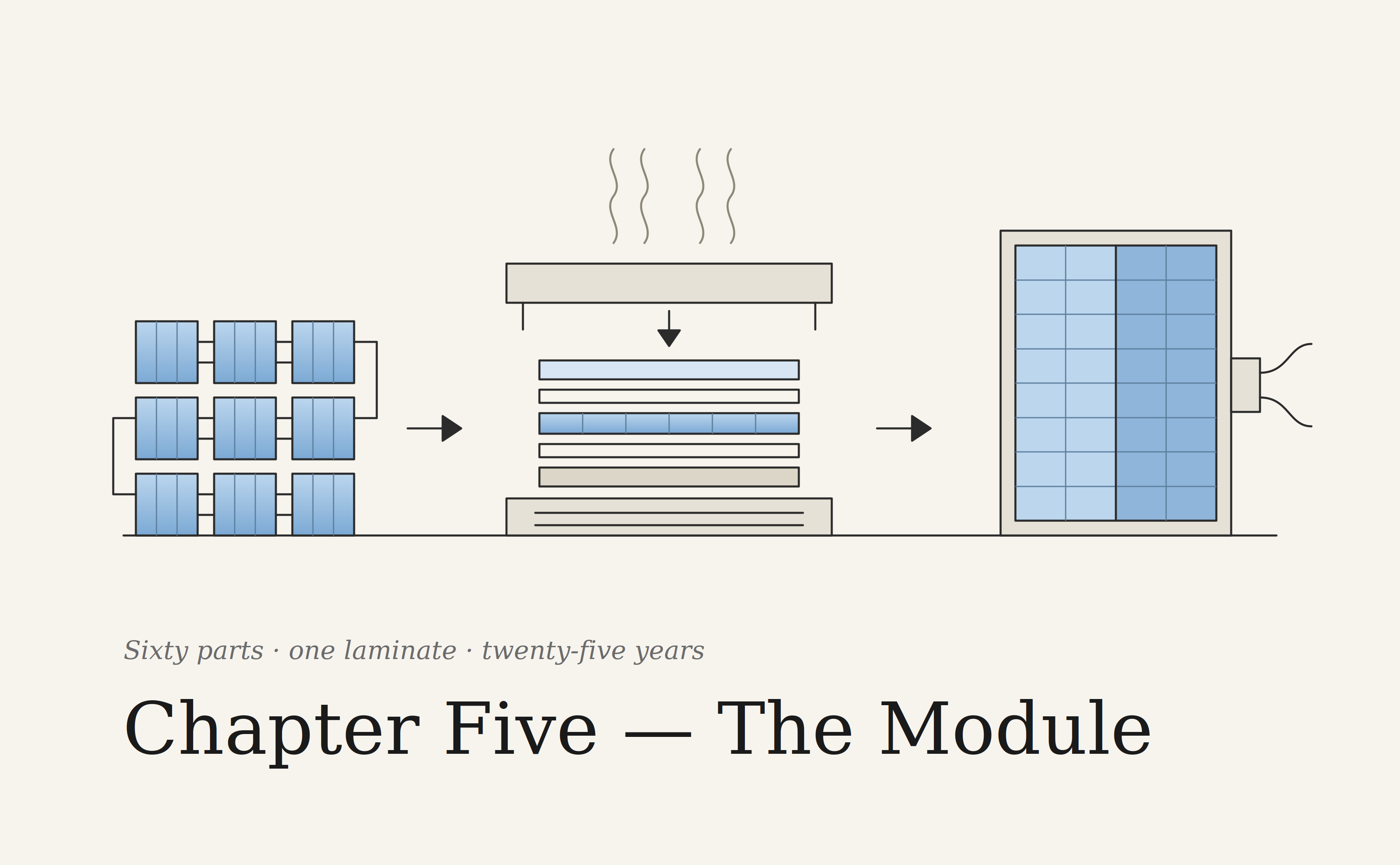
A modern solar module — take any 590-watt bifacial panel off any pallet in any warehouse in America — is a sandwich, and it is worth naming the layers in order, because every one of them is a compromise that somebody argued about.
At the front: glass. Three and a half millimeters of it, or two millimeters in a double-glass design. Not ordinary window glass — low-iron, so it is nearly colorless rather than the faint green of a windowpane, because iron oxide absorbs precisely the wavelengths you spent four chapters learning to capture. It is heat-strengthened or tempered, textured on the outer face to cut reflection, and coated with an anti-reflective layer that buys back another percentage point or so of the light that would otherwise bounce straight off. Glass is, by weight, roughly two-thirds of the panel. It is also the single largest cost item after the cells themselves, and it is the reason a pallet of modules weighs a ton and a quarter rather than a couple of hundred pounds.
Behind the glass: encapsulant. A sheet of transparent polymer — EVA, ethylene-vinyl acetate, or increasingly a polyolefin — laid in like a slice of cheese. Cold, it is a stiff, cloudy film. Heated, it melts, flows around every edge and wire, and then cross-links into a permanent, optically clear rubber that will never melt again. This is the material that holds the entire assembly together for the next quarter-century, and almost nobody who buys a solar panel has ever heard of it.
In the middle: the cells. Not sixty, in a modern panel, and not seventy-two: since about 2019, the industry has cut every cell in half, so a panel that used to hold seventy-two full cells now holds a hundred and forty-four half-cells. Halving the cell halves the current through it, and because resistive loss goes with the square of current, it cuts electrical loss in the wiring by roughly three-quarters. It also means that when a cloud shades the bottom of the panel, only the bottom half stops producing. This is a genuinely clever trick, and the buyer sees it only as an extra ten or fifteen watts on the label.
Threading the cells: interconnect ribbon. Thin flat copper wire, silver-coated, soldered across the front of one cell and the back of the next, in series, over and over — a "string." Six strings, wired together, make a panel. Soldering four hundred-odd joints onto brittle silicon without cracking any of it, at a rate of one panel every ten or twenty seconds, is one of those problems that sounds impossible until you watch a machine do it, at which point it looks like nothing at all.
Behind the cells: a second sheet of encapsulant, and then the back — either a backsheet, a multi-layer polymer laminate whose job is to keep water vapor out for thirty years, or, in the bifacial double-glass designs that now dominate the commercial market, a second pane of glass. Glass keeps water out better than polymer does. It also lets light in from behind, which is the entire point of bifacial.
Around the edge: an aluminum frame, extruded, anodized, with a sealant in the channel, giving the laminate its mechanical strength — the reason a panel can hold up under a snow load or a hundred-mile-an-hour gust rather than folding like a sheet of cardboard.
And on the back: a junction box, potted with silicone, holding three bypass diodes and the two cables with their connectors. The diodes are the panel's emergency exits: if part of a string is shaded or damaged, the diode lets current route around it instead of forcing it through a cell that will heat up and burn.
That is the module. Perhaps sixty distinct components, if you count generously; nine or ten distinct materials; four or five separate global supply chains, since the glass and the aluminum and the polymer and the silver paste and the cells all come from different places and different industries with nothing whatsoever in common.
And here is the design constraint that governs every one of those choices, and that makes the module far harder than it looks:
None of it can move, degrade, delaminate, corrode, yellow, crack, or leak — outdoors, unattended, through every temperature between forty below and eighty above, under ultraviolet light, hail, snow, salt spray and thermal cycling — for twenty-five years.
Not "should not." Cannot. Because a warranty was written.
The eleven minutes that decide everything
Walk through a module factory and you will find, in the middle of the line, a machine that looks like nothing much: a long, flat, heated press. It is called a laminator, and everything before it is preparation and everything after it is packaging.
The sequence goes like this. Cells arrive in trays and are inspected and sorted. A stringer solders them into strings. A layup station stacks the sandwich in order — glass, encapsulant, strings, encapsulant, backsheet — onto a moving belt. Between layers, a machine takes an electroluminescence image: run current backwards through the cells in a dark chamber and they glow faintly in the infrared, and any crack, any bad solder joint, any dead region shows up as a black line or a black patch. It is an X-ray for solar panels, and it is taken before lamination because after lamination nothing can be fixed.
Then the sandwich goes into the laminator. The chamber pulls a vacuum to draw every last bubble of air out of the stack, heats the whole assembly to around 140 to 150 degrees Celsius, and presses. The encapsulant melts, flows into every crevice, wets the glass and the backsheet and the cells and the ribbons, and then cross-links — the polymer chains stitching themselves into a three-dimensional network that will never re-melt. Ten to fifteen minutes, depending on the material.
That is the whole product. Everything that happens after — trimming the flash, gluing the frame, potting the junction box, curing the silicone, flash-testing the panel under a calibrated xenon lamp to measure its actual wattage, a second electroluminescence image, the label, the pallet — is finishing work. The lamination is the panel.
And it is irreversible in both directions. A module cannot be repaired; there is no opening it up. There is also no meaningful way to recycle it cheaply, which is a problem the industry has been politely postponing for twenty years and will not be able to postpone for another twenty. Once that press closes, the glass, the polymer, the silicon, the silver and the copper are one object, permanently.
Get the temperature profile wrong by a few degrees, or the vacuum dwell wrong by a minute, and you will produce a panel that looks perfect, flash-tests perfectly, ships perfectly, and delaminates in year seven. This is the reason that module manufacturing, which from the outside looks like the least sophisticated step in the chain, is the step where the difference between a good factory and a bad one is largest — and least visible at the moment of purchase.
You cannot inspect your way to confidence here. The defect and the product look identical for the first several years.
The hardest number in the industry
Which brings us to the number on every datasheet, the one that quietly underwrites the entire economics of solar, and that nobody can actually verify: twenty-five years.
Or thirty, on the double-glass products that dominate the commercial market now. The standard structure is two warranties in one. A product warranty — ten, twelve, sometimes fifteen years — covering manufacturing defects, delamination, frame failure, junction box failure. And a performance warranty — twenty-five or thirty years — guaranteeing that the panel will still produce some specified percentage of its nameplate power at the end: typically a couple of percent lost in the first year as the cell settles, and then something like 0.4 percent a year, arriving at 87 to 92 percent of original output after three decades.
Now sit with the epistemology of that for a moment, because it is genuinely odd.
A manufacturer in 2026 is making a legally binding promise about the physical condition of a polymer laminate in 2056. Nobody has ever run this particular combination of encapsulant, cell architecture, glass coating and backsheet for thirty years, because this particular combination did not exist five years ago. The cell technology changed in 2023, as we saw in the last chapter. The glass thinned. The frames got taller and the panels got bigger. Half the materials in a 2026 panel have no thirty-year field history because they have no thirty-year history at all.
So how does anyone know?
The answer is accelerated testing, and it is one of the more interesting intellectual constructions in industrial engineering. The international standards — IEC 61215 for performance and durability, IEC 61730 for safety — subject sample panels to a battery of deliberately brutal ordeals. Damp heat: a thousand hours at 85 degrees Celsius and 85 percent relative humidity, which is roughly the inside of a pressure cooker in Manila, continuously, for six weeks. Thermal cycling: two hundred cycles from minus forty to plus eighty-five, each one making every material in the sandwich expand and contract at its own rate and tug at its neighbors. Humidity freeze. Ultraviolet preconditioning. Mechanical load, pushing on the glass to simulate snow and then sucking on it to simulate wind uplift. Hail impact, firing twenty-five-millimeter ice balls at eighty kilometers an hour. A hot-spot endurance test that deliberately shades a cell to see whether the diodes save it or the panel cooks.
And then the leap of faith: the assumption that a thousand hours of damp heat correlates, in some stable and knowable way, with twenty-five years on a roof in Georgia.
It is a reasonable assumption. It is not a proven one. Everyone in the industry knows this, and everyone proceeds anyway, because the alternative is to wait twenty-five years before selling anything.
I want to be careful here, because it would be easy to read that as an indictment, and it isn't one. Accelerated testing works remarkably well; the field data on modules built since about 2010 is genuinely good, and the median panel does track something close to its warranted curve. But it is worth understanding what the twenty-five-year number is. It is not a measurement. It is a well-founded inference, backed by a standardized ordeal and a manufacturer's balance sheet.
Which is the part people forget. A thirty-year warranty is only as good as the thirty-year existence of the company that wrote it. The solar manufacturing industry has, over two decades, seen an extraordinary number of large, credible, well-capitalized firms disappear — through consolidation, through bankruptcy, through trade cases, through the ordinary brutality of a business where the price per watt falls forever. The panel may well outlast the warranty. The question is whether the warranty outlasts the warrantor.
When I am asked what to look at when comparing two datasheets that claim the same thing, that is the honest answer: past the numbers, look at whose signature is under them, how long they have been making modules, and whether they will still be making them in fifteen years. The paper is a promise. The promise has a counterparty.
The failures nobody photographs
Ask a room of solar buyers what fails on a solar panel and they will say: the cells degrade. It is very nearly the wrong answer.
Cell degradation is the predictable loss — the slow half-percent-a-year fade that the performance warranty covers and that everybody has already priced in. Real-world module failures are almost never that. They are dumber, more mechanical, and more interesting.
Microcracks. Silicon at 150 microns is about as forgiving as a cracker. Cells crack during stringing, during lamination, during transport when a pallet is dropped an inch too hard onto a dock, and during installation when someone kneels on a panel or carries it by one corner. A microcracked cell frequently works perfectly at first — the crack is closed, the current still crosses it. Then a few hundred thermal cycles open it up, the crack propagates, and a region of the cell goes dark. This is the single most common source of real-world underperformance, and the majority of it is inflicted after the panel leaves the factory, during handling and transport. It is also invisible: you cannot see a microcrack by looking at a panel. You need an electroluminescence camera.
Delamination. The encapsulant lets go of the glass or the backsheet, water gets in, corrosion follows. Usually the fingerprint of a lamination-process problem years earlier, or a bad encapsulant batch.
Backsheet cracking. Certain polymer backsheets used in a certain window of years — the industry knows exactly which ones — turned brittle under ultraviolet and cracked, exposing live parts. It became one of the largest quality claims in the history of the industry, and it is a substantial part of why the commercial market moved to glass-glass construction. Glass does not care about ultraviolet.
Potential-induced degradation. In a long string wired to a high system voltage, a panel sitting far from ground can find itself at several hundred volts relative to its own frame, and sodium ions begin to migrate out of the glass into the cell. Power falls, sometimes sharply. It is largely solved now, through better glass, better encapsulant and better inverter grounding, but it is a lovely example of a failure mode that only appears at system scale — one panel on a bench will never show it.
Junction boxes, diodes and connectors. And here is the finding that most surprises people the first time they meet it: in a great deal of field data, the most common physical failure point in an installed solar array is not the module at all. It is the connector — the little plastic MC4 fitting on the end of the cable. Usually because someone crimped it badly, or mated two connectors from different manufacturers that were not designed to mate, and a bad connection heats up, and heat is how fires start. The panel, the most sophisticated object in the array, is often the most reliable thing on the roof. The five-dollar plug is not.
Notice the shape of that list. Almost none of these are failures of the physics. They are failures of handling, materials selection, and workmanship — which is to say, they are failures of the module layer and the layers downstream of it, not of the mine, the refinery, the crystal or the cell.
The most advanced part of the chain is not where the risk lives. It never is.
Bigger, heavier, and the arms race nobody asked for
There is one more thing the module layer has been doing for the last several years, and unlike the quiet cell-technology migration of the last chapter, this one is entirely visible: panels have been growing.
The logic is simple and, in isolation, unanswerable. Almost every cost in a solar project that is not the panel itself scales with the number of panels, not with the watts. Racking. Bolts. Cable runs. Connectors. Labor hours. Truck trips. If you can put more watts inside one rectangle, every one of those costs falls per watt delivered. So the wafer got bigger — 156 millimeters, then 166, then 182, then 210 — and the panel got bigger with it, and the nameplate wattage climbed: 320 watts, 400, 450, 545, 590, 630, and on.
Every manufacturer had to follow, because a developer comparing bids on dollars per watt will simply choose the bigger panel. Nobody in the industry particularly wanted a size war. Everyone had to enter one.
And this is the point in the story where I stop being a narrator and start being an interested party, because the consequences of that arms race land squarely in the layer I actually work in.
A modern high-power bifacial double-glass module is a rectangle roughly 2.28 meters long — seven and a half feet — weighing 30 to 35 kilograms. Two people can handle it in still air. In a fifteen-mile-an-hour wind on a roof, it is a sail. The pallet it ships on holds 36 or 37 of them and weighs something over 2,500 pounds, which is at the upper end of what an ordinary liftgate is rated to handle. A 53-foot dry van takes somewhere between 14 and 18 of those pallets depending on their footprint, and on a full load the truck reaches its weight limit and its floor limit at very nearly the same moment — a coincidence the industry has quietly engineered toward.
None of that is on the datasheet, and all of it decides what a project actually costs. A panel that is two inches longer can be the difference between fitting a rack layout and not. A pallet that is a hundred pounds heavier can be the difference between a standard delivery and a special one. The bigger-is-cheaper logic is real, but it stops being free the moment the object leaves the factory — and the factory is not the one who finds out.
Which is, more or less, the subject of the next chapter.
Where "made in" gets stamped
Now the political part, and it is the reason this chapter matters more than its subject would suggest.
Of all the layers in this chain, the module factory is by a wide margin the cheapest and fastest to build. A polysilicon plant is a billion-dollar chemical facility that takes years. A wafer fab is an exercise in metallurgical expertise measured in decades. A cell line is hundreds of millions of dollars of precision equipment. A module assembly line — stringer, layup, laminator, framer, tester — can be stood up in a leased industrial building in something like a year, for a small fraction of the cost of the layers upstream of it.
And under the ordinary rules of trade, the module factory is where the country of origin is decided.
Put those two facts side by side and you have explained roughly a decade of American solar industrial policy, most of a decade of trade litigation, and the entire strange geography of who assembles panels where. The cheapest layer to relocate is the layer that confers nationality. So it moved, repeatedly — to Malaysia, Vietnam, Thailand, Cambodia, then to India and Laos and Indonesia, and then, after the Inflation Reduction Act, to Texas, Ohio, Alabama, Georgia and half a dozen other American states, at a pace that has produced more announced module capacity in the United States than the country can currently supply with American cells.
Which is exactly the tension. The Section 45X manufacturing credit pays a producer 7 cents per watt for a module, 4 cents per watt for a cell, $12 per square meter for a wafer, and $3 per kilogram for polysilicon. Look at what that structure is doing: it pays separately for each layer, deliberately, because the policy intent is not merely to have panels assembled in America but to pull the upstream layers here too. Assembly alone was never the goal. Assembly alone is just the easiest thing to get.
And so a module made in the United States from imported cells is a genuinely American-assembled product that is also, in the specific technical senses that matter to a tax credit, not very American at all. The domestic-content bonus available to project owners looks past the frame to what is inside it. The rules around prohibited foreign entities look past the corporate letterhead to who owns and controls the production. "Made in the USA," as a phrase printed on a box, has come apart into a set of separate, specific, auditable questions: where was the module laminated, where was the cell made, where was the wafer grown, where was the polysilicon refined, and who ultimately owns the company that did each step.
This is why the honest answer to "is this panel American?" is now a document request rather than a yes. And it is why, as I write this in 2026, a large part of what a serious American solar buyer is actually purchasing is provenance — the traceable, documented answer to those five questions — which happens to arrive attached to a rectangle of glass.
I will say plainly what I think about this, since it is my industry. The policy logic is sound: if you want a domestic solar manufacturing base, paying for each layer separately is precisely the right instrument, because paying only for the last one buys you a screwdriver plant. But the burden of proving it has landed almost entirely on the buyer, who now needs a compliance file for a commodity purchase. That is an odd place for it to land, and it is a large part of why the layer we are about to meet — the unglamorous one between the factory and the roof — has become far more important than anyone intended.
What the module teaches us
Step back and count what we have.
The mine taught us the chain is narrow. The refinery taught us it is concentrated and political. The wafer taught us it is deep in expertise. The cell taught us it is fast.
The module teaches us something less comfortable, and it is this: the chain is compressed.
Everything we have spent five chapters unpacking — 380 million years of geology, a hyper-pure chemistry that only a handful of places on Earth can do, a crystal grown atom by atom, a p-n junction a fraction of a micron thick, four separate global industries and hundreds of billions of dollars of capital — arrives at the buyer as a single number.
Dollars per watt.
That is the compression. An entire chain of extraordinary specialization, flattened into one figure on one line of one quote, next to a lead time and a warranty term. And because everything is compressed into that number, everything that is not in that number — the lamination profile, the encapsulant grade, the backsheet chemistry, the solvency of the warrantor, the cell's country of origin, whether the pallet will fit on a standard liftgate — becomes invisible at exactly the moment the decision is made.
This is not a failure of buyers. It is what happens to every product that becomes a commodity: the market prices the dimension it can see, and stops seeing the rest. Solar modules are a commodity now, and that is, on balance, a triumph — it is precisely why solar electricity is the cheapest new power on the planet. But the commoditization is more complete on the price axis than on any other. Two panels at the same dollars per watt can differ by a factor of several in how much they will actually cost their owner over thirty years, and nothing in the quote will tell you which is which.
The module, in other words, is the point where a chain of profound and specific knowledge turns into a rectangle with a price on it. Everything upstream of this chapter is engineering. Everything downstream of it is commerce — logistics, credit, freight, inventory, documentation, lead times, and the ordinary, unglamorous business of getting a heavy object from a factory to a roof in a country far away.
Which is where we go next, and it is the layer that hides in plain sight.
Chapter Six — The Distributor — is coming soon.
This series is published by SolarStock USA. We distribute Sunpro Power modules from inventory positioned in the United States. We wrote this guide because we believe the people who buy, specify, and install solar deserve to understand the whole chain they are part of — not just the part that touches their invoice.