
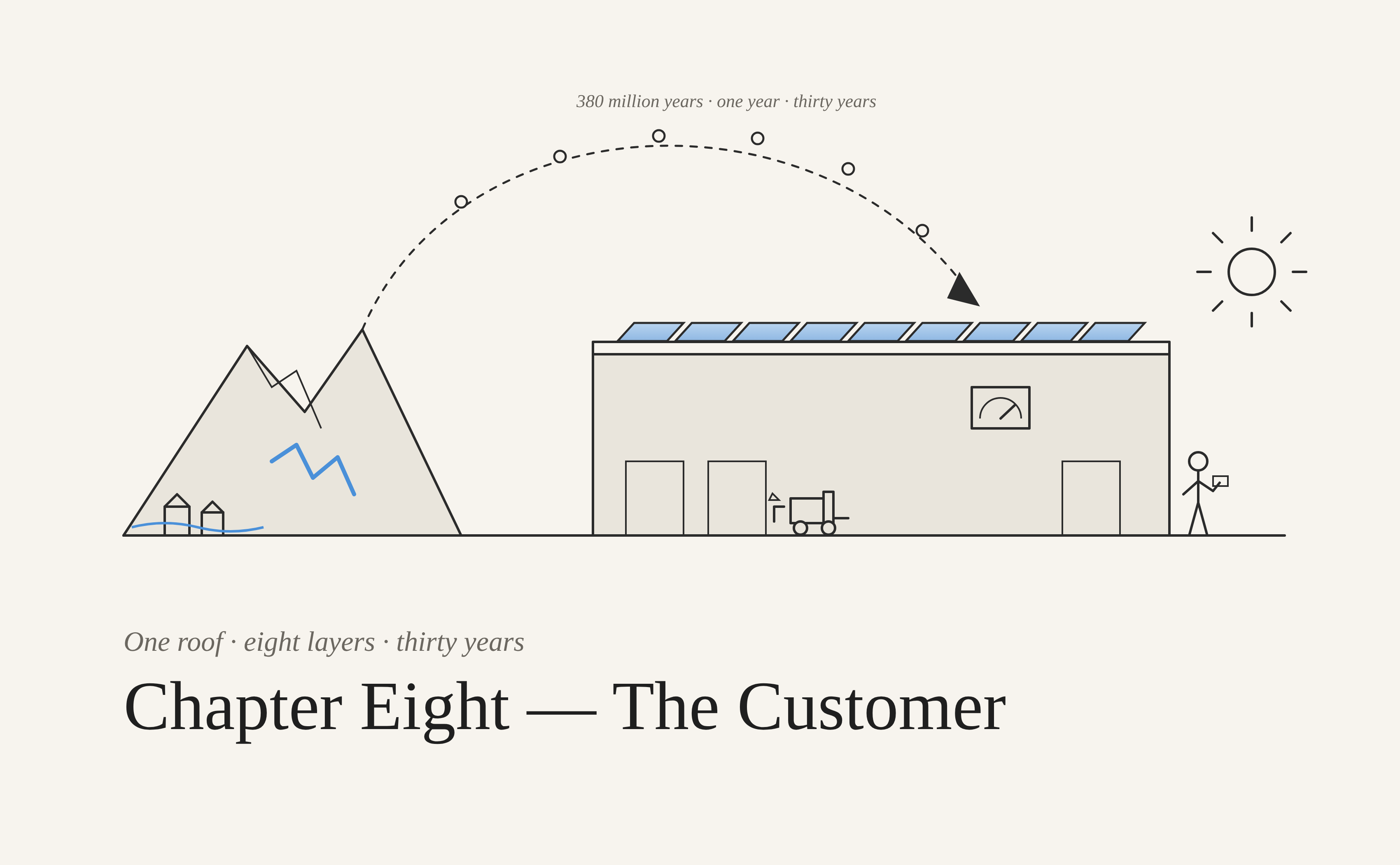
The Solar Value Chain Decoded · Chapter Eight
The Customer

An eight-part field guide to the people, places, and machines that stand between a vein of rock and the panel on your roof. Over seven chapters we have followed one object from a mine in Appalachia, through refineries, crystal pullers, diffusion furnaces, laminators, container ships, warehouses and, finally, the crew that clamped it to a roof. This is the last chapter. It is about the one person in the whole story who never asked to understand any of it — and who, in the end, is the reason all of it exists.
In 1958 an American economist named Leonard Read wrote a short essay in the voice of a pencil. It is called I, Pencil, and its argument is in its first and most famous claim: not a single person on the face of the earth knows how to make one.
The pencil is not being modest. It walks the reader through its own family tree. The cedar came from a forest in Oregon; felling it took saws, which took steel, which took ore, which took mines. The graphite came from Sri Lanka, mixed with clay from Mississippi and shaped with tallow and wax. The brass ferrule came from zinc and copper that were mined on different continents. The eraser is not rubber but a compound involving rapeseed oil from what was then the Dutch East Indies and sulfur chloride. Thousands of people were involved. The pencil's point is that none of them knew they were making a pencil. The logger did not know, the miner did not know, the chemist did not know. Each of them knew only their own work, and the pencil came into existence anyway, without a plan and without a planner, assembled by a market out of a million small acts of expertise that never met.
I have thought about that essay more during the writing of this series than I expected to. Because a solar panel is a pencil — a pencil with a tax credit, a customs regime and a thirty-year warranty — and this book has been, in effect, the pencil's family tree, told layer by layer. But there is a character in Read's essay he never bothers to describe, because for his purposes he did not need to: the person who picks the pencil up.
That is who this chapter is about.
A roof near the airport
Let us meet her.
She is the facilities director of a logistics company that leases a distribution warehouse south of Atlanta, a few miles from the airport. Two hundred and fifty thousand square feet, built in the early 2000s, a flat white roof the size of four football fields, loading docks on two sides, a fleet of forklifts inside that charge all night. Her electricity bill is the second-largest line in her operating budget after rent, and it has gone up every year she has held the job.
Eighteen months ago a developer came to see her. The pitch was not about silicon, or Spruce Pine, or the Czochralski method. It was a spreadsheet: a solar array on the roof, built and owned by someone else, selling her the power it produced at a price per kilowatt-hour a little below what the utility charged, fixed for twenty-five years. She would sign a contract and a roof lease, and in return her bill would go down and stop climbing. She asked three questions, which are the three questions every customer in this layer asks in one form or another. Will it damage the roof? What happens if it breaks? And can I get out of this if I need to?
She did not ask where the quartz came from. She has never heard of Mitchell County, North Carolina. She will not, in all likelihood, ever read this series. And this is exactly as it should be, because the entire purpose of a value chain — the reason it is organized as a chain rather than as something the customer has to understand — is that the customer should not have to.
Last September, after the inspector signed off and the utility closed the disconnect, two thousand and forty panels on her roof began turning Georgia sunlight into electricity for the forklifts. She got an email that said the system was live. She did not go up to look.
What she actually bought
Here is a question that sounds trivial and is not. What did she buy?
Not panels. She does not own them; the developer does. Not a power plant, exactly, since she will never operate it. If you press the question, what she bought is a promise: that for the next twenty-five years, on a roof she rents, a machine she did not choose and does not understand will produce a predictable amount of electricity at a predictable price, and that if it does not, someone — the developer, the contractor, the module factory, an insurer, a bank — will make it right.
That promise is the real product of this entire chain, and it is worth pausing on how strange it is.
Twenty-five years is a long time. It is longer than most companies in this industry have existed. It is far longer than any of the technologies in the panel have been in mass production in their current form: the TOPCon cell we met in Chapter Four was a laboratory curiosity ten years ago. It is longer than the lease on the building. It is probably longer than the facilities director will hold her job. And yet a twenty-five-year performance warranty — the panel will still produce, say, eighty-odd percent of its rated power at year twenty-five — is the industry's standard offer, printed on the datasheet of practically every module sold in America, and the whole financial structure of her project rests on it.
Think back to what we learned in Chapter Six about the bullwhip, and in Chapter Four about how fast the technology turns over. The chain that made her panels is reconfiguring itself every few years. Factories change hands, change lines, change countries. Brands appear and disappear. The company whose name is on the frame of her panels may well not exist, in its current form, in 2051. The promise outlives the people who made it. Every customer in this layer is, whether they know it or not, placing a long bet on the durability of an arrangement that is itself in constant motion.
What makes the bet reasonable — and it is reasonable; the panels on American roofs from the early 2000s are, by and large, still working — is not any single company's word. It is the physics. A properly laminated module, as we saw in Chapter Five, is a sealed object with no moving parts, and the degradation of silicon under sunlight is slow and well understood. The promise is credible because the thing is simple, even though the chain that made it is not. The customer is trusting the glass, not the brand.
The number on the quote
I said in Chapter Five that the module is where an entire chain of extraordinary specialization gets flattened into a single number, dollars per watt, and in Chapter Six that the distributor finishes the flattening by folding freight, duty, time and risk into the same figure. The customer's layer completes the process one final time, and the result is a number so compressed that it no longer mentions the panel at all.
Her number is cents per kilowatt-hour. Not the price of a panel; the price of what a panel does, spread across the years it will do it. The industry's term is levelized cost — the total cost of building and running the system, divided by all the electricity it will produce over its life — and it is the only figure in this entire book that the customer will ever actually look at. Everything we have followed is inside it. The purity of the quartz is in it. The electricity price in Sichuan is in it. The kerf loss on the wire saw, the efficiency of the junction, the eleven minutes in the laminator, the twenty-thousand-dollar container, the twelve weeks in transit, the crane that could not wait, the liquidated damages — all of it, compressed, into a figure with two decimal places and a unit she already understood from her utility bill.
Here is what I find moving about that, after seven chapters. The compression is not a loss of information. It is the point. It is what allows a facilities director in Georgia to make a sound decision about a technology she will never understand, in an afternoon, with a spreadsheet. Markets do many things badly. This — taking a million acts of specialized knowledge and delivering them to a stranger as a single comprehensible number — they do better than anything else humans have invented. Read's pencil cost a few cents. Her electricity costs a few cents. In both cases the price is the whole chain, speaking in the only language the customer needs.
The questions underneath the questions
Let me go back to her three questions, because each of them is a layer of this book wearing a disguise.
Will it damage the roof? This is Chapter Five and Chapter Seven: the sandwich and the clamp. The weight of the glass, the wind on a panel that becomes a sail, the engineer's letter about the structure, the fire marshal's pathways. She is asking about physics and construction without using either word.
What happens if it breaks? This is the warranty, which is Chapter Five again — the laminator decides whether the panel lasts four years or thirty-five — but it is also Chapter Six and Chapter Seven in a form that customers rarely see coming. If a panel fails in year nine, someone has to supply a replacement. Of the same size, so it fits the racking. Of a compatible electrical type, so it works in the string. From a factory that may no longer make it, in a size the industry may have abandoned, through a chain that may have reconfigured twice. Where, in 2035, will the replacement panel come from? The honest answer, in most cases, is: from someone's stock in the United States, if someone has it. The customer does not know she is asking a question about warehousing. She is.
Can I get out of this? This is the most interesting of the three, and the one this series has not yet touched, because it is the question of who, in the end, carries the risk that the whole arrangement was a mistake. She is asking it of the developer, who will ask it of the bank, who will ask it of the lawyers, and the answer will be a clause. But underneath the clause is the thing we described in Chapter Seven: a long chain of parties, each of whom has passed risk one step downhill, ending at someone who promised an outcome. In Chapter Seven the outcome was a roof built by a date. In this chapter it is twenty-five years of electricity at a price. The customer is the last runner's last runner. The asymmetry does not stop at the EPC. It stops here, on her desk, in a contract she will read once.
Why the end of the chain shapes the beginning
There is a tendency, in writing about supply chains, to treat the customer as an afterthought — the place the arrows point to. I want to argue the opposite, and I think the seven chapters behind us support it: the customer's layer is the one that shapes all the others, and it does so invisibly, from the end.
Consider the warranty. A twenty-five-year performance promise is a customer requirement — nobody would finance a rooftop plant without it — and that single requirement runs all the way back up the chain. It is why the encapsulant has to cross-link into a polymer that will never yellow. It is why the glass is low-iron and tempered and why the frame is anodized. It is why the module is laminated under vacuum for eleven minutes at a temperature someone argued about. It is, if you follow it far enough, why the polysilicon must be refined to parts per billion and why the quartz in the crucible must come from a particular valley in North Carolina. Nobody at the mine thinks about a facilities director in Georgia. But the facilities director's unwillingness to sign a twenty-year contract for a panel that might last ten is, in a real sense, the reason the mine's product has to be as pure as it is. The chain is pulled from the end, not pushed from the beginning.
Or consider the question she did not ask, the one that every policy chapter in this book has circled: is this panel American? She did not ask it, but her developer did, because the answer determined the size of the tax credit that made the spreadsheet work, and the tax credit depended on where the cell was made and the wafer grown and the polysilicon refined. A file of documents, assembled in Asia, carried across the Pacific, held in a warehouse in Georgia and handed to a lawyer in Atlanta, so that a customer who has never heard of any of those places could pay slightly less for her electricity. The paper problem of Chapter Six exists because of the customer's layer. So does the factory in Dublin, Georgia, that we met in Chapter Five. So, increasingly, does the whole geography of where this industry's factories are being built. The end of the chain is rearranging the beginning, one incentive at a time.
Three clocks
I want to end with time, because time is the thing this series has quietly been about all along, and the customer's layer is where its three different scales finally meet.
The first clock is the rock's. The quartz in the crucible that grew the crystal that became the wafer that became the cell that became the panel on her roof cooled in the dark, as we learned in Chapter One, something like 380 million years ago, in the heat of two continents colliding to make the Appalachians. It sat in the mountain, undisturbed, through the whole of the age of dinosaurs, the whole of the age of mammals, and the whole of the age of humans until a few decades ago, when someone noticed it was clean. On that clock, everything else in this book happened in the last instant.
The second clock is the chain's. From the day the quartz left Spruce Pine to the day the panel was clamped to the roof — through the refinery, the crystal puller, the wire saw, the diffusion furnace, the laminator, the port, the ocean, the customs hall, the warehouse and the crane — something like a year passed, give or take a season. A year of extraordinary speed and extraordinary slowness at once: a cell technology that can change in a procurement season, moving at the speed of a ship. That is the clock this book has been set to. Seven chapters, one year.
The third clock is hers. The panel will sit on her roof, bolted down, making electricity, for twenty-five or thirty years — longer, by a wide margin, than the entire chain took to make and deliver it, and longer than most of the companies in that chain will survive in their present form. A year of being made; three decades of working. On the customer's clock the whole of this book — the mine, the refinery, the crystal, the junction, the laminate, the ocean, the crane — is a prologue.
And then a fourth, which is not a clock but a direction. Every one of the other seven layers hands its product on. The mine hands quartz to the refinery, the refinery hands polysilicon to the crystal puller, the module factory hands pallets to a ship, the distributor hands them to a crew. The customer is the one layer that hands nothing on. The chain ends on her roof. The electrons go into the forklifts and the lights, and the forklifts move boxes, and the boxes go to people who will never think about any of this either. The relay is over. There is no next runner.
What the customer teaches us
For the last time, line them up.
The mine taught us the chain is narrow. The refinery taught us it is concentrated and political. The wafer taught us it is deep. The cell taught us it is fast. The module taught us it is compressed. The distributor taught us it is slow. The EPC taught us it is asymmetric.
The customer teaches us the thing that makes all seven of those lessons bearable, and it is this: the chain is invisible on purpose. Not by accident, and not as a failure. Its entire design — the layers, the specialization, the compression into a single number, the warranty that outlives its makers — exists so that a person at the end can make a good decision without understanding any of it. Read's pencil is miraculous precisely because the person writing with it does not have to know about Oregon cedar and Sri Lankan graphite. The panel on the roof in Atlanta is miraculous for the same reason. The facilities director's ignorance of Spruce Pine is not a gap in the system. It is the system working.
Which leaves one question, and it is the question I have been quietly asking myself for eight chapters. If the chain is designed to be invisible to the customer, who is this book for?
My answer is: for everyone in the chain who is not the customer. For the distributor who has never stood in a cell factory and the installer who has never thought about a customs petition. For the procurement manager whose desk is where all seven layers land at once. For the people — and after fifteen years in this industry I think they are most of the people in it — who know their own layer intimately, the neighbors passably, and the rest not at all. The customer is allowed not to understand the chain. The rest of us, I have come to think, are not. Because every expensive surprise this industry produces — every frozen port, every idle crew, every warranty claim with no replacement panel behind it — happens in the gap between two layers that did not know what the other was doing. The chain is invisible to the customer. It should not be invisible to itself.
So let me end where we began, because that is where the whole thing began. A town of two thousand people in the mountains of North Carolina. A river called the North Toe. A rock that cooled in the dark 380 million years ago and turned out, against everyone's expectations, to be the cleanest in the world. It left the valley as sand. It crossed an ocean twice. It passed through more hands, more furnaces, more countries and more contracts than any person in the chain could name. And on a clear afternoon last September, on the flat white roof of a warehouse near the Atlanta airport, it began — quietly, and for the next thirty years — to turn the light of the sun into something a stranger could use.
She did not go up to look. She did not have to. That was the point.
This series is published by SolarStock USA. We distribute Sunpro Power modules from inventory positioned in the United States. We wrote this guide because we believe the people who buy, specify, and install solar deserve to understand the whole chain they are part of — not just the part that touches their invoice.