
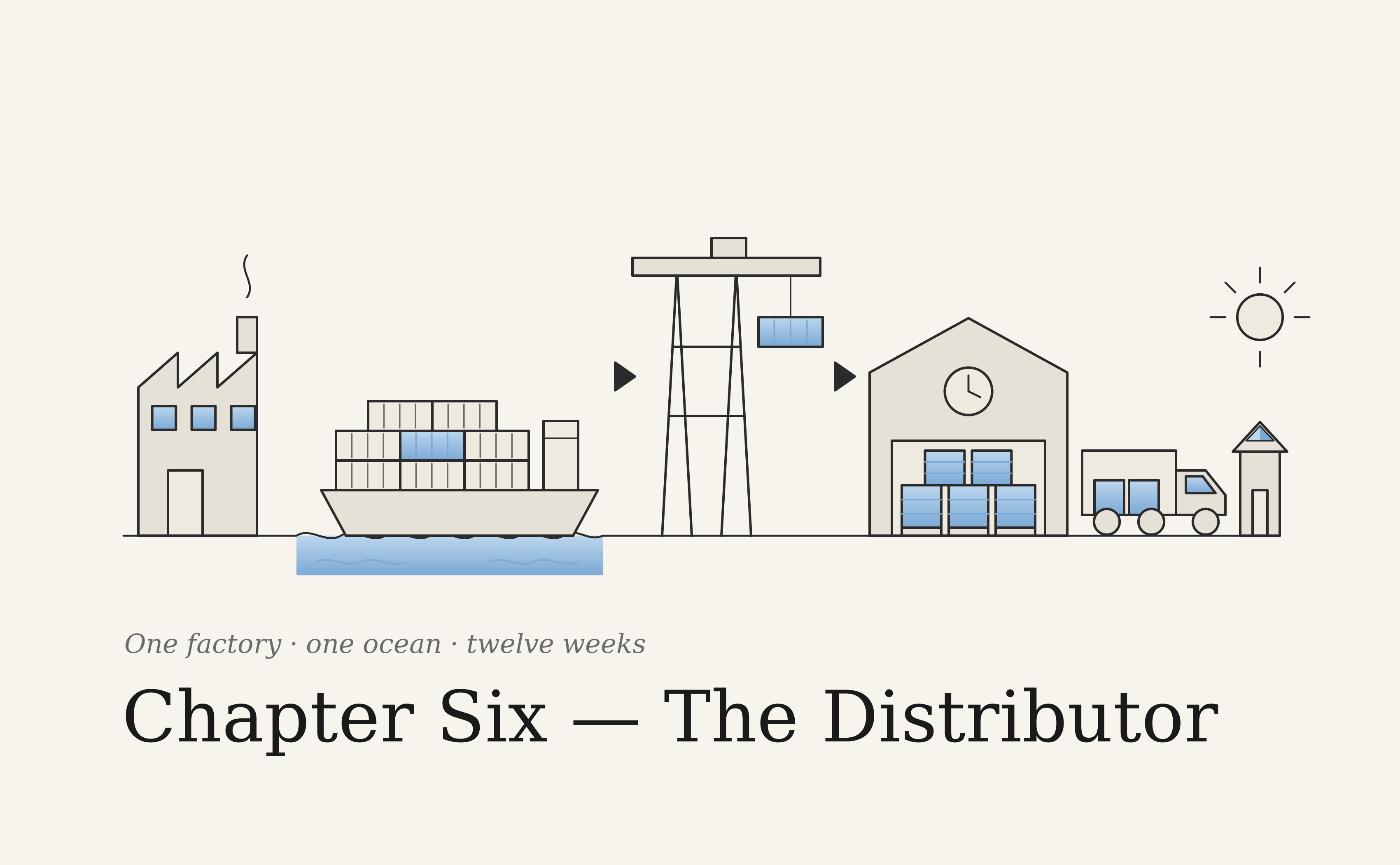
The Solar Value Chain Decoded · Chapter Six
The Distributor

An eight-part field guide to the people, places, and machines that stand between a vein of rock and the panel on your roof. In the first five chapters we dug quartz out of an Appalachian valley, refined it into hyper-pure silicon, grew that silicon into a single crystal and sliced it into wafers, taught the wafer to turn light into electricity, and finally laminated the cells between glass and polymer into a panel you can hold in your hands. The panel now exists. This chapter is about the surprisingly long distance between existing and arriving.
There is a game they play at business schools, and it is the best introduction I know to the layer of the solar industry I am about to describe.
It was devised at MIT in the early 1960s, in the circle around the engineer Jay Forrester, and it is called the Beer Distribution Game. The rules are almost insultingly simple. Four players sit in a line. One is a retailer, one a wholesaler, one a distributor, one a brewery. Customers buy cases of beer from the retailer; the retailer orders from the wholesaler; the wholesaler from the distributor; the distributor from the brewery. Each player sees only their own inventory and the orders arriving from the player next to them. Orders take a couple of weeks to travel up the line, and beer takes a couple of weeks to travel back down. That is all. There are no storms, no strikes, no tariffs, no pandemics.
Early in the game, customer demand changes exactly once. It steps up from four cases a week to eight, and then it stays there, perfectly flat, for the rest of the game.
What happens next has been observed in thousands of sessions, with undergraduates and with senior executives, and it almost never varies. The retailer, short of beer, orders a bit more. The wholesaler, seeing that larger order and short of beer himself, orders more still. By the time the signal reaches the brewery it has been amplified into a roar, and the brewery cranks up production to meet a surge that does not exist. Then the beer arrives — all of it, at once, weeks late — and every warehouse in the line is suddenly drowning. Orders collapse to zero. The brewery idles. And when the players are asked afterwards to sketch what they think customer demand looked like, most of them draw a wild, jagged mountain range. They are genuinely astonished to learn it was a single small step.
The MIT professor John Sterman, who has studied the game for decades, likes to point out the moral: nobody in the room was stupid, and nobody was unlucky. The chaos was manufactured entirely by the structure of the chain — by the delays between the links, and by the fact that each link could see only its neighbor.
Hold that game in your mind. The solar industry plays it every year, for real, with an ocean in the middle.
The panel that exists and the panel you can get
Here is the idea at the center of this chapter, and it is one that people outside the industry find almost too obvious to be worth saying, and people inside the industry find almost too painful.
A solar panel that exists is not the same thing as a solar panel you can get.
The world is not short of solar panels. As we saw in the last two chapters, global manufacturing capacity has for some years run comfortably ahead of global demand; there are factories in Asia that could flood every roof in Georgia within a season. On any given day there are millions of finished modules sitting on pallets somewhere on Earth, laminated, flash-tested, labeled and shrink-wrapped, waiting.
And yet, on that same day, there will be a project manager in Atlanta with a crew booked, a racking system delivered, a utility interconnection approved and a customer waiting — who cannot get the panels she needs for nine weeks.
Both of those things are true at the same time, routinely, and the gap between them is the distributor's entire world. The panel exists in Jiangsu. The roof exists in Georgia. Between them sit eight thousand miles of ocean, two port authorities, one customs regime that can change its mind with a signature, a payment term, a truck, a liftgate, and the weather. Chapters One through Five were about making the thing. This chapter is about the fact that a thing in the wrong place, at the wrong time, is worth almost nothing — and that most of what you pay for when you buy a solar panel in America is not the panel at all. It is the panel being here, now.
Twelve weeks, one box at a time
Let us follow one pallet. Call it a pallet of thirty-six 590-watt bifacial modules, of the kind we took apart in the last chapter, leaving a module factory in eastern China. The journey I am about to describe is not a worst case. It is an ordinary one.
Day one, the pallet is loaded into a forty-foot shipping container — a high-cube box, a foot taller than the standard — alongside sixteen or seventeen of its siblings. Something like six hundred panels in all, around a third of a megawatt, a little under twenty tons. The container doors are sealed with a numbered bolt that will not be cut again until the box is on the other side of the Pacific. The box is trucked to a port — Shanghai, or Ningbo, two of the busiest container terminals on the planet — where it waits for its ship. At least twenty-four hours before it is loaded, someone has already filed a security declaration with US Customs describing what is inside, who sold it and who is buying it; the box is not allowed to leave Asia until America knows it is coming.
Then the ocean. A container ship crossing the Pacific to Los Angeles or Long Beach takes something like two to three weeks. If the panels are bound for the East Coast — for the port of Savannah, which is how most of what ends up on a roof in Atlanta actually arrives — the ship either sails on through the Panama Canal, adding a week or two, or the box comes ashore in California and crosses the continent by rail. The big ships do not hurry; many of them deliberately sail below their top speed, because fuel is the largest cost a shipping line can control, and going slower burns dramatically less of it. Our pallet crosses the largest ocean on Earth at roughly the speed of a moped.
The ship docks. A crane lifts the box off in about two minutes. And then the box does nothing, for a while, because now it must be cleared — the entry filed, the duties calculated, the paperwork checked, and occasionally the box itself pulled aside for inspection. In normal times this takes days. In abnormal times, as we will see, it can take months. Once released, the box is picked up by a short-haul truck — the trade calls this drayage — and taken to a warehouse inland, where it is finally opened, the seal cut, and the pallets pulled out one at a time with a forklift.
Here the container's life ends and a completely different logistics system begins. A roof in Atlanta does not need six hundred panels. It needs, say, a hundred and eighty — five pallets. So the pallets are counted, labeled, stored, sold, and eventually loaded onto a different truck, often sharing space with other people's freight, and driven to a jobsite where someone has to get two and a half thousand pounds of glass off the back of that truck without dropping it an inch too hard. You will remember from the last chapter what an inch too hard does to a cell.
Add it up — production slot, inland trucking, port wait, ocean crossing, discharge, customs, drayage, warehousing, final delivery — and twelve weeks from factory gate to roof is a reasonable number. Not a pessimistic one. A reasonable one.
Twelve weeks is long enough for the price of the panel to change. It is long enough for a tariff to change. It is, as we saw in Chapter Four, very nearly long enough for the cell technology inside the panel to change. And it is far too long for a project manager with a crew booked next Tuesday.
The man who invented the box
It would be easy to read the last section as a lament. It is not, and the reason it is not is a trucking entrepreneur from North Carolina — the same state, as it happens, as the quartz we began with.
His name was Malcom McLean, and in the 1950s he was frustrated by the absurd inefficiency of loading ships. Cargo then went aboard the way it had for centuries: as "break-bulk," every sack and crate and barrel lifted, carried, stowed and lashed individually by teams of dockworkers. A ship could spend more time sitting in port being loaded than it spent at sea. McLean's idea, which seems almost childishly obvious in hindsight, was to stop loading the cargo and load the truck instead — or rather, the steel box on the back of the truck, lifted off its wheels and stacked in the hold.
In April 1956 a converted tanker called the Ideal X sailed from Newark to Houston carrying fifty-eight of his boxes. The economist Marc Levinson, whose book The Box is the definitive history of what followed, tells the story of the arithmetic McLean did afterwards: the cost of loading cargo dropped from several dollars a ton to a matter of cents. Within a couple of decades, the standardized container had remade every port on Earth, emptied the old waterfront neighborhoods of their dockworkers, and made it cheaper to ship a box across an ocean than to truck it across a state.
Every chapter of this book so far has depended on McLean without mentioning him. The quartz leaves Spruce Pine for Asia in containers. The polysilicon, the wafers, the cells and the frames all move between countries in containers. And the module arrives in America in one. When we said in the last chapter that solar electricity has become the cheapest new power on the planet, a meaningful share of the credit belongs not to a physicist but to a man who thought about trucks.
Here is the arithmetic that matters for solar. A forty-foot box holds roughly a third of a megawatt of modules. In ordinary times, shipping that box across the Pacific costs a couple of thousand dollars — call it half a cent per watt, a rounding error on the price of the panel. That is McLean's gift: the ocean has become, most of the time, nearly free.
Most of the time.
When the ocean stopped being free
In 2021, it stopped.
The pandemic did something to the container system that the Beer Game would have predicted precisely. Demand for goods swung violently — first down, then sharply up, as locked-down households in America stopped buying experiences and started buying things. Ports slowed as workers fell ill. Empty containers piled up in the wrong places, because the boxes that carried goods to America were not coming back to Asia fast enough to be refilled. In March of that year a single enormous ship, the Ever Given, turned sideways in the Suez Canal and blocked one of the world's main shipping lanes for six days, and the global system, already stretched, had no slack left to absorb even that.
By the late summer of 2021, the spot price of shipping one forty-foot container from Asia to the US West Coast had risen to something like ten times its pre-pandemic level — on some routes, past twenty thousand dollars a box.
Run the arithmetic again. Twenty thousand dollars spread across a third of a megawatt is around six cents per watt, at a moment when the module itself might have cost somewhere between a quarter and a third of a dollar. Freight, which had been a rounding error, was suddenly something like a fifth of the price of the product. And nothing whatsoever had changed about the panel. Not the glass, not the cell, not the encapsulant. The same rectangle, from the same factory, had become dramatically more expensive purely because of where it was and where it needed to be.
That is the first lesson of the distributor's layer, and it is a lesson that every earlier chapter of this book has been quietly setting up. Upstream, cost is governed by physics and chemistry: by purity, by electricity, by microns of kerf, by fractions of a percent of efficiency. Downstream, cost is governed by geography and time. And geography and time are far more volatile than chemistry.
The panels that existed but could not be had
If 2021 was the year the ocean stopped being free, 2022 was the year the border stopped being predictable — and it is the clearest example I know of the gap between the panel that exists and the panel you can get.
You will remember from earlier chapters that by the early 2020s a large share of the panels sold in the United States came, on paper, from Southeast Asia: Vietnam, Malaysia, Thailand and Cambodia, where cells and modules were made from wafers that very often traced back to China. In the spring of 2022, a small American manufacturer filed a petition asking the Department of Commerce to investigate whether that arrangement was simply a way of routing Chinese products around existing duties. Commerce opened an inquiry. The potential consequence — duties applied retroactively to panels already imported — was so large and so uncertain that much of the market simply froze. Importers stopped ordering, because they could not price the risk. Developers paused projects, because they could not price the panels.
At almost exactly the same moment, the forced-labor law we met in Chapter Two came into force, and US Customs began detaining solar shipments at the border while importers tried to document, all the way down the chain, where the polysilicon inside had come from. Containers of finished panels sat in ports, physically present on American soil and legally unavailable, sometimes for months.
By the summer, the White House had paused the new duties for two years to let the pipeline unblock. But consider what that spring actually looked like from the ground. The panels existed. Many of them were already made. Some of them were already here, in boxes, a few miles from the roofs they were meant for. And the roofs waited anyway — not for want of technology or factory capacity, but for want of certainty, documentation and a decision in Washington.
No chapter about polysilicon or cell efficiency would ever tell you that this, more than anything that happens in a clean room, is what most often decides whether a solar project in America gets built this quarter or next year. But anyone who has worked in this layer will tell you exactly that.
The bullwhip
And then the Beer Game played out, on a continental scale.
The supply-chain scholar Hau Lee and two colleagues gave the phenomenon its name in a 1997 paper. They told the story of logisticians at Procter & Gamble who had noticed something odd about Pampers: babies, unsurprisingly, consume diapers at an extremely steady rate, and yet the orders P&G received from distributors swung up and down wildly from month to month. The fluctuation was being created inside the chain, not by the babies. Lee and his co-authors called it the bullwhip effect, after the way a small flick of the wrist becomes a violent crack at the tip of the whip.
Solar, after 2022, was a bullwhip. Burned by the shortages, the frozen ports and the detained containers, everyone in the American market did exactly what the retailer does in the Beer Game: they over-ordered, to make sure it would never happen to them again. Developers built buffer stock. Importers built buffer stock. Distributors built buffer stock. Meanwhile, on the other side of the Pacific, factories that had been expanding at a ferocious pace for years kept expanding. By 2023 and into 2024, the shortage had become a glut. Warehouses across the United States filled with modules — by some industry estimates, many gigawatts of them, far more than the market could install in the near term — and module prices, globally, fell by something like half in little more than a year.
Now put yourself in the position of the company holding that inventory.
Selling ice in a warming room
This is the part of the distributor's job that nobody outside the industry ever thinks about, and that everybody inside it thinks about constantly.
Almost every product in a warehouse loses some value as it sits. Fashion goes out of season; food expires; electronics are superseded. Solar modules combine the worst of these at once. As we saw in Chapter Four, the technology inside them is quietly improving every year, so the panel on the shelf is slowly becoming the old model. And as the whole history of this industry demonstrates, the price per watt has fallen, with interruptions, for seventy years. A warehouse full of solar panels is a warehouse full of something whose market price, over any long enough horizon, only goes one way.
It is a bit like running a business that sells ice in a room where someone is slowly turning up the heating. You can do it — people do — but you had better be fast, and you had better be precise about how much ice you keep.
So why would anyone hold inventory at all? Why not just order straight from the factory when a project needs panels?
Because of the twelve weeks. Because the project manager in Atlanta with the crew booked for Tuesday cannot wait for a production slot, an ocean crossing and a customs clearance. Because the roof is not going to move to the factory, and the factory is not going to move to the roof. The entire economic function of holding stock in the country where it will be used is to absorb that twelve-week delay on the buyer's behalf — to take the risk that the price will fall while the panels sit, so that the buyer does not have to take the risk that the panels will not arrive. The distributor is, in the most literal sense, selling time.
What the middle actually does
There is a long tradition, in business writing and in politics alike, of treating the layer between the factory and the customer as a kind of tax on the economy: the middleman, who adds nothing and skims something. "Cutting out the middleman" is one of the most reliably popular promises a new company can make. I have heard it said about solar many times, usually by someone who has not yet tried to get a pallet of glass off the back of a truck.
The honest answer is that the middle layer exists because the gap exists, and the gap is made of several quite distinct problems, each of which somebody has to solve.
The size problem. Factories think in containers; roofs think in pallets; installers, often, think in single panels. Somebody has to break six hundred panels into five pallets, and occasionally a pallet into twelve panels for a homeowner's garage, without cracking any of them. The trade calls this breaking bulk, and it is as old as commerce.
The time problem. We have met it: twelve weeks of transit against a construction schedule measured in days. Somebody has to own the inventory in between, with the falling price that comes with it.
The money problem. This one surprises people most. A factory, especially a factory on the other side of the world selling to a customer it does not know, wants to be paid early — often a deposit when the order is placed and the balance before the goods are released. An installer in Georgia, on the other hand, would like to pay after the panels have arrived and been inspected, ideally after their own customer has paid them. Between those two preferences sits a gap of several months, and that gap has to be financed by somebody. When a solar distributor offers an installer thirty days to pay, the distributor is quietly acting as a small bank. Nobody calls it that.
The paper problem. You will recall from the last chapter that the honest answer to "is this panel American?" has become a document request rather than a yes — a file tracing where the module was laminated, where the cell was made, where the wafer was grown, where the polysilicon was refined. That file has to exist before the panel crosses the border, and it has to follow the panel all the way to the project owner who will rely on it for a tax credit. Somebody has to keep the paper attached to the glass.
The last-mile problem. We left the last chapter with a pallet that weighs more than many liftgates are designed to lift and a panel that turns into a sail in a modest breeze. Getting that object from a warehouse to a jobsite intact — on a truck that can actually unload it, to a site with somewhere to put it — is a specialized skill, and the cost of getting it wrong falls, as it always does, on whoever is holding the broken glass.
There is even a corner of American trade law built around the time problem. The US allows imported goods to sit in a bonded warehouse, under customs supervision, for up to five years without the duty being paid; the duty is due only when the goods are withdrawn for use. It is a legal recognition of a commercial truth: the moment a thing arrives in a country and the moment it is needed there are not the same moment, and the space between them has value.
None of these five problems is glamorous. All of them are real. A company that cuts out the middleman does not make them disappear. It simply becomes the middleman.
Hiding in plain sight
Why, then, is this layer so invisible — so much less discussed than the quartz mine or the polysilicon reactor or the efficiency race in the cell factory?
Part of the answer is that it has no hero object. The mine has its pit, the refinery its billion-dollar reactors, the wafer its glowing crystal, the cell its p-n junction, the module its laminator. The distributor's layer has a warehouse, a forklift and a spreadsheet. Nobody puts a forklift on the cover of a magazine.
But part of the answer is more interesting, and it goes back to the compression we described at the end of the last chapter — the way an entire chain of extraordinary specialization arrives at the buyer flattened into a single number, dollars per watt. The distributor's layer is the place where that compression is completed. It is where the freight, the duty, the financing, the warehousing, the risk of a falling price and the paperwork are all folded silently into the figure on the quote. When it is done well, the buyer sees nothing at all: a price, a delivery date, and a truck that arrives when it said it would. The better this layer works, the more completely it disappears.
Which means the only time most people ever notice it is when it fails — when the ocean stops being free, when the border stops being predictable, when the bullwhip cracks. Like plumbing, it is invisible until the morning it isn't.
I should say plainly, since it has been obvious for five chapters, that this is the layer I know best, and that I am therefore an interested party. So let me make the claim as carefully as I can. I am not arguing that this layer is more important than the ones beneath it. Without the quartz and the refinery and the crystal and the junction and the laminate, there would be nothing to distribute. I am arguing something narrower: that this is the layer where the most expensive surprises in American solar most often happen, and that it is the one the people who buy solar are least likely to have thought about.
What the distributor teaches us
Step back once more, and line up what we have learned.
The mine taught us the chain is narrow. The refinery taught us it is concentrated and political. The wafer taught us it is deep in expertise. The cell taught us it is fast. The module taught us it is compressed.
The distributor teaches us the property that sits most awkwardly beside the cell's lesson, and it is this: the chain is also slow.
Not slow in its technology, which, as we saw, can be rebuilt in a single procurement season. Slow in its atoms. The recipe of a solar cell can change at the speed of research. The panel that carries that cell moves at the speed of a ship — sixteen knots or so, across eight thousand miles, through two ports and one customs regime, and then on the back of a truck. Every layer upstream of this one is measured in microns and parts per billion. This layer is measured in weeks, miles and pounds, and in the payment terms that bridge them.
And between fast and slow lives risk. A chain whose technology moves faster than its freight, whose prices fall while its products sit in transit, and whose rules can change while a container is on the water, generates risk at every link — exactly as the Beer Game generates chaos from a single small step in demand, with nobody to blame but the structure. The distributor's real work is not moving panels. It is absorbing some of that risk so that the people further down the chain do not have to absorb all of it.
Some of it. Not all. Because there is one more layer, and it is the one that finally has to stand on the roof, with a crew that is being paid by the hour, when the truck is late.
Chapter Seven — The EPC — is coming soon.
This series is published by SolarStock USA. We distribute Sunpro Power modules from inventory positioned in the United States. We wrote this guide because we believe the people who buy, specify, and install solar deserve to understand the whole chain they are part of — not just the part that touches their invoice.