
State-by-State Solar Rebates & Incentives Guide
A 50-state reference for commercial and utility-scale solar — federal credits after OBBBA, state tax treatment, REC markets, utility programs and how the incentives stack
Prepared for procurement officers, EPC executives, project developers and tax counsel. This guide does not constitute legal, tax, or investment advice. Readers should consult qualified counsel before making decisions based on this analysis.
Part IExecutive Summary
Commercial and utility-scale solar economics in late 2026 are set by a compressed federal calendar and by a patchwork of state programs that are, in several important markets, approaching their own cliffs. This guide maps both layers for all 50 states and the District of Columbia, separates what has been verified on primary or dated sources from what still needs confirmation, and shows how the pieces combine in a project's capital stack.
The guide is written for buyers and builders: procurement officers who need to know which documentation will be demanded by tax-credit buyers, EPC executives sequencing 2026–2027 construction starts, developers screening states, and tax counsel looking for a single dated reference. Every value cited carries its source and date. Items that the research desk could not confirm on a primary source are omitted, or marked "n/c" (not confirmed in primary sources as of October 2026) in tables, rather than presented as fact, and state opportunity tiers are a SolarStock USA Research assessment built on the transparent rubric set out in Section 3 and in the Methodology.
Conclusions
- The federal calendar now drives project sequencing. Under the One Big Beautiful Bill Act (OBBBA, P.L. 119-21), a solar facility that began construction after July 4, 2026 earns §48E or §45Y credits only if it is placed in service by December 31, 2027. Facilities that began construction on or before July 4, 2026 keep the older phase-out timeline, which makes beginning-of-construction evidence the most valuable document in a 2026 project file.
- The 5% safe harbor is available again, but its durability is not settled. On June 6, 2026 the U.S. District Court for the District of Columbia vacated Notice 2025-42 in Oregon Environmental Council v. IRS, restoring the 5%-cost safe harbor alongside the physical work test. No appeal had been filed as of the September 4, 2026 extension deadline, no later appeal has been publicly reported and Treasury has issued no replacement guidance.
- FEOC compliance is a gating item for every 2026 construction start. Notice 2026-15 sets a 40% material assistance cost ratio (MACR) for solar facilities beginning construction in 2026. Supplier certifications and cost tables now sit on the critical path for tax-equity and credit-transfer closings, and the same cost data can support the domestic content adder, whose threshold is 50% for 2026 starts.
- Credits remain monetizable and depreciation is still front-loaded. §6418 transferability survives OBBBA, with transfers to specified foreign entities barred. 100% bonus depreciation is permanently restored for property acquired after January 19, 2025, and on the statutory text solar that qualifies for §48E remains 5-year MACRS property under §168(e)(3)(B)(viii), even though OBBBA removed the separate energy-property reference.
- USDA REAP grants are not a source of upfront capital for 2026–2027 builds. Grants have been paused since March 31, 2026, and the final rule published October 1, 2026 (effective October 16) requires twelve months of operating data before application. Guaranteed loans remain open.
- Commercial demand is concentrated in a handful of states. California installed 39% of U.S. commercial solar in 2025, out of 2,345 MWdc nationally, with Illinois and New York following. In Q2 2026, California accounted for 256 MW of 638 MW commercial nationwide, and SEIA/Wood Mackenzie expect commercial volumes to decline an average of 7% across 2026–2027.
- State performance incentives remain open and material. New Jersey's ADI pays $85–$110 per SREC-II for non-residential segments, Illinois Shines Large DG RECs range from $31.96 to $69.65, Massachusetts SMART 3.0 base rates run $0.179–$0.281/kWh with most of the 600 MW PY2026 block still unallocated, and DC SRECs were assessed near $358–$360/MWh in August 2026.
- Three state cliffs land in 2026–2027. California's §73 property-tax exclusion applies only to systems completed before January 1, 2027; Maryland's retail net metering closes no later than July 1, 2027 under HB 1532; and North Carolina's H 1213 would end the 80% property-tax exclusion for systems placed in service on or after July 1, 2027 — a bill that cleared House Finance 12–8 in July 2026 but had not been confirmed as enacted as of mid-October.
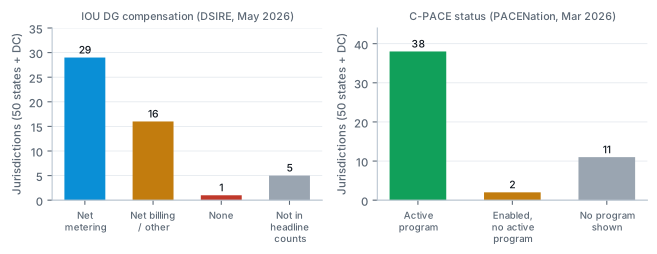
- Export compensation keeps eroding for larger systems. DSIRE's May 2026 map counts 28 states plus DC with net metering at investor-owned utilities and 16 with net billing or other compensation. Illinois moved new systems to supply-only crediting in 2025, Virginia approved Dominion's NEM 2.0, Connecticut enacted NRES successors in Public Act 26-127 and Maine is phasing out front-of-meter net energy billing.
- Financing infrastructure is broad. PACENation data show C-PACE enabling legislation in 40 states plus DC and active programs in 36 plus DC; New Jersey's statewide program has operated since July 30, 2025. Arizona, Indiana, Iowa, Kansas, Louisiana, Mississippi, the Dakotas, South Carolina, West Virginia and Wyoming show no active program.
At a glance
| Item | Status (as of October 14, 2026) | Source |
|---|---|---|
| Federal BOC line (wind/solar) | July 4, 2026; later starts must be placed in service by Dec 31, 2027 | Steptoe; Novogradac; Clifford Chance |
| BOC safe harbor | Physical work test or 5% safe harbor (Notice 2025-42 vacated June 6, 2026) | Steptoe (June 9, 2026) |
| MACR, 2026 construction starts | 40% (solar); 55% (storage) | Notice 2026-15 via pv magazine USA |
| Domestic content threshold | 50% for 2026 starts; 55% after Dec 31, 2026 | Eide Bailly |
| Bonus depreciation | 100%, permanent, property acquired after Jan 19, 2025 | SEIA (May 14, 2026) |
| U.S. commercial solar, 2025 | 2,345 MWdc; California 39% | SEIA/Wood Mackenzie |
| Net metering at IOUs | 28 states + DC; 16 net billing/other; 1 none (TN) | DSIRE (May 2026) |
| C-PACE | Legislation 40 + DC; active 36 + DC | PACENation (Mar 2026) |
| Tier 1 jurisdictions (SolarStock USA Research assessment) | CA, DC, IL, MA, MD, NJ, NY | This guide, Section 3 |
| Nearest state cliff | California §73: systems must be complete by Dec 31, 2026 | CA BOE LTA 2024/031 |
Section 1The federal layer as of October 2026
The federal credit remains the largest single layer in most commercial and utility-scale capital stacks. What changed in 2025–2026 is not the existence of the credit but the window in which it can be earned, the evidence required to prove eligibility, and the supply-chain conditions attached to it.
1.1 §48E ITC and §45Y PTC after OBBBA
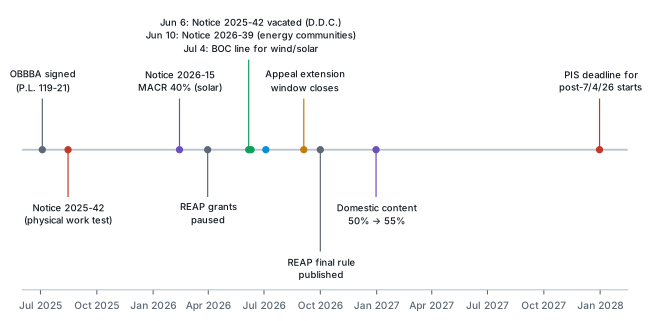
OBBBA, signed July 4, 2025, kept the technology-neutral investment credit (§48E) and production credit (§45Y) but drew a hard line for wind and solar. Projects that began construction on or before July 4, 2026 keep the pre-OBBBA phase-out schedule. Projects that began construction after that date must be placed in service by December 31, 2027 to earn any credit. Law-firm analyses by Steptoe (June 9, 2026), Novogradac (June 16, 2026), Bracewell (July 15, 2025) and Clifford Chance (September 4, 2026) are consistent on this structure.
For a buyer of modules or an EPC planning 2027 completions, the practical consequence is binary. A project that can prove construction began by July 4, 2026 has time; a project that cannot must reach placed-in-service status within roughly fifteen months of this guide's date. Interconnection queues, transformer lead times and permitting therefore weigh more heavily on post-July-4 starts than any single state incentive.
The underlying credit-rate structure — a 6% base rate rising to 30% when prevailing wage and apprenticeship (PWA) requirements are met, with facilities of less than 1 MW AC exempt from PWA — is set by §48E(a)(2)(A) and was not changed by OBBBA. Two OBBBA changes are worth noting. First, for tax years beginning after July 4, 2025, no §48E credit is available for property attributable to qualified solar water heating or small wind expenditures for leased dwellings (Eide Bailly). Second, for tax years beginning after July 4, 2027 — 2028 for calendar-year taxpayers — payments to specified foreign entities within ten years after placed-in-service can trigger 100% recapture of §48E credits under §50(a)(4) (Novogradac; Bracewell). This sits alongside the general investment-credit recapture period in §50(a)(1): five full years from placed in service, with the recapture percentage stepping down from 100% in year one by 20 points a year.
1.2 Beginning of construction: Notice 2025-42 and its vacatur
Notice 2025-42, issued August 15, 2025, required wind and solar projects to establish beginning of construction through the physical work test. It eliminated the 5% safe harbor except for solar facilities of 1.5 MW AC or less, and kept the four-year continuity safe harbor (Novogradac; IRS notice text).
On June 6, 2026 the U.S. District Court for the District of Columbia, in Oregon Environmental Council v. IRS (No. 1:25-cv-04400), vacated the Notice in full and remanded it, finding it arbitrary and capricious under the Administrative Procedure Act. The practical effect, as summarized by Steptoe on June 9, 2026, is that solar projects can again rely on either the physical work test or the 5% safe harbor.
The government's 60-day appeal window expired August 5, 2026, and an extension under FRAP 4(a)(5) was available until September 4, 2026. Clifford Chance reported that no notice of appeal had been filed as of its September 4 briefing and advised developers to revisit beginning-of-construction strategy for projects started on or after September 2, 2025. The research desk found no public report of an appeal, stay or extension after that date, but did not review the court docket. Treasury has not issued replacement beginning-of-construction guidance: none appears in Internal Revenue Bulletins through IRB 2026-42 or in the Federal Register through October 14, 2026, and the IRS's draft 2026 Form 3468 instructions (September 15, 2026) describe the 5% safe harbor as an available method without a wind/solar limitation.
What this means for procurement
Under the 5% safe harbor, the timing and documentation of equipment purchases — binding written contracts, title transfer, delivery and cost incurrence — become evidence of beginning of construction. Procurement teams should assume that tax-equity investors and credit buyers will review purchase orders, invoices and delivery records with the same care as engineering milestones, and that a later reversal of the vacatur would put weight back on physical work. Building the file to satisfy both tests is the conservative course.
Notice 2025-42 never governed the separate beginning-of-construction determination under the FEOC material-assistance rules. For pre-2026 construction starts under those rules, both the physical work test and the 5% safe harbor remained available (Novogradac).
1.3 Bonus adders
| Adder | 2026 status | Source |
|---|---|---|
| Domestic content | +10 percentage points to the ITC with PWA (+2 without). Adjusted-percentage threshold for manufactured products depends on when construction begins: 40% before June 16, 2025; 45% from June 16, 2025 to Dec 31, 2025; 50% in 2026; 55% after Dec 31, 2026. | Eide Bailly |
| Energy community | Notice 2026-39 (June 10, 2026) updated the Statistical Area and Coal Closure lists; the Brownfield category was unchanged. ITC adder +10 points with PWA (+2 without); PTC +10%. The dual-vintage framework of Notice 2025-31 continues. | Baker Tilly; Holland & Knight (July 2026) |
| §48E(h) low-income allocation (+10 or +20 points; facilities under 5 MW) | 2026 application window ran Feb 2 – Aug 7, 2026, with 1.8 GW of capacity plus 2025 carryover across four categories, 50% of each reserved for additional selection criteria. The IRS program page (updated July 27, 2026) does not mention OBBBA; by inference, wind and solar allocations remain subject to the OBBBA BOC/PIS deadlines. A 2027 round was not found. | IRS §48E(h) program page; DOE program summary |
Eide Bailly OBBB energy-credit alert; Baker Tilly, Notice 2026-39; IRS §48E(h) program page (July 27, 2026).
The domestic content step from 50% to 55% at the end of 2026 is a procurement deadline in its own right. A project that begins construction in 2026 is tested against the lower threshold; the same bill of materials for a 2027 start must clear a higher bar. For energy communities, the June 2026 list update matters most for projects sited in statistical areas whose unemployment data changed; siting teams should re-run eligibility against the current lists rather than relying on 2025 screens.
1.4 FEOC, prohibited foreign entities and the MACR
OBBBA introduced two families of foreign-entity restrictions. Taxpayer-level restrictions on specified foreign entities and foreign-influenced entities apply to tax years beginning after July 4, 2025. Material-assistance restrictions apply to §48E and §45Y facilities beginning construction after December 31, 2025 (Bracewell; Novogradac).
Notice 2026-15, reported February 13, 2026, provides interim guidance. It sets the material assistance cost ratio — the share of a facility's relevant costs that must come from non-prohibited sources — at 40% for qualified facilities such as solar beginning construction in 2026, 55% for energy storage, and 50% for §45X components sold in 2026. It offers three safe harbors: an identification safe harbor, a cost-percentage safe harbor based on IRS tables, and a supplier certification safe harbor. Domestic content tables may also be used. Qualified interconnection property is calculated separately, and MACR errors carry a six-year assessment window (pv magazine USA, February 13, 2026; Troutman, February 20, 2026).
Costs under binding written contracts signed before June 16, 2025 can be excluded from the MACR if the facility began construction before August 1, 2025 and is placed in service within the statutory deadline (Novogradac). MACR thresholds for construction starts after 2026 were not found in the sources read, and rules for determining prohibited-foreign-entity status were still pending as of June 2026.
Documentation is now a gating item
Because the domestic content tables can also support MACR attribution, procurement documentation should be assembled once and used for both purposes: supplier certifications, country-of-origin and manufacturer data by component, and the cost allocation behind each figure. A missing certification can delay a tax-equity or transfer closing more than a late delivery.
1.5 Monetization: transferability and elective pay
OBBBA preserved §6418 credit transfers, except that transfers to specified foreign entities are prohibited (Eide Bailly, February 3, 2026; Holland & Knight; Buchanan Ingersoll). The mechanics are unchanged: a cash sale to an unrelated party, IRS pre-filing registration, an irrevocable election, no re-transfer, passive treatment of the credits in the buyer's hands, and a 20% excessive-credit penalty borne by the buyer absent reasonable cause. Market pricing for 2026 transfers was not found in the sources read, so this guide does not cite a discount.
§6417 elective pay remains the route for tax-exempt, governmental and tribal owners and for rural electric cooperatives. OBBBA did not change who may elect, but it added §6417(d)(6)(D), which applies the excessive-payment rule — including the 20% addition — to an elective-pay entity whose applicable energy credit is disallowed within the meaning of §6662(m)(2), for taxable years beginning after July 4, 2025.
1.6 Depreciation
100% bonus depreciation was permanently restored for qualified property acquired after January 19, 2025 (SEIA, page modified May 14, 2026; Bracewell). Rate-regulated public-utility property is excluded. Depreciable basis is reduced by 50% of the ITC claimed, so a project taking a 30% ITC depreciates 85% of its basis (SEIA).
OBBBA §70509 removed solar and wind energy property described by reference to §48(a)(3)(A) from the 5-year class in §168(e)(3)(B)(vi), for property beginning construction after December 31, 2024. It did not amend §168(e)(3)(B)(viii), which continues to list §48E qualified property that is part of a qualified investment and §45Y qualified facilities as 5-year property, and IRS Publication 946 (2025) states both rules. On the statutory text, solar property that qualifies for the §48E credit therefore remains 5-year MACRS property. Solar that does not qualify under §48E or §45Y — for example, a post-July 4, 2026 start placed in service after 2027 — would fall back to its general class life; that reading is the research desk's inference from the statutory structure, and owners should confirm treatment with tax counsel.
1.7 USDA REAP
The Rural Energy for America Program has historically been a meaningful source of grant funding for small agricultural and rural-business solar. For 2026–2027 starts, it is not. USDA paused grants on March 31, 2026, and a Federal Register notice of April 15, 2026 rescinded the October 16, 2024 notice of funding opportunity; there is no FY2026 grant NOFO (USDA REAP FAQ; OpenGrants). Guaranteed loans remain open, covering up to 75% of project cost with an 80% guarantee.
A final rule amending 7 CFR 4280 (RIN 0570-AB13) was published in the Federal Register on October 1, 2026 (91 FR 62600; FR Doc. 2026-20178) and is effective October 16, 2026. As described in the public-inspection filing, the rule makes ground-mounted solar and wind on certified cropland ineligible; bars components from foreign-adversary countries; requires projects to be complete and operating, with twelve months of production or savings data, before applying; requires systems sized to historical use, caps storage at 120% of average use and requires simple payback no longer than useful life; and allows one application per fiscal year, with the top two applications per state funded first.
SolarStock USA Research assessment: under these terms, REAP functions as a post-construction reimbursement for small on-site systems rather than as upfront capital. Criteria: the twelve-month operating-data prerequisite and the absence of a FY2026 grant NOFO.
1.8 Federal timeline, January–October 2026
| Date | Event |
|---|---|
| Feb 2026 | Notice 2026-15 (FEOC/MACR interim guidance); comments due Mar 30, 2026 |
| Feb 2 – Aug 7, 2026 | §48E(h) 2026 application window |
| Mar 31 / Apr 15, 2026 | REAP grants paused; FY2025 NOFO rescinded |
| June 6, 2026 | Notice 2025-42 vacated (D.D.C.) |
| June 10, 2026 | Notice 2026-39 (energy community lists) |
| July 4, 2026 | Wind/solar beginning-of-construction line |
| Aug 5 / Sept 4, 2026 | Appeal and extension windows on the vacatur; no appeal filed as of Sept 4 and none publicly reported since |
| Oct 1, 2026 | REAP final rule published (91 FR 62600); effective Oct 16, 2026 |
| Pending | MACR proposed regulations (date not found); prohibited-foreign-entity status rules |
IRS, USDA, Federal Register and law-firm sources cited above.
Section 2How the incentives stack
No single incentive makes or breaks a commercial project; the combination does. The order in which layers are applied matters, because several of them interact — most importantly through the ITC's reduction of depreciable basis and through the tax characterization of state payments.
2.1 Stacking order
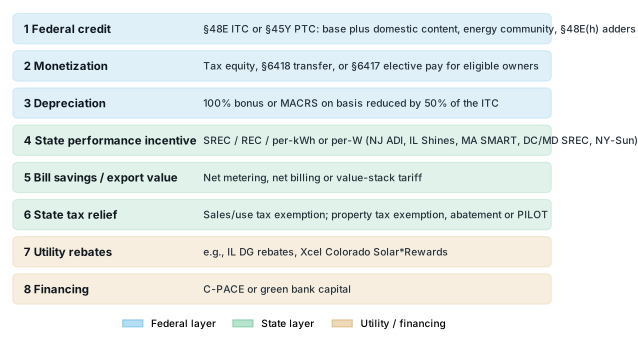
The federal credit is applied first: the §48E ITC or §45Y PTC base rate, plus any domestic content, energy community or §48E(h) adder. The credit is then monetized through tax equity, a §6418 transfer, or §6417 elective pay for eligible tax-exempt owners. Depreciation follows on a basis reduced by half of the ITC. State performance payments — SREC or REC sales, per-kWh tariffs or per-watt incentives — and bill savings or export compensation make up the operating revenue line. State tax relief (sales and use tax exemptions on equipment; property tax exemptions, abatements or PILOT agreements) lowers capital and operating costs. Utility rebates and financing tools such as C-PACE or green-bank capital close the stack.
2.2 Interaction rules to confirm with counsel
- Grants and rebates may affect ITC basis depending on how they are characterized for tax purposes; the treatment of each grant, rebate and REC sale should be confirmed with tax counsel.
- Some programs take the RECs. Xcel Energy's Solar*Rewards program in Colorado takes ownership of the RECs, so the same attributes cannot be sold elsewhere.
- Programs can be mutually exclusive. Delaware's SEU SREC Purchase Program, for example, excludes systems that hold other long-term SREC contracts.
- MACR and domestic content share data. Because the domestic content tables can support MACR attribution, one well-built procurement file can serve both tests.
2.3 Worked example — Illustrative
Illustrative only
The example below uses hypothetical inputs chosen for arithmetic transparency. It is not a quote, a forecast or a statement of market prices, and it does not represent any SolarStock USA pricing. Program values are those verified in this guide; everything else is an assumption shown in the table.
A taxable C-corporation owns a hypothetical rooftop system in New Jersey sized to fall within the ADI non-residential rooftop segment under 1 MW. Construction is assumed to have begun in 2026 before July 4.
| Assumption | Value used | Basis |
|---|---|---|
| System size | 900 kWdc | Hypothetical, chosen to sit below 1 MW |
| Installed cost | $1.80/Wdc → $1,620,000 | Hypothetical assumption; not a market price |
| Annual production | 1,200 kWh/kWdc → 1,080 MWh | Hypothetical assumption |
| SREC-II generation | 1 SREC-II per MWh → 1,080 per year | Assumption |
| ADI value | $110 per SREC-II | NJ BPU order, May 21, 2026 |
| ITC base rate | 30% (PWA assumed satisfied or not applicable) | Assumption; see Section 1.1 |
| Domestic content and energy community | Scenario A: neither. Scenario B: both (+10 each) | Assumption; eligibility is fact-specific |
| Federal corporate tax rate | 21% | Statutory rate |
| Bonus depreciation | 100% in year 1, fully usable | Assumption on taxable capacity |
| Excluded | State income tax; NJ sales tax exemption (N.J.S.A. 54:32B-8.33) and on-site property tax exemption (54:4-3.113a), not modelled; transfer discounts (pricing not found), financing costs, time value of money, O&M, bill savings | |
| Layer | Calculation | Scenario A | Scenario B |
|---|---|---|---|
| ITC — base | $1,620,000 × 30% | $486,000 | $486,000 |
| ITC — domestic content | $1,620,000 × 10% | — | $162,000 |
| ITC — energy community | $1,620,000 × 10% | — | $162,000 |
| Total ITC | $486,000 | $810,000 | |
| Depreciable basis | $1,620,000 − 50% × ITC | $1,377,000 | $1,215,000 |
| Bonus depreciation tax value | Basis × 21% | $289,170 | $255,150 |
| ADI SREC-II revenue, year 1 | 1,080 × $110 | $118,800 | $118,800 |
SolarStock USA Research, Illustrative calculation. ADI value: NJ BPU order (May 21, 2026). Basis-reduction rule: SEIA. All other inputs hypothetical.
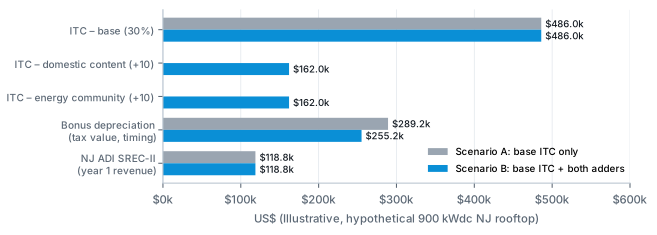
Three observations follow from the arithmetic. First, the two adders together add $324,000 of credit but reduce the depreciation tax value by $34,020, because each additional ITC dollar removes fifty cents of depreciable basis. Second, the ADI revenue line recurs annually over the 15-year SREC-II qualification life set by the BPU; its present value depends on production over that term and on the discount rate, neither of which is modelled here. Third, the constraints that decide whether the numbers are available at all sit outside the table: the 40% MACR for 2026 starts, the December 31, 2027 placed-in-service deadline for any start after July 4, 2026, and any discount on a §6418 transfer.
Section 3National overview
Installation volume, policy prevalence and tax treatment point in different directions. The states with the most commercial capacity are not always the states with the richest incentives, and the national counts published by SEIA, DSIRE and PACENation cover different jurisdictions and dates.
3.1 Where commercial solar is being built
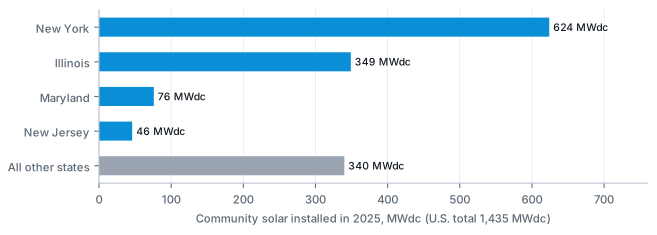
SEIA and Wood Mackenzie's 2025 Year in Review put U.S. commercial installations at 2,345 MWdc, up 6%, within a total market of 43.2 GW (down 14%) dominated by 34.7 GW of utility-scale capacity. California alone accounted for 39% of commercial installations, up 28% year on year. California, Illinois and New York led, with Massachusetts, Pennsylvania and Texas also strong. Community solar fell 25% to 1,435 MWdc.
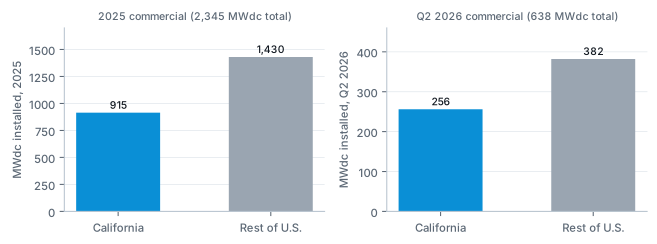
The Q2 2026 data, released in September, show 638 MW of commercial installations nationally (+11% year on year), of which California contributed 256 MW, largely from its NEM 2.0 pipeline. Illinois, New York, Texas and Ohio together contributed more than 150 MW. SEIA and Wood Mackenzie expect commercial volumes to decline an average of 7% per year across 2026–2027.
3.2 How common are the main policy tools?
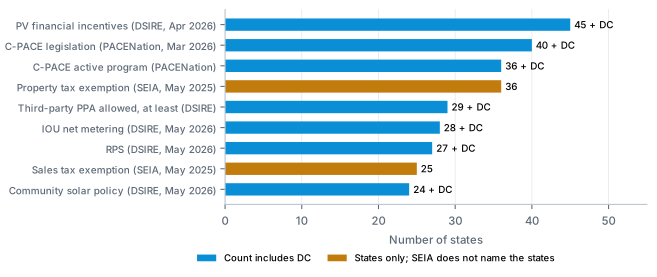
DSIRE's summary maps for April–May 2026 show PV financial incentives in 45 states plus DC, IOU net metering in 28 states plus DC, community solar policy in 24 states plus DC and third-party PPAs allowed in at least 29 states plus DC. PACENation's March 2026 data show C-PACE legislation in 40 states plus DC and active programs in 36 plus DC. SEIA's most recent published counts — 36 states with property tax exemptions and 25 with sales tax exemptions — date from May 2025 and do not name the states.
3.3 How much of the state tax picture is verified?
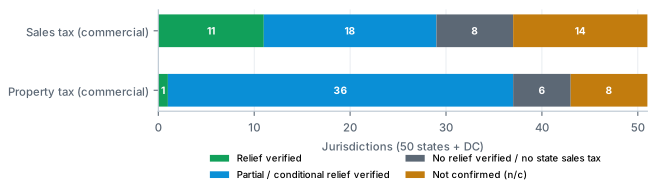
State tax treatment of commercial solar is where the public record is weakest. Several widely used comparison tables are undated or draw on 2024 data, and many state statutes distinguish residential from commercial use in ways those tables do not capture. Chart 09 shows how many jurisdictions' commercial sales and property tax treatment this edition could verify on a primary or dated source.
3.4 Opportunity tiers
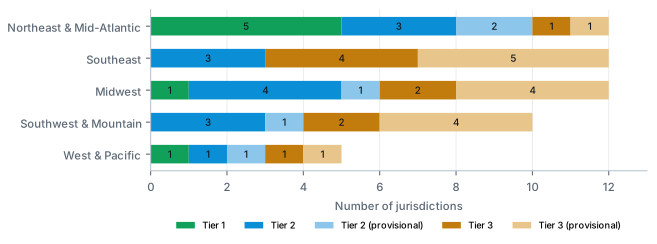
Each jurisdiction carries a tier badge. The tiers are a SolarStock USA Research assessment, not an official rating, and are built from four criteria scored 0–2 on the October 2026 status found:
| Criterion | 2 points | 1 point | 0 points |
|---|---|---|---|
| (A) State performance incentive open to C&I | Active SREC/REC, per-kWh or per-W program | Limited or closing | None |
| (B) Commercial export compensation | Retail net metering | Net billing, successor or partial | None or utility discretion only |
| (C) Tax relief | Sales and property relief for commercial | One of the two | None |
| (D) Market activity | Named by SEIA/WoodMac as a leading commercial or community-solar state (2025–Q2 2026) | Notable utility-scale or C&I volume | Small |
Tier 1 = 6–8 points; Tier 2 = 4–5; Tier 3 = 0–3. Where inputs are unverified, the tier is marked provisional. Tiers describe the incentive and market environment for commercial solar; they say nothing about the merits of any individual project.
Section 4Northeast & Mid-Atlantic
The Northeast and Mid-Atlantic hold the deepest set of state performance incentives in the country: New Jersey's ADI, Massachusetts' SMART 3.0, the DC and Maryland SREC markets and New York's NY-Sun per-watt incentives. It is also the region where several retail net metering regimes are being replaced.
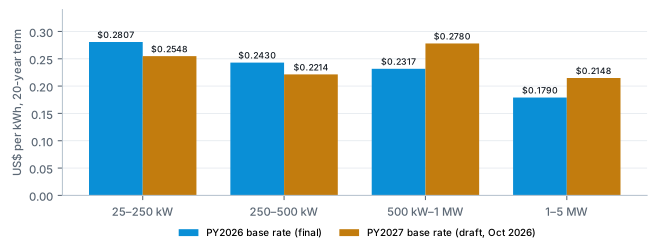
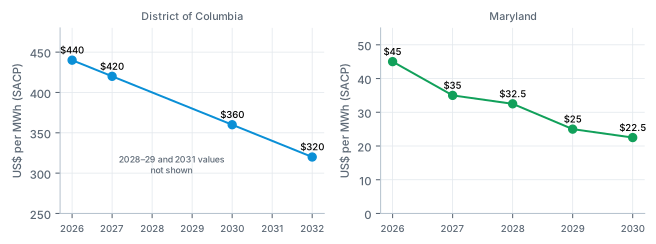
Three dynamics define the region in late 2026. First, incentive levels in New Jersey were held steady for non-residential segments in the May 2026 Triennial Review, and the EY2027 net-metered non-residential block grew to 150 MW. Second, Massachusetts' SMART 3.0 has capacity available — only 8.3% of the 600 MW PY2026 block had been qualified as of September 10, 2026 — while the PY2027 draft shows rates moving in both directions by size class. Third, the solar alternative compliance payments that cap SREC prices are stepping down in DC and Maryland, and the DC market faces oversupply.
Regional snapshot
| Jurisdiction | State performance incentive | Commercial NEM | Tier |
|---|---|---|---|
| New Jersey | ADI SREC-II $85–$110; CSI | Net metering | Tier 1 |
| New York | NY-Sun $/W; VDER | NM small; VDER larger | Tier 1 |
| Massachusetts | SMART 3.0 per-kWh | Net metering | Tier 1 |
| Maryland | SREC + Certified SREC | NM until ≤7/1/2027 | Tier 1 |
| Pennsylvania | PA SREC (AEPS) | Net metering | Tier 2 |
| District of Columbia | SREC ~$358–$360/MWh | Net metering | Tier 1 |
| Connecticut | NRES; PA 26-127 successors | NM, being replaced | Tier 2 |
| Delaware | n/c | Net metering | Tier 2 · provisional |
| Rhode Island | REG tariff | Net metering | Tier 2 |
| Maine | NEB (C&I being phased) | Net metering (BTM) | Tier 2 · provisional |
| Vermont | — | NM with adjustors | Tier 3 |
| New Hampshire | — | n/c | Tier 3 · provisional |
Sections 4–8 state profiles; DSIRE IOU net metering map (May 2026). Tiers: SolarStock USA Research assessment.
State profiles
New Jersey (NJ)
Tier 1- Sales tax
- N.J.S.A. 54:32B-8.33 exempts receipts from sales of solar energy devices or systems, including storage of solar-generated energy, with no residential-only limit. BPU technical standards govern eligibility; the purchaser gives the seller Form ST-4 marked as a solar energy system (N.J.A.C. 18:24-26).
- Property tax
- N.J.S.A. 54:4-3.113a–113b exempts the assessed value added by a certified renewable energy system that is part of, or added to, a residential, commercial, industrial or mixed-use building as an accessory use and produces energy on site for that building (certified by the local construction official on Form CRES). Commercial rooftop and on-site systems qualify; stand-alone ground-mount or grid-supply projects do not meet the accessory-use definition.
- Key programs
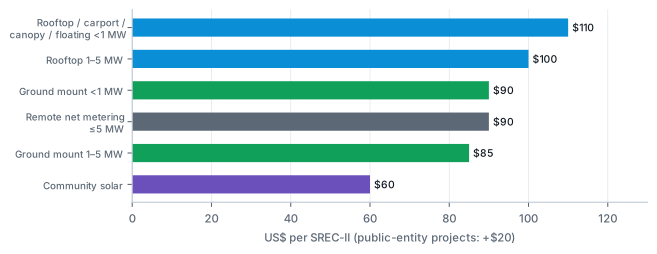
- ADI (SuSI) SREC-II values, unchanged for non-residential in the Triennial Review order of May 21, 2026: rooftop, carport, canopy or floating under 1 MW $110; rooftop 1–5 MW $100; ground mount under 1 MW $90; remote net metering up to 5 MW $90; ground mount 1–5 MW $85; community solar $60; public-entity adder +$20 (adder value per secondary source). The automatic 10% non-residential reduction was avoided.
- EY2027 capacity: net-metered non-residential block raised to 150 MW (from 115 MW); RNM 50 MW. Net-metered segments opened June 1, 2026 and run first-come, first-served until filled or June 1, 2027.
- CSI (above 5 MW, competitive): Solicitation 3 (order of Mar 4, 2026) awarded only 24.1 MWdc against a 300 MW target; awards included rooftop at $80, landfill at $124 and net-metered floating at $119. Annual cycle opens in February and closes in April, with results in May; the Board intends to lower incentives over time.
- Community solar: 3,000 MW allocation (Mar 2026) valid through Dec 31, 2029; 46 MWdc installed in 2025.
- ADI qualification life: SREC-IIs are issued for a 15-year qualification life (BPU order, May 21, 2026).
- Commercial NEM
- Retail net metering (DSIRE IOU map, May 2026).
- Community solar
- Yes — permanent program.
- C-PACE
- Active: Garden State C-PACE (NJEDA) operational since July 30, 2025; 16 municipalities opted in as of Aug 2026. PACENation's map still shows the program as in development.
- RPS / CES
- Class I waiver holds 35% for EY2027 and 40% for EY2028; DSIRE shows 52.5% by 2030.
- Upcoming deadlines
- June 1, 2027 — EY2027 net-metered ADI segments close if not filled earlier. CSI cycle: Feb–Apr annually.
New York (NY)
Tier 1- Sales tax
- Commercial solar equipment sales and installation are exempt from the 4% state and ⅜% MCTD sales tax under Tax Law §1115(ii); local sales tax applies only where the locality has opted in (Pub. 718-CS). Electricity sold under a PPA from a commercial system is exempt under §1115(ee), effective Dec 1, 2015.
- Property tax
- RPTL §487: 15-year exemption for systems built before Jan 1, 2030. Localities may opt out and may require PILOT payments up to the exemption amount.
- Key programs
- NY-Sun (10 GW by 2030 target): the July 2025 operating plan created Upstate C/I SEEF Block 1 (400 MWdc) at a base incentive of $0.12/W, plus prevailing-wage and beneficial-siting adders. Con Ed non-residential MW Blocks open; community-solar incentives $0.05–$0.12/W plus a $0.10/W performance adder.
- VDER value stack applies to community distributed generation and larger projects.
- Commercial NEM
- Net metering for smaller customers; larger systems are compensated under VDER.
- Community solar
- Yes — national leader; 624 MWdc installed in 2025 (−20% year on year).
- C-PACE
- Active (PACENation).
- RPS / CES
- 70% renewable by 2030.
- Upcoming deadlines
- Jan 1, 2030 — RPTL §487 exemption applies to systems built before this date.
Massachusetts (MA)
Tier 1- Sales tax
- Taxable for commercial projects: the exemption in M.G.L. c.64H §6(dd) is limited to a principal residence.
- Property tax
- Clause 45 (DLS guidance, Jan 8, 2026): 20-year exemption, extendable by agreement, where the system produces no more than 125% of on-site annual load, is 25 kW or less, or is covered by a municipal PILOT agreement. Applies to any property type; systems owned by distribution or electric companies are excluded.
- Key programs
- SMART 3.0 (225 CMR 28): 20-year term for 25 kW–5 MW (landfill and brownfield up to 10 MW). Annual program-year parameters replace declining blocks; DPU approved the SMART 2.0/3.0 provisions May 19, 2026.
- PY2026 base rates ($/kWh): 25–250 kW 0.2807; 250–500 kW 0.2430; 500 kW–1 MW 0.2317; 1–5 MW 0.1790. Draft PY2027 (Oct 2026): 0.2548 / 0.2214 / 0.2780 / 0.2148.
- Capacity: PY2026 block of 600 MW, of which only 8.3% had been qualified as of Sept 10, 2026; applications open through Dec 31, 2026. PY2027 block of 300 MW opens Jan 4, 2027.
- Adders include building-mounted, canopy, brownfield, landfill, agricultural, floating, storage, tracking, pollinator, community-shared, low-income and public-entity.
- Commercial NEM
- Retail net metering (DSIRE IOU map).
- Community solar
- Yes — 15% community-shared set-aside within SMART 3.0.
- C-PACE
- Active (PACENation).
- RPS / CES
- 40% by 2030, then +1% per year.
- Upcoming deadlines
- Dec 31, 2026 — PY2026 SMART applications close. Jan 4, 2027 — PY2027 block opens.
Maryland (MD)
Tier 1- Sales tax
- Tax-General §11-230 exempts sales of solar energy equipment — equipment that uses solar energy to generate electricity used in a structure or supplied to the grid — with no residential or size limit. Separately, TG §11-207(a)(5) exempts solar electricity used in residential property.
- Property tax
- Real property: Tax-Property §7-242 exempts solar energy property (equipment generating electricity used in a structure or supplied to the grid). Personal property: §7-237 exempts machinery generating electricity for sale from state tax, while counties and municipalities tax it at 50% of value. Community solar equipment in systems of 5 MW AC or less is fully exempt from county and municipal tax if placed in service after June 30, 2022 and approved by Dec 31, 2030, serving at least 50% low- or moderate-income customers at a discount of at least 20%, and sited agrivoltaically or on a rooftop, brownfield, canopy, landfill or clean fill.
- Key programs
- SREC market (in-state systems only; 5-year SREC life). Solar carve-out 8.0% in 2026 rising to 14.5% in 2030. SACP $45 (2026), $35 (2027), $32.50 (2028), $25 (2029), $22.50 (2030). Market indications of about $40 for 2026 vintage; early-2026 broker bids of $42.50 variable or $29.50 for a 3-year lock (secondary market data).
- Brighter Tomorrow "Certified" SRECs (1.5× compliance value): 20 kW–5 MW tier capped at the first 270 MW AC; systems above 2 MW only on rooftops, canopies or brownfields; prevailing wage above 1 MW; installed July 1, 2024 – Jan 1, 2028. SB 669 / HB 990 (2026), which would have moved the deadline to Jan 1, 2031 and the cap to 540 MW, received committee hearings with no further action recorded, so the Jan 1, 2028 deadline stands.
- Net metering successor (HB 1532, signed May 2026): successor tariff with lower compensation and a combined 6,000 MW cap, effective by July 1, 2027 or when the 3,000 MW cap is reached. PSC draft framework due Oct 27, 2026; final by Feb 1, 2027.
- Commercial NEM
- Retail net metering until the HB 1532 cutoff, then a successor tariff.
- Community solar
- Yes — permanent program; record 76 MWdc in 2025.
- C-PACE
- Active (PACENation).
- RPS / CES
- 50% by 2030.
- Upcoming deadlines
- Oct 27, 2026 — PSC draft framework. Feb 1, 2027 — final framework. July 1, 2027 — latest NEM closure. Jan 1, 2028 — Certified SREC install window ends (extension not enacted).
Pennsylvania (PA)
Tier 2- Sales tax
- Not confirmed in primary sources as of October 2026.
- Property tax
- No statutory solar exemption. The Assessors' Association of Pennsylvania reads the machinery exclusion in the Consolidated County Assessment Law (53 Pa.C.S. §8811) as excluding panels, inverters and transformers from real estate assessment; land and structures are valued on the income approach, and treatment varies by county (Penn State Extension, July 2022).
- Key programs
- PA SREC (AEPS solar carve-out 0.5%; in-state only since Act 40 of 2017). Current market prices were not confirmed in primary sources.
- Solar for Schools: $25M added in the 2026-27 budget; about $27.2M awarded to 84 schools to date (MyChesCo, Aug 27, 2026).
- Commercial NEM
- Net metering (DSIRE IOU map): non-residential systems up to 3 MW, or up to 5 MW for large customer-generators meeting §75.16 conditions; residential up to 50 kW (52 Pa. Code §75.13).
- Community solar
- No state program in force (legislation pending).
- C-PACE
- Active (PACENation).
- RPS / CES
- AEPS 18% by 2021.
- Upcoming deadlines
- No hard state deadline identified for 2026–2027.
District of Columbia (DC)
Tier 1- Sales tax
- Not confirmed in primary sources as of October 2026. No solar-specific provision appears in D.C. Code §47-2005.
- Property tax
- D.C. Code §47-1508(a)(11) (D.C. Law 19-252, 2013) exempts systems using exclusively solar energy from the personal property tax. No real-property solar exemption was found in §47-1002.
- Key programs
- DC SREC: solar carve-out 5.0% (2026) rising to 9.0% (2032). SACP $440 (2026), $420 (2027), $360 (2030), $320 (2032). Platts assessed 2025–2027 vintages at about $358–$360/MWh (Aug 6, 2026). Eligibility limited to DC-sited or DC-certified facilities; cross-certification has ended.
- Oversupply: eligible capacity of 373.7 MW versus a 293 MW target at end-2025, per the 2026 DC RPS report as reported by S&P Global.
- Commercial NEM
- Retail net metering (DSIRE IOU map).
- Community solar
- Yes.
- C-PACE
- Active (PACENation).
- RPS / CES
- 100% by 2032.
- Upcoming deadlines
- SACP steps down annually (to $420 in 2027).
Connecticut (CT)
Tier 2- Sales tax
- Conn. Gen. Stat. §12-412(117)(A) exempts sales of solar energy electricity generating systems, related equipment (modules, racking, inverters, controls, batteries) and installation services, in effect since July 1, 2007, with no buyer-type limit stated.
- Property tax
- CGS §12-81(57)(D), as amended by PA 23-102: mandatory exemption for commercial and industrial Class I sources installed on or after Jan 1, 2014 where nameplate capacity does not exceed on-site (or virtual-net-metering aggregated) load. Municipalities may abate up to 100% for PPA projects.
- Key programs
- NRES (PURA Docket 20-07-01): buy-all or netting tariff in small (0–200 kW), medium (200 kW–1 MW) and large (1–5 MW) tiers; larger tiers are competitively bid. Next RFP window Aug 3 – Sept 14, 2026 (secondary source). Tariff rates were not found.
- NRES successors — Public Act 26-127 (HB 5340, approved June 4, 2026): PURA must open a successor proceeding by Aug 1, 2026 and issue a final order by Dec 1, 2027; utility procurements and tariffs start Jan 1, 2028, with terms of up to 20 years for on-site resources of 5 MW or less, offered until Dec 31, 2035; combined targets of 180 MW/yr and $85M/yr across the successor programs and §16-243ee from 2028.
- Commercial NEM
- Retail net metering, being replaced by successor programs.
- Community solar
- Yes (SCEF).
- C-PACE
- Active — CT Green Bank (PACENation).
- RPS / CES
- 37% by 2030.
- Upcoming deadlines
- Dec 1, 2027 — PURA final order on the NRES successor (PA 26-127). Jan 1, 2028 — successor procurements and tariffs begin.
Delaware (DE)
Tier 2 · provisional- Sales tax
- No state sales tax.
- Property tax
- Not confirmed in primary sources as of October 2026.
- Programs / notes
- State SREC procurement terms and 2026 auction results: not confirmed in primary sources as of October 2026.
- Commercial NEM
- Retail net metering (DSIRE IOU map).
- Community solar
- Yes.
- C-PACE
- Active (PACENation).
- RPS / CES
- 40% by 2035.
- Upcoming deadlines
- None identified.
Rhode Island (RI)
Tier 2- Sales tax
- R.I. Gen. Laws §44-18-30(57) exempts listed renewable energy products — PV modules, grid-tied DC-to-AC inverters, manufactured mounting racks and ballast pans, and manufacturer-specified monitoring and control equipment — with no buyer-type limit. Racking fabricated from raw materials and general electrical fixtures are excluded.
- Property tax
- Residential systems (§44-3-3(a)(48)) and systems used by a manufacturer (§44-3-3(a)(49)) are exempt. Other renewable energy resources may be taxed by municipalities only at $5.00 per kW AC of nameplate capacity on the tangible property (§44-5-3(c), as amended 2025); municipalities may also exempt renewable systems by ordinance (§44-3-21).
- Key programs
- Renewable Energy Growth (REG) PY2026 (Docket 25-52-REG): classes under 1 MW receive the 30 MW statutory minimum, with more capacity directed to the Medium and Commercial classes; 15–20 year terms. Ceiling prices were not found.
- 2026 legislation allows utilities to charge grid-access fees on larger DG.
- Commercial NEM
- Retail net metering (DSIRE IOU map).
- Community solar
- Yes.
- C-PACE
- Active (PACENation).
- RPS / CES
- 100% by 2033.
- Upcoming deadlines
- None identified.
Maine (ME)
Tier 2 · provisional- Sales tax
- No solar-specific exemption: the former solar energy equipment exemption (36 M.R.S. §1760(38)) was repealed in 1985. Whether the general production-machinery exemption applies to generation equipment was not confirmed.
- Property tax
- 36 M.R.S. §§655(1)(U)–(V) and 656(1)(K)–(L) exempt the contributory value of solar equipment for assessments on or after Apr 1, 2025. A commercial array qualifies only if all output is used on site, if it is collocated with net energy billing customers subscribed to at least 50% of output, or if it is a bill-credit project with an interconnection agreement executed before June 1, 2024. Land and construction in progress are not exempt; owners apply to the assessor by April 1.
- Programs / notes
- LD 1777 (P.L. 2025 c.430, effective Sept 24, 2025): commercial and institutional NEB tariff rates end for certain resources, with new rates from Jan 1, 2026; no new NEB agreements for utility-side-of-meter DG after Dec 31, 2025; the Governor's Energy Office is designing a front-of-meter successor in 2026; monthly fees apply to certain kWh-credit DG.
- Commercial NEM
- Behind-the-meter net energy billing continues.
- Community solar
- Policy exists; installations fell 87% in 2025.
- C-PACE
- Active (PACENation).
- RPS / CES
- 90% by 2040.
- Upcoming deadlines
- Front-of-meter successor design during 2026.
Vermont (VT)
Tier 3- Sales tax
- 32 V.S.A. §9741(46) exempts tangible personal property incorporated into a net-metering system (30 V.S.A. §8002, up to 500 kW) or an off-grid home or business energy system, claimed on Form S-3E. Non-net-metered grid-supply projects are not covered.
- Property tax
- Statewide exemption only for net-metered or off-grid solar plants under 50 kW (32 V.S.A. §3802(17)); towns may vote to exempt renewable sources for on-premises use (§3845). Larger plants are appraised on an income or DCF model (§3481), with the first 50 kW excluded for net-metered plants of 50 kW or more. The uniform capacity tax (§8701) was not reviewed.
- Programs / notes
- No state C&I performance incentive researched.
- Commercial NEM
- Net metering with negative adjustors (DSIRE note); the IOU map shows net billing/other.
- C-PACE
- Enabled; no active program shown (PACENation).
- RPS / CES
- CES 100% by 2030.
- Upcoming deadlines
- None identified.
New Hampshire (NH)
Tier 3 · provisional- Sales tax
- No state sales tax.
- Property tax
- Local option: RSA 72:62 lets each city or town adopt (under RSA 72:27-a) an exemption from assessed value for real property equipped with a solar energy system (RSA 72:61).
- Programs / notes
- No state performance incentive researched. In 2026 Liberty proposed a mechanism to recover net metering credits (NCCETC).
- Commercial NEM
- Not confirmed in primary sources as of October 2026.
- Community solar
- Yes.
- C-PACE
- Active (PACENation).
- RPS / CES
- 25.2% by 2025.
- Upcoming deadlines
- None identified.
Section 5Southeast
The Southeast combines large utility-scale volume with thin state incentive programs. Commercial economics rest on federal credits, property tax treatment and, increasingly, utility-run subscription products rather than state performance payments.
Florida stands out for verified tax relief: a sales tax exemption with no sunset and an 80% exemption on renewable energy devices treated as tangible personal property through 2037. Virginia exempts business-owned solar equipment from sales tax and applies a property tax stepdown under §58.1-3660 that gives utility-scale projects a predictable schedule; the SCC also approved Dominion's NEM 2.0, which kept monthly netting. North Carolina, South Carolina, Kentucky, Arkansas and West Virginia have no solar-specific sales tax exemption, but plants generating electricity for sale can exempt equipment under manufacturing or electric-power provisions. North Carolina's 80% property tax exclusion is the region's main policy risk: H 1213, which would end it for systems placed in service on or after July 1, 2027, cleared House Finance 12–8 but had not been confirmed as enacted. In Georgia, the main path for C&I buyers is Georgia Power's CARES CIR subscription program, whose distributed-generation window is expected to open in Q4 2026.
Tennessee exempts generation equipment at TDEC-certified green energy production facilities, while Louisiana's property tax exemption is residential-only. Tennessee is also the only state that DSIRE's May 2026 map classifies as offering no DG compensation, and South Carolina, Mississippi, Louisiana and West Virginia show no active C-PACE program.
Regional snapshot
| Jurisdiction | State performance incentive | Commercial NEM | Tier |
|---|---|---|---|
| North Carolina | — | Net metering | Tier 2 |
| Florida | — | Net metering | Tier 2 |
| Virginia | — | NM; NEM 2.0 (Dominion) | Tier 2 |
| Georgia | — (CARES CIR) | Net billing / other | Tier 3 |
| South Carolina | — | Net metering | Tier 3 |
| Alabama | — | Net billing | Tier 3 · provisional |
| Mississippi | — | Net billing | Tier 3 · provisional |
| Tennessee | — | None | Tier 3 · provisional |
| Kentucky | — | Net billing | Tier 3 |
| Arkansas | — | Net billing | Tier 3 · provisional |
| Louisiana | — | Net billing | Tier 3 · provisional |
| West Virginia | — | Net billing | Tier 3 |
Sections 4–8 state profiles; DSIRE IOU net metering map (May 2026). Tiers: SolarStock USA Research assessment.
State profiles
North Carolina (NC)
Tier 2- Sales tax
- No solar-specific exemption. NCDOR treats generating electric power for distribution and sale as manufacturing, and mill machinery and parts bought for that use are exempt under G.S. 105-164.13(5e) (Sales and Use Tax Bulletin 57-8; non-precedential rulings MEPLR 2010-0002 and SUPLR 2021-0016). The 2010 ruling applied the 1% machinery privilege tax (G.S. 105-187.51); its current application was not confirmed. Behind-the-meter systems are not addressed.
- Property tax
- G.S. 105-275(45) excludes 80% of the appraised value of solar energy electric systems. H 1213 would deny the exclusion to systems placed in service on or after July 1, 2027, with existing systems grandfathered. It was approved by House Finance 12–8 (reported July 2, 2026) and goes next to House Rules. Enactment had not been confirmed as of October 14, 2026; no edition after the House Finance committee substitute (v2) is posted on ncleg.gov as of Oct 14, 2026. Press frames it as utility-scale; the text appears to cover all systems. The fiscal note projects local revenue gains of about $4.8M in FY2027-28 rising to $11.1M by FY2030-31.
- Key programs
- Duke net metering: the 2023 NCUC order moved new residential customers to time-of-use rates.
- Commercial NEM
- Net metering (DSIRE IOU map).
- Community solar
- Yes.
- C-PACE
- Active (PACENation).
- RPS / CES
- REPS 12.5% (IOUs).
- Market / other
- Third-party PPAs are prohibited; leases are allowed (DSIRE).
- Upcoming deadlines
- July 1, 2027 — proposed H 1213 cutoff (legislation pending).
Florida (FL)
Tier 2- Sales tax
- §212.08(7)(hh) exempts solar energy systems and components, with no sunset; a purchaser form and FSEC-certified equipment are required. No residential-only limit is stated.
- Property tax
- §196.182: 80% of the assessed value of renewable energy source devices treated as tangible personal property is exempt (devices installed on or after Jan 1, 2018, among other routes); sunsets Dec 31, 2037. §193.624 applies to real property.
- Key programs
- No state performance incentive found.
- Commercial NEM
- Net metering for IOUs under Rule 25-6.065, covering customer-owned renewable generation up to 2 MW in three tiers: up to 10 kW; above 10 kW to 100 kW; above 100 kW to 2 MW.
- Community solar
- No state policy (DSIRE).
- C-PACE
- Active, residential and commercial (PACENation).
- RPS / CES
- None.
- Market / other
- Leases explicitly allowed. Florida ranked third nationally for total solar installed in H1 2026 (1.61 GW).
- Upcoming deadlines
- Dec 31, 2037 — §196.182 sunset.
Virginia (VA)
Tier 2- Sales tax
- Va. Code §58.1-609.3(9) exempts certified pollution control equipment, a definition that under §58.1-3660 includes solar equipment owned or operated by a business, whether or not certified; contractors claim it on Form ST-11A. Equipment used to generate electricity for sale also qualifies under the manufacturing exemption (§58.1-609.3(2)(iii); P.D. 18-112), except for public service corporations, whose solar-equipment exemption expires June 30, 2027.
- Property tax
- Va. Code §58.1-3660: projects of 5 MW or less with interconnection filed on or after Jan 1, 2019 are 100% exempt (§58.1-3660(C)(iv)), as are projects of 20 MW or less with interconnection requests filed by Dec 31, 2018. Projects above 5 MW and under 150 MW: 80% exempt in years 1–5, 70% in years 6–10, 60% thereafter; 100% where the locality adopts a revenue-share ordinance (§58.1-2636). For projects above 5 MW, the locality application must be filed before July 1, 2030. Storage above 5 MW follows the same stepdown.
- Key programs
- Dominion NEM 2.0 (SCC order, ~Apr 30, 2026): monthly netting retained; credits carry 12 months; year-end surplus paid at 5.829¢/kWh (4.829¢ avoided cost + 1¢ RPS value); $1/month administrative fee; NEM 1.0 customers grandfathered indefinitely; statutory cap of 6% of peak.
- 2026 law: grant to offset interconnection costs for public bodies.
- Commercial NEM
- Net metering; NEM 2.0 terms at Dominion as above.
- Community solar
- Yes (shared solar).
- C-PACE
- Active (PACENation).
- RPS / CES
- VCEA: 100% by 2045/2050.
- Upcoming deadlines
- June 30, 2027 — solar-equipment sales tax exemption for public service corporations expires. July 1, 2030 — locality application deadline for projects above 5 MW.
Georgia (GA)
Tier 3- Sales tax
- Not confirmed in primary sources as of October 2026.
- Property tax
- Not confirmed in primary sources as of October 2026.
- Key programs
- Georgia Power CARES CIR (release of June 25, 2026): utility-scale subscription for customers above 3 MW of demand (open); distributed-generation subscription for C&I customers of 1–3 MW demand, for local projects of 250 kW–6 MW, with the window expected to open in Q4 2026. Up to 3,000 MW authorized.
- Commercial NEM
- No traditional net metering (DSIRE map: net billing/other).
- Community solar
- —
- C-PACE
- Active (PACENation).
- RPS / CES
- None.
- Upcoming deadlines
- Q4 2026 — CARES CIR distributed-generation window expected to open.
South Carolina (SC)
Tier 3- Sales tax
- No solar-specific exemption. SCDOR treats a utility-scale facility selling all its power wholesale as a manufacturer, so the manufacturing exemptions in §12-36-2120 can apply, including item (17) for machines and item (67) for construction materials where investment is $100M or more (PLR 15-1, Oct 15, 2015, 74.9 MW project; binding only on the requester).
- Property tax
- §12-37-220(B)(53) exempts renewable energy resource property of no more than 20 kW AC nameplate capacity; larger commercial and utility-scale systems have no statewide exemption.
- Programs / notes
- Third-party PPAs prohibited; leasing allowed (DSIRE). Community solar: option policy (DSIRE).
- Commercial NEM
- Net metering (DSIRE IOU map).
- C-PACE
- No program shown (PACENation).
- RPS / CES
- 2% (2021).
Alabama (AL)
Tier 3 · provisional- Sales tax
- Not confirmed in primary sources as of October 2026.
- Property tax
- Not confirmed in primary sources as of October 2026.
- Commercial NEM
- Net billing / other (DSIRE IOU map).
- C-PACE
- Enabled; no active program shown (PACENation).
- RPS / CES
- None.
Mississippi (MS)
Tier 3 · provisional- Sales tax
- Not confirmed in primary sources as of October 2026.
- Property tax
- No automatic exemption. Two local incentives can be combined (AG Op. 2021-00164): counties may grant up to a 50% assessed-value exemption for renewable projects of $100M or more (Miss. Code §27-31-46), and a fee-in-lieu under §27-31-104 can abate up to 90% for renewable projects from July 1, 2022, with MDA certification (Butler Snow, Nov 2022).
- Programs / notes
- Leasing allowed (DSIRE).
- Commercial NEM
- Net billing / other (DSIRE IOU map).
- C-PACE
- No program shown (PACENation).
Tennessee (TN)
Tier 3 · provisional- Sales tax
- Tenn. Code Ann. §67-6-346: machinery and equipment that produce or store electricity at a TDEC-certified green energy production facility (solar included) can be bought tax-exempt, or tax paid can be refunded or credited; since July 1, 2022 this covers on- and off-premises use. TDEC certification and a TDOR supplemental application are required, and contractors receive the exemption certificate.
- Property tax
- Not confirmed in primary sources as of October 2026.
- Commercial NEM
- No DG compensation offered — the only state so classified on the DSIRE May 2026 map.
- C-PACE
- Active (PACENation).
Kentucky (KY)
Tier 3- Sales tax
- No solar-specific exemption. KDOR treats a solar plant selling electricity as manufacturing, so its equipment can be exempt as machinery for new and expanded industry (KRS 139.480(10)) — panels, racking, trackers, DC/AC system items, inverters and in-process transformers. Foundations, substation building materials, transmission property, security and communications equipment and batteries are not covered.
- Property tax
- No exemption. Once operational, solar power companies are assessed as public service companies on unit value (KRS 136.115 et seq.); panels, racking, inverters and transformers are classed as manufacturing machinery (KRS 132.020(1)(c)), and former farmland loses agricultural valuation.
- Commercial NEM
- Net billing / other (DSIRE IOU map).
- C-PACE
- Active (PACENation).
Arkansas (AR)
Tier 3 · provisional- Sales tax
- No solar-specific exemption. DFA Revenue Legal Opinion 20190510 (June 17, 2019), as reported by Aprio, treated solar generation for sale as manufacturing under Ark. Code §26-52-402: panels, piles, trackers, inverters, collection cabling, substation, main transformer and interconnection qualified; foundations and security systems did not. Contractors may buy exempt under GR-55.
- Property tax
- Not confirmed in primary sources as of October 2026.
- Programs / notes
- Third-party PPAs limited to tax-exempt entities (DSIRE). Among the top states for total 2025 installations (SEIA/WoodMac).
- Commercial NEM
- Net billing / other (DSIRE IOU map).
- C-PACE
- Active (PACENation).
Louisiana (LA)
Tier 3 · provisional- Sales tax
- Not confirmed in primary sources as of October 2026.
- Property tax
- La. R.S. 47:1706 exempts solar equipment attached to owner-occupied residential buildings or swimming pools only; there is no statutory exemption for commercial or utility-scale systems (industrial tax exemption programs not reviewed).
- Programs / notes
- Community solar policy adopted, plus a New Orleans local program (DSIRE).
- Commercial NEM
- Net billing / other (DSIRE IOU map).
- C-PACE
- No program shown (PACENation).
West Virginia (WV)
Tier 3- Sales tax
- No solar-specific exemption. W. Va. Code §11-15-9 exempts machinery, supplies and services directly used in the generation, production or sale of electric power; the exemption is technology-neutral, and solar-specific Tax Department guidance was not found.
- Property tax
- No exemption. Solar facilities are appraised at true and actual value (assessed at 60%) and, unlike wind, are not deemed pollution-control facilities eligible for salvage valuation; SB 578 (2020) reduced the B&O tax on solar generation instead (Frost Brown Todd, Apr 2020).
- Commercial NEM
- Net billing / other (DSIRE IOU map).
- C-PACE
- No program shown (PACENation).
Section 6Midwest
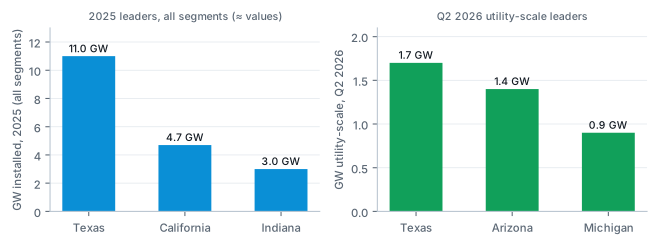
Illinois anchors the Midwest with the region's only large, actively priced REC program for commercial solar. Elsewhere, the region's activity is driven by utility-scale volume — Indiana was third nationally in 2025 and Michigan third in Q2 2026 utility-scale — rather than by state incentives.
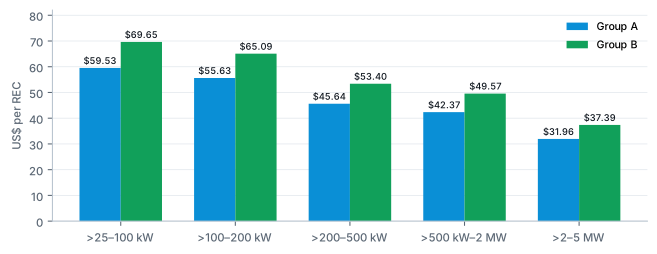
Illinois Shines opened PY2026-27 on June 1, 2026 with Large DG REC prices from $31.96 to $69.65 depending on size and group, alongside $300/kW utility DG rebates at ComEd and Ameren. Illinois also moved new systems to supply-only crediting from January 1, 2025, which shifts more value onto the REC contract. HB 5444, which would roughly double the statutory per-MW property tax basis from 2027, stalled in House Rules in March 2026. Minnesota offers a sales tax exemption with no sunset, exempts solar personal property and levies a $1.20/MWh production tax above 1 MW, and runs a community solar garden program whose annual cap steps down from 100 MW to 80 MW in 2027. Ohio was among the leading commercial states in Q2 2026; it has no state SREC market (its RPS solar carve-out has been 0% since 2020) but offers a sales tax exemption for generation for others and a $7,000/MW Qualified Energy Project PILOT. Michigan's PA 108 replaces property tax with a $7,000/MW specific tax for 20 years on facilities of 2 MW AC or more, and Treasury confirmed in April 2026 that solar equipment selling its power qualifies for the industrial-processing sales tax exemption. Several Plains states use in-lieu generation taxes instead of property tax — Nebraska ($3,518/MW), South Dakota ($3/kW plus a production charge above 5 MW) and North Dakota — while Missouri's statutory solar property exemption was struck down in 2022.
Regional snapshot
| Jurisdiction | State performance incentive | Commercial NEM | Tier |
|---|---|---|---|
| Illinois | IL Shines REC | Net billing (supply-only) | Tier 1 |
| Minnesota | Community solar garden | Net metering | Tier 2 |
| Ohio | — (0% solar carve-out) | Net metering | Tier 2 |
| Michigan | — | Net billing | Tier 2 · provisional |
| Wisconsin | — | Net metering | Tier 2 |
| Indiana | — | Net billing | Tier 3 · provisional |
| Iowa | — | Net metering | Tier 3 · provisional |
| Missouri | — | Net metering | Tier 3 |
| North Dakota | — | Net metering | Tier 2 |
| South Dakota | — | Net billing | Tier 3 · provisional |
| Nebraska | — | Net metering | Tier 3 |
| Kansas | — | Net metering | Tier 3 · provisional |
Sections 4–8 state profiles; DSIRE IOU net metering map (May 2026). Tiers: SolarStock USA Research assessment.
State profiles
Illinois (IL)
Tier 1- Sales tax
- Not confirmed in primary sources as of October 2026.
- Property tax
- Commercial solar is assessed under 35 ILCS 200/10-720 at a statutory per-MW cost basis of $218,000/MW. HB 5444, which would raise the basis to $446,000/MW from 2027, was re-referred to House Rules under Rule 19(a) on Mar 27, 2026 and has not advanced.
- Key programs
- Illinois Shines PY2026-27 (opened June 1, 2026), Large DG REC prices: $59.53–$69.65 (>25–100 kW) down to $31.96–$37.39 (>2–5 MW), Group A / Group B. Traditional community solar $33.99–$72.15 by size and group. As of June 2, 2026, traditional community solar had 52.17 MW (Group A) and 181.86 MW (Group B) remaining with no waitlists. Large DG opened PY2026-27 with 236.71 MW
- Utility DG rebates: ComEd $300/kW DC; Ameren $300/kW inverter AC; storage $300/kWh (non-residential eligibility terms to be confirmed with each utility).
- Commercial NEM
- Since Jan 1, 2025, new systems receive supply-only crediting; pre-2025 systems are grandfathered (DSIRE map: net billing/other).
- Community solar
- Yes — 349 MWdc installed in 2025.
- C-PACE
- Active (PACENation).
- RPS / CES
- 50% by 2040.
- Upcoming deadlines
- None — HB 5444 is stalled in House Rules (Mar 27, 2026).
Minnesota (MN)
Tier 2- Sales tax
- Minn. Stat. §297A.67 subd. 29 exempts solar energy systems with no sunset; no residential limit stated.
- Property tax
- Minn. Stat. §272.02 subd. 24 exempts solar generating systems' personal property. Systems above 1 MW AC pay a production tax of $1.20/MWh (§272.0295), split 80% to counties and 20% to cities and towns; systems of 1 MW AC or less are exempt from it. Land used primarily for taxed production is class 3a (commercial-industrial).
- Key programs
- Community Solar Garden program, now administered by the Department of Commerce (the Xcel legacy program closed Dec 31, 2023). 2026 capacity approved as of Sept 1, 2026: 30.5 MW; request for applications open. The 2023 law (HF 2310) set 5 MW projects and annual caps of 100 MW for 2024–26 and 80 MW for 2027–30, plus a DG procurement standard (Xcel 3% by 2030).
- Commercial NEM
- Net metering (DSIRE IOU map).
- Community solar
- Yes — Commerce-administered program.
- C-PACE
- Active (PACENation).
- RPS / CES
- 55% by 2035 (IOUs); 100% carbon-free by 2040.
- Upcoming deadlines
- 2027 — community solar garden annual cap steps from 100 MW to 80 MW.
Ohio (OH)
Tier 2- Sales tax
- R.C. 5739.02(B)(40) exempts tangible personal property and services sold to a provider of electricity and used directly and primarily in generating, transmitting or distributing electricity for use by others, including energy conversion equipment. On-site (self-consumption) systems do not qualify under this provision.
- Property tax
- R.C. 5727.75 Qualified Energy Project: the project's tangible personal and real property is exempt in exchange for a service payment of $7,000 per MW of nameplate capacity for solar; a county may add a further payment, but the total may not exceed $9,000/MW. Projects of 20 MW or more need county commissioners' approval. Certification applications are due by the last day of the tax year before the applicable year, and construction must begin before that year; the applicable year is the later of tax year 2029 or the year emissions fall to 25% of 2022 levels under §45Y. Federal prevailing wage and apprenticeship standards apply.
- Programs / notes
- Ohio's RPS (R.C. 4928.64) requires 8.5% renewables by end-2026 with a 0% solar benchmark since 2020; there is no state SREC compliance market.
- Commercial NEM
- Net metering (DSIRE IOU map).
- Community solar
- —
- C-PACE
- Active (PACENation).
- RPS / CES
- 8.5% by 2026.
- Market / other
- Among the leading commercial states in Q2 2026 (with IL, NY and TX).
- Upcoming deadlines
- Dec 31, 2028 — latest QEP certification application date if the applicable year is 2029.
Michigan (MI)
Tier 2 · provisional- Sales tax
- The industrial-processing exemption (MCL 205.54t / 205.94o) applies to solar generating equipment, including PV panels and foundations, when the electricity is sold at retail or consumed in industrial processing; mixed use is prorated, and eligibility does not depend on being a public utility (Treasury RAB 2026-6, Apr 28, 2026).
- Property tax
- 2023 PA 108 (MCL 211.1151 et seq., immediate effect July 27, 2023): qualified facilities of at least 2 MW AC in a local solar energy district are exempt from ad valorem tax for 20 years and pay a specific tax of $7,000/MW AC instead ($2,000/MW on brownfields and certain other sites). Land stays taxable, local approval is required, and no new exemptions are granted after Dec 31, 2031.
- Commercial NEM
- DG tariff — net billing (DSIRE map).
- Community solar
- —
- C-PACE
- Active (PACENation).
- RPS / CES
- CES 60% by 2030; 100% by 2050.
- Market / other
- 0.9 GW of utility-scale solar installed in Q2 2026 (third nationally).
- Upcoming deadlines
- Dec 31, 2031 — last date for new PA 108 exemptions.
Wisconsin (WI)
Tier 2- Sales tax
- Wis. Stat. §77.54(56) exempts sales of products powered by solar (or wind) that produce at least 200 W AC; no buyer-type or size cap is stated.
- Property tax
- Wis. Stat. §70.111(18) exempts solar energy systems from general property tax. Plants of 1 MW or more used by a light, heat or power company instead generate state shared-revenue payments to host municipalities and counties of $2,000 per MW (§79.04(6)).
- Commercial NEM
- Net metering (DSIRE IOU map).
- C-PACE
- Active (PACENation).
- RPS / CES
- 10%.
Indiana (IN)
Tier 3 · provisional- Sales tax
- Not confirmed in primary sources as of October 2026.
- Property tax
- IC 6-1.1-12-26.1 / 27.1 give an assessed-value deduction for solar devices to owners, lessees and contract buyers; it does not apply to utility companies. Since Jan 1, 2022 (HEA 1348-2021), utility-grade solar facilities selling power for resale are taxed as light, heat or power companies, with land capped at regional solar land base rates — for the Jan 1, 2026 assessment date $18,356/acre North, $26,141 Central and $20,000 South (IC 6-1.1-8-24.5).
- Programs / notes
- 3 GW installed in 2025, third nationally across all segments (SEIA/WoodMac).
- Commercial NEM
- Net billing (EDG) (DSIRE map).
- C-PACE
- No program shown (PACENation).
Iowa (IA)
Tier 3 · provisional- Sales tax
- Iowa Code §423.3(90) exempts sales of solar energy equipment — equipment primarily used to collect and convert solar radiation into energy or move it to storage or point of use — with no buyer-type limit.
- Property tax
- Iowa Code §441.21(8)(b): a solar energy system on agricultural, residential, commercial or industrial property does not increase assessed value for five full assessment years.
- Programs / notes
- State solar credit (Iowa Code §422.11L): business credit of 50% of the federal §48 solar credit (IRC as of Jan 1, 2016), capped at $20,000 per installation; statewide cap $5M/yr with at least $1M reserved for residential; application due by May 1 after installation, with a waitlist when oversubscribed. Current-year availability not checked.
- Commercial NEM
- Net metering (DSIRE IOU map).
- C-PACE
- No program shown (PACENation).
- RPS / CES
- 105 MW.
Missouri (MO)
Tier 3- Sales tax
- RSMo §144.030.2(46) exempts a company's purchases of PV systems, components and construction materials when the systems are sold or leased to an end user or used to produce electricity for resale or retail.
- Property tax
- RSMo §137.100(10) lists solar energy systems not held for resale as exempt, but the Missouri Supreme Court held it unconstitutional in Johnson v. Springfield Solar 1, LLC, 648 S.W.3d 101 (Mo. banc 2022). Treat commercial solar as taxable.
- Commercial NEM
- Net metering (DSIRE IOU map).
- C-PACE
- Active, residential and commercial (PACENation).
- RPS / CES
- 15%.
North Dakota (ND)
Tier 2- Sales tax
- N.D.C.C. §57-39.2-04.2 exempts production equipment and construction materials for power plants, covering any non-coal, non-wind generating facility of 100 kW or more that produces electricity for resale or for use in a business. A certificate from the Tax Commissioner is required, or the buyer pays and claims a refund.
- Property tax
- N.D.C.C. §57-02-08(27): solar devices are exempt for five years after installation (locally assessed property only). Grid-connected non-coal, non-wind generators in projects of 100 kW or more owned by companies taxed under ch. 57-33.2 instead pay $0.50/kW of rated capacity plus $0.001/kWh, centrally assessed in lieu of property tax on operative property (§57-33.2-04(2)).
- Commercial NEM
- Net metering (DSIRE IOU map).
- C-PACE
- No program shown (PACENation).
- RPS / CES
- 10% goal.
South Dakota (SD)
Tier 3 · provisional- Sales tax
- Not confirmed in primary sources as of October 2026.
- Property tax
- Facilities under 5 MW: the greater of the first $50,000 or 70% of the renewable energy property's assessed value is exempt from real property tax (SDCL 10-4-44). Solar facilities of 5 MW or more pay $3 per kW of nameplate annually plus $0.0009/kWh in lieu of property tax (SDCL 10-35-17 to 10-35-19.1).
- Commercial NEM
- Net billing / other (DSIRE IOU map).
- C-PACE
- No program shown (PACENation).
Nebraska (NE)
Tier 3- Sales tax
- No solar exemption. Nebraska Reg. 1-107.03A excludes generation of electricity from manufacturing, so the manufacturing machinery exemption does not apply.
- Property tax
- Solar facilities of 100 kW or more installed on or after Jan 1, 2016 pay a nameplate capacity tax of $3,518/MW per year (Neb. Rev. Stat. §77-6203, as amended 2026), and their depreciable personal property is exempt (§77-202(9)). Public power and co-op facilities and net-metered customer-generators are not subject to the nameplate tax.
- Commercial NEM
- Net metering (DSIRE IOU map).
- C-PACE
- Active (PACENation).
Kansas (KS)
Tier 3 · provisional- Sales tax
- K.S.A. 79-3606(kk) integrated-production machinery and equipment exemption names electricity power generation as a qualifying operation; KDOR has applied it to generators and wind-farm equipment (P-2001-133, P-2008-012). Application to solar should be confirmed with KDOR.
- Property tax
- K.S.A. 79-201 Eleventh: property used predominantly to generate electricity from renewables, solar included, is exempt; for applications after Dec 31, 2016 the exemption runs for the 10 taxable years after construction is completed.
- Commercial NEM
- Net metering (DSIRE IOU map).
- C-PACE
- No program shown (PACENation).
- RPS / CES
- 20% goal.
Section 7Southwest & Mountain
The Southwest and Mountain region is the country's utility-scale engine. Texas led the nation with about 11 GW in 2025, and Arizona ranked second in H1 2026. State incentives for commercial solar are modest; tax treatment and market access do most of the work.
Texas offers a property tax exemption under Tax Code §11.27 for solar devices primarily for on-site use, while utility-scale projects rely on Chapter 312 abatements; SB 1754, which would have barred those abatements for wholesale solar, died in 2025, and the issue may return when the legislature meets in 2027. There is no statewide net metering rule; in ERCOT, export compensation is at the retail electric provider's discretion. Arizona's transaction privilege tax deduction for solar devices now survives only for retail sales — the prime-contracting deduction expired at the end of 2016 — and generation equipment for sale is valued at 20% of depreciated cost through 2040; the state has no C-PACE program. Colorado exempts renewable generation components from state sales and use tax, and Xcel Energy's Solar*Rewards pays C&I systems of 8 kW–1 MW AC a 20-year production incentive. New Mexico's gross receipts tax deduction applies only to on-site systems. Utah's sales tax exemption for facilities of 2 MW or more ends June 30, 2027; Nevada offers GOED sales and property tax abatements for wholesale facilities of 10 MW or more; and Idaho replaces property tax with a 3.5% tax on gross solar earnings.
Regional snapshot
| Jurisdiction | State performance incentive | Commercial NEM | Tier |
|---|---|---|---|
| Texas | — | REP discretion | Tier 2 |
| Arizona | — | Net billing | Tier 2 |
| Colorado | Xcel Solar*Rewards | Net metering | Tier 2 |
| New Mexico | — | Net metering | Tier 2 · provisional |
| Utah | — | Net billing | Tier 3 · provisional |
| Nevada | — | Mixed | Tier 3 |
| Oklahoma | — | Net metering | Tier 3 · provisional |
| Idaho | — | Mixed | Tier 3 · provisional |
| Montana | — | Net metering | Tier 3 |
| Wyoming | — | Net metering | Tier 3 · provisional |
Sections 4–8 state profiles; DSIRE IOU net metering map (May 2026). Tiers: SolarStock USA Research assessment.
State profiles
Texas (TX)
Tier 2- Sales tax
- Not confirmed in primary sources as of October 2026.
- Property tax
- Tax Code §11.27 (as amended by SB 63, 2021) exempts the appraised value added by a solar device on real property when the device is primarily for on-site use; subsection (a-1) lets device owners claim it without owning the land. Utility-scale projects typically rely on Chapter 312 abatements. SB 1754 (2025), which would have barred abatements for wholesale wind, solar and storage from Jan 1, 2026, passed the Senate but died in House Ways & Means when the session ended. Other anti-renewable bills (SB 819, SB 388, SB 715) died in 2025. The legislature next meets in 2027.
- Key programs
- Utility rebates are mostly residential (e.g., Austin Energy, AEP, Oncor via installers). Commercial performance-based programs (Austin Energy, CPS Energy): not found.
- Commercial NEM
- No statewide rule. In ERCOT, export compensation is at the retail electric provider's discretion; a 2025 law lets the PUC approve alternative DG compensation.
- Community solar
- No state policy (DSIRE).
- C-PACE
- Active (PACENation).
- RPS / CES
- —
- Market / other
- No. 1 state in 2025 (about 11 GW, all segments); 1.7 GW utility-scale in Q2 2026 and 3.44 GW in H1 2026.
- Upcoming deadlines
- 2027 legislative session — watch abatement and property-tax bills.
Arizona (AZ)
Tier 2- Sales tax
- A.R.S. §42-5061(M) retail TPT deduction for solar energy devices sold by registered solar energy retailers continues, as does the rental-classification deduction. The prime-contracting deduction (§42-5075(B)(13)) covered only periods before Jan 1, 2017 (ADOR deduction code 538 expired Dec 31, 2016); a contractor may still buy qualifying devices exempt from a registered solar retailer.
- Property tax
- §42-11054: on-site solar devices add no value. §42-14155: renewable generation equipment for sale is valued at 20% of depreciated cost through Dec 31, 2040.
- Key programs
- The non-residential solar income tax credit (10%, $25,000 per building) applied through tax year 2018 and has expired.
- Commercial NEM
- Net billing / export rate (DSIRE map). The Court of Appeals vacated the APS Grid Access Charge approval in Q2 2026.
- Community solar
- Option policy (DSIRE).
- C-PACE
- Not enabled.
- RPS / CES
- —
- Market / other
- 1.4 GW utility-scale in Q2 2026; No. 2 in H1 2026. Third-party PPAs limited to certain sectors.
- Upcoming deadlines
- Dec 31, 2040 — §42-14155 valuation treatment ends.
Colorado (CO)
Tier 2- Sales tax
- C.R.S. 39-26-724 exempts components used to produce AC electricity from renewables from state sales and use tax, with no sunset. Excludes components beyond the generator step-up transformer, labor, storage and remote monitoring. No buyer-type limit; local taxes are a separate local option.
- Property tax
- Residential systems up to 100 kW AC on residential property are exempt. Systems above 2 MW AC are state-assessed as public-utility property; 2 MW or less are county-assessed.
- Key programs
- Xcel Solar*Rewards for C&I systems of 8 kW–1 MW AC (demand-rate customers only): $0.040–$0.0475/kWh for 20 years; Xcel takes the RECs (secondary source, Oct 12, 2026; confirm 2026 rates with Xcel).
- Commercial NEM
- Net metering (DSIRE IOU map).
- Community solar
- Yes.
- C-PACE
- Active (PACENation).
- RPS / CES
- 30% (IOUs); 100% by 2050.
- Upcoming deadlines
- None identified.
New Mexico (NM)
Tier 2 · provisional- Sales tax
- The NMSA §7-9-112 deduction for receipts from selling and installing solar energy systems applies only where the system serves on-site consumption; commercial on-site systems qualify, generation for sale does not (TRD 2025 Tax Expenditure Report). A separate §7-9-54.3 deduction covers sales of solar and storage equipment to government agencies, sunsetting July 1, 2034.
- Property tax
- Not confirmed in primary sources as of October 2026.
- Programs / notes
- The state solar market development personal income tax credit was repealed effective July 1, 2025 (TRD 2025 Tax Expenditure Report).
- Commercial NEM
- Net metering (DSIRE IOU map).
- Community solar
- Yes.
- C-PACE
- Active (PACENation).
- RPS / CES
- 80% by 2040 (IOUs).
- Upcoming deadlines
- None identified.
Utah (UT)
Tier 3 · provisional- Sales tax
- Utah Code §59-12-104(55) exempts purchases and long-term leases (7+ years) of equipment for alternative energy electricity production facilities of 2 MW or more (§59-12-102(13)), up to the point of grid interconnection, when made on or before June 30, 2027; construction materials and contracted services are excluded.
- Property tax
- Not confirmed in primary sources as of October 2026.
- Programs / notes
- Among the top states for total 2025 installations (SEIA/WoodMac).
- Commercial NEM
- Net billing (DSIRE map).
- C-PACE
- Active (PACENation).
- RPS / CES
- 20% goal.
- Upcoming deadlines
- June 30, 2027 — §59-12-104(55) sales tax exemption ends.
Nevada (NV)
Tier 3- Sales tax
- No general exemption. Wholesale renewable facilities of 10 MW or more can apply to GOED (NRS 701A.360–.370) for a 3-year abatement of local sales and use tax above 0.6%, so the facility pays 2.6%; the program runs through June 30, 2049.
- Property tax
- On-site qualified systems that supply buildings or irrigation, including net-metered systems, are exempt (NRS 701A.200). Wholesale facilities of 10 MW or more may receive a GOED abatement of 55% of real and personal property tax for 20 fiscal years (NRS 701A.370).
- Programs / notes
- Community solar: yes (DSIRE).
- Commercial NEM
- Mixed (hatched on DSIRE map).
- C-PACE
- Active (PACENation).
- RPS / CES
- 50% by 2030.
Oklahoma (OK)
Tier 3 · provisional- Sales tax
- Not confirmed in primary sources as of October 2026.
- Property tax
- Not confirmed in primary sources as of October 2026.
- Programs / notes
- SB 237 (2026), which would have excluded solar and battery storage from the five-year manufacturing ad valorem exemption from January 2028, was pocket-vetoed June 1, 2026.
- Commercial NEM
- Net metering (DSIRE IOU map). OG&E proposed a standard DG interconnection agreement in 2026.
- C-PACE
- Active (PACENation).
- RPS / CES
- 15% goal.
Idaho (ID)
Tier 3 · provisional- Sales tax
- Not confirmed in primary sources as of October 2026.
- Property tax
- Solar producers' generation property is exempt from property tax (I.C. 63-602JJ); they pay instead a solar energy tax of 3.5% of gross solar energy earnings (I.C. 63-3502B).
- Commercial NEM
- IOU-specific; one utility uses alternative compensation (DSIRE).
- C-PACE
- Active (PACENation).
Montana (MT)
Tier 3- Sales tax
- No state sales tax.
- Property tax
- MCA 15-6-224: a capital investment in nonfossil energy generation is exempt for 10 years after installation, up to $20,000 of appraised value for a single-family dwelling or $100,000 for a multifamily or nonresidential structure; it is not a full exemption for utility-scale plants.
- Commercial NEM
- Net metering (DSIRE IOU map).
- C-PACE
- Active (PACENation).
Wyoming (WY)
Tier 3 · provisional- Sales tax
- Not confirmed in primary sources as of October 2026.
- Property tax
- No solar-specific property tax exemption in Title 39 (2026 compilation). HB 46 (2026), which would have imposed a $1/MWh solar generation tax from 2027, failed introduction on Feb 9, 2026.
- Commercial NEM
- Net metering (DSIRE IOU map).
- C-PACE
- No program shown (PACENation).
Section 8West & Pacific
California is the largest commercial solar market in the country and, in 2026, the one facing the sharpest state-level deadline: the §73 property tax exclusion for new construction applies only to systems completed before January 1, 2027.
California's Net Billing Tariff, upheld on remand by the First District Court of Appeal in March 2026, has reduced export credits by roughly 75–80% compared with NEM 2.0, and commercial volume in 2026 is being sustained by the NEM 2.0 pipeline. AB 2389, which would have extended the §73 exclusion, was held in committee on May 14, 2026, and as of October 8, 2026 no replacement had been reported. California also offers a 3.9375% partial sales tax exemption for businesses primarily engaged in power generation, through June 30, 2030. Washington's sales tax exemption is size-tiered — full for systems up to 100 kW AC, 50% for 100–500 kW AC — and expires at the end of 2029, while facilities of 10 MW AC or more can swap the state property levy for a per-MW excise tax. Oregon's state rebate is closed to commercial projects; its on-site property tax exemption runs to 2029, and the county fee-in-lieu option for utility-scale projects closes to new agreements on January 2, 2028. Hawaii capped and will sunset its renewable energy income tax credit under Act 24 (2026), and Alaska's local property exemption option covers residential systems only.
Regional snapshot
| Jurisdiction | State performance incentive | Commercial NEM | Tier |
|---|---|---|---|
| California | — (NBT) | Net billing | Tier 1 |
| Washington | — | Net metering | Tier 2 |
| Oregon | — | Mixed | Tier 2 · provisional |
| Hawaii | — | Net billing | Tier 3 · provisional |
| Alaska | — | Net metering | Tier 3 |
Sections 4–8 state profiles; DSIRE IOU net metering map (May 2026). Tiers: SolarStock USA Research assessment.
State profiles
California (CA)
Tier 1- Sales tax
- No general exemption. RTC §6377.1 gives a 3.9375% partial exemption (state portion) on qualifying equipment bought by businesses primarily engaged in electric power generation (NAICS 221111–221118, including solar) or storage, through June 30, 2030, capped at $200M per year per qualified person (CDTFA Regulation 1525.4).
- Property tax
- R&T Code §73 new-construction exclusion is available only for systems completed before Jan 1, 2027. Construction in progress on Jan 1, 2026 qualifies, but work added during 2026 must be complete by Dec 31, 2026. Once excluded, a system stays excluded until a change in ownership. AB 2389 (extension to 2031 for certain systems) was held in committee May 14, 2026; as of Oct 8, 2026 no replacement bill was reported. This is a hard cliff for 2027 commercial operation dates.
- Key programs
- Net Billing Tariff (NEM 3.0) upheld by the First District Court of Appeal on remand (reported Mar 2026); export credits about 75–80% lower than under NEM 2.0.
- SGIP and other storage incentives were not researched for this edition.
- Commercial NEM
- Net billing (DSIRE map).
- Community solar
- Yes.
- C-PACE
- Active, residential and commercial (PACENation).
- RPS / CES
- 60% by 2030; 100% by 2045.
- Market / other
- 39% of U.S. commercial installations in 2025 (+28% y/y); 256 MW commercial in Q2 2026.
- Upcoming deadlines
- Dec 31, 2026 — last day to complete a system for the §73 exclusion. June 30, 2030 — §6377.1 partial sales tax exemption ends.
Washington (WA)
Tier 2- Sales tax
- RCW 82.08.962 (expires Jan 1, 2030): systems up to 100 kW AC receive a 100% state and local exemption for installations started on or after July 1, 2019 and completed by Dec 31, 2029, subject to contractor requirements; 100–500 kW AC receive 50% remittance subject to L&I labor-standards certification; systems above 500 kW are not covered.
- Property tax
- RCW 84.36.680: personal property of solar or wind facilities of 10 MW AC or more, with construction beginning on or after July 1, 2023, is exempt from the state portion of property tax for 10 or 15 years; such facilities pay a renewable generation excise tax (ch. 82.96 RCW) of $80 (10-year) or $75 (15-year) per MW per month for solar. Local levies and real property remain taxable; no exemption was found for smaller systems.
- Commercial NEM
- Net metering (DSIRE IOU map).
- Community solar
- Yes.
- C-PACE
- Active (PACENation).
- RPS / CES
- CES 100% by 2045.
- Upcoming deadlines
- Dec 31, 2029 — completion deadline for the sales tax exemption.
Oregon (OR)
Tier 2 · provisional- Sales tax
- No state sales tax.
- Property tax
- ORS 307.175 exempts systems that are net-metering facilities or primarily offset on-site use, plus community solar projects; it is not allowed for property tax years beginning after July 1, 2029. Utility-scale projects outside cities may instead agree with the county on a fee in lieu of property tax of $5,500–$7,000 per MW for up to 20 years (Or. Laws 2015 ch. 571); new agreements end when that law is repealed on Jan 2, 2028, and existing agreements continue.
- Programs / notes
- The Oregon Solar + Storage Rebate serves residential customers and low-income service providers only; commercial projects are not eligible. It reopened June 15, 2026 and its $1.1M was fully reserved.
- Commercial NEM
- Mixed on the DSIRE map; statewide policy applies to IOUs except Idaho Power.
- Community solar
- Yes.
- C-PACE
- Active (PACENation).
- RPS / CES
- 50% by 2040.
- Upcoming deadlines
- Jan 2, 2028 — solar fee-in-lieu agreements close to new projects. July 1, 2029 — ORS 307.175 exemption ends.
Hawaii (HI)
Tier 3 · provisional- Sales tax
- Not confirmed in primary sources as of October 2026.
- Property tax
- Set by county. Honolulu (ROH §8-10.12): improvements used exclusively for renewable energy are fully exempt and land in physical contact with them is 80% exempt where the facility produces or stores energy primarily for a utility or the public under a PPA, for the PPA term. Other counties: not confirmed.
- Programs / notes
- Renewable energy technologies income tax credit (HRS §235-12.5, amended by Act 24, signed May 21, 2026): commercial cap stays at $500,000 per system (35% of cost); aggregate credits capped at $40M a year for 2027–2030 and $0 from Jan 1, 2031; AGI limits added for taxable years after 2026; systems of 5 MW or more under PUC-approved PPAs remain excluded.
- Commercial NEM
- Net billing / other (DSIRE IOU map).
- Community solar
- Yes.
- C-PACE
- Active: HI C-PACER, a state-sponsored program run by the Hawaii Green Infrastructure Authority for commercial, industrial, agricultural, nonprofit and 5+ unit multifamily properties; solar PV and storage qualify.
- RPS / CES
- 100% by 2045.
- Upcoming deadlines
- Jan 1, 2031 — aggregate cap on the state renewable energy tax credit falls to $0.
Alaska (AK)
Tier 3- Sales tax
- No state sales tax.
- Property tax
- No state property tax. AS 29.45.050(b)(1)(E) lets municipalities exempt only residential renewable energy systems by ordinance; there is no specific local option for commercial solar.
- Commercial NEM
- Net metering (DSIRE IOU map).
- Community solar
- Yes.
- C-PACE
- Active (PACENation).
Section 951-jurisdiction summary table
The table condenses the state profiles. Sales and property tax columns refer to commercial applicability where known. "REC/SREC" lists state SREC or REC markets, state-administered REC procurements and per-kWh or per-watt state or utility performance programs. Net metering categories follow DSIRE's May 2026 IOU map; C-PACE status follows PACENation (March 2026), with New Jersey treated as active per NJEDA. Tier is the SolarStock USA Research assessment; "p" marks a provisional tier. n/c = not confirmed in primary sources as of October 2026.
| State | Sales tax | Property tax | REC/SREC | Commercial NEM | C-PACE | Tier |
|---|---|---|---|---|---|---|
| AK | No state sales tax | Local option (residential only) | — | Net metering | Active | 3 |
| AL | n/c | n/c | — | Net billing | Enabled | 3p |
| AR | No solar exemption; gen.-for-sale mfg. exempt | n/c | — | Net billing | Active | 3p |
| AZ | Exempt (retail; contracting deduction expired 2016) | On-site exempt; 20% valuation for sale | — | Net billing | Not enabled | 2 |
| CA | Partial 3.9375% (generators) to 6/2030 | §73 only if completed before 1/1/2027 | — (NBT) | Net billing | Active | 1 |
| CO | Exempt (state) | Partial (residential ≤100 kW) | Xcel Solar*Rewards | Net metering | Active | 2 |
| CT | Exempt (§12-412(117)) | Yes, C&I ≤ on-site load | NRES; PA 26-127 successors | NM, being replaced | Active | 2 |
| DC | n/c | Personal property exempt (§47-1508) | SREC ~$358–$360/MWh | Net metering | Active | 1 |
| DE | No state sales tax | n/c | n/c | Net metering | Active | 2p |
| FL | Exempt | 80% exempt (TPP) | — | Net metering | Active | 2 |
| GA | n/c | n/c | — (CARES CIR) | Net billing / other | Active | 3 |
| HI | n/c | County level (Honolulu: PPA facilities) | — | Net billing | Active | 3p |
| IA | Exempt (§423.3(90)) | 5-yr no added value (§441.21) | — | Net metering | None | 3p |
| ID | n/c | 3.5% gross-earnings tax in lieu | — | Mixed | Active | 3p |
| IL | n/c | Special assessment $218k/MW | IL Shines REC | Net billing (supply-only) | Active | 1 |
| IN | n/c | Device deduction (non-utility); utility land capped | — | Net billing | None | 3p |
| KS | Likely exempt (79-3606(kk)) | 10-yr exempt (79-201) | — | Net metering | None | 3p |
| State | Sales tax | Property tax | REC/SREC | Commercial NEM | C-PACE | Tier |
|---|---|---|---|---|---|---|
| KY | No solar exemption; industry machinery exempt | No (public service assessment) | — | Net billing | Active | 3 |
| LA | n/c | Residential only (R.S. 47:1706) | — | Net billing | None | 3p |
| MA | No (residential only) | Clause 45, 20 yr | SMART 3.0 per-kWh | Net metering | Active | 1 |
| MD | Exempt (TG §11-230) | Real property exempt (§7-242); 50% local on generation equipment | SREC + Certified SREC | NM until ≤7/1/2027 | Active | 1 |
| ME | No solar exemption | Exempt if on-site, collocated or pre-6/2024 IA | NEB (C&I being phased) | Net metering (BTM) | Active | 2p |
| MI | Industrial-processing exemption (prorated) | PA 108: $7k/MW, 20 yr (≥2 MW) | — | Net billing | Active | 2p |
| MN | Exempt | PP exempt; $1.20/MWh >1 MW | Community solar garden | Net metering | Active | 2 |
| MO | Exempt (resale/retail generation) | No (statute struck down 2022) | — | Net metering | Active | 3 |
| MS | n/c | Local: up to 50% or fee-in-lieu | — | Net billing | None | 3p |
| MT | No state sales tax | 10-yr, capped $100k nonresidential | — | Net metering | Active | 3 |
| NC | No solar exemption; gen.-for-sale machinery exempt | 80% exclusion; H 1213 pending | — | Net metering | Active | 2 |
| ND | Exempt ≥100 kW (certificate) | 5-yr exempt; in-lieu tax for generators | — | Net metering | None | 2 |
| NE | No exemption | Nameplate tax $3,518/MW in lieu | — | Net metering | Active | 3 |
| NH | No state sales tax | Local option (RSA 72:62) | — | n/c | Active | 3p |
| NJ | Exempt (54:32B-8.33) | On-site / accessory exempt (54:4-3.113a) | ADI SREC-II $85–$110; CSI | Net metering | Active (NJEDA, 7/2025) | 1 |
| NM | GRT deduction (on-site only) | n/c | — | Net metering | Active | 2p |
| NV | Abatement ≥10 MW wholesale | On-site exempt; 55%/20-yr ≥10 MW | — | Mixed | Active | 3 |
| State | Sales tax | Property tax | REC/SREC | Commercial NEM | C-PACE | Tier |
|---|---|---|---|---|---|---|
| NY | Exempt, state 4%; local option | RPTL §487, 15 yr; local opt-out | NY-Sun $/W; VDER | NM small; VDER larger | Active | 1 |
| OH | Exempt (generation for others) | QEP: $7k/MW PILOT (cap $9k) | — (0% solar carve-out) | Net metering | Active | 2 |
| OK | n/c | n/c | — | Net metering | Active | 3p |
| OR | No state sales tax | On-site/NEM exempt to 2029; fee-in-lieu | — | Mixed | Active | 2p |
| PA | n/c | No statutory exemption; equipment excluded per assessors | PA SREC (AEPS) | Net metering | Active | 2 |
| RI | Exempt (§44-18-30(57)) | Commercial taxed at max $5/kW AC | REG tariff | Net metering | Active | 2 |
| SC | No solar exemption; mfg. exemptions (utility-scale) | ≤20 kW AC only | — | Net metering | None | 3 |
| SD | n/c | <5 MW partial; in-lieu ≥5 MW | — | Net billing | None | 3p |
| TN | Exempt, TDEC-certified (§67-6-346) | n/c | — | None | Active | 3p |
| TX | n/c | On-site §11.27; Ch. 312 abatements | — | REP discretion | Active | 2 |
| UT | ≥2 MW exempt to 6/30/2027 | n/c | — | Net billing | Active | 3p |
| VA | Exempt, business-owned (§58.1-609.3(9)) | ≤5 MW exempt; 80/70/60% >5 MW | — | NM; NEM 2.0 (Dominion) | Active | 2 |
| VT | Net-metered (≤500 kW) exempt | <50 kW exempt; local option | — | NM with adjustors | Enabled | 3 |
| WA | ≤100 kW 100%; 100–500 kW 50% | State-levy PP exempt ≥10 MW (excise) | — | Net metering | Active | 2 |
| WI | Exempt (§77.54(56)) | Exempt (§70.111(18)) | — | Net metering | Active | 2 |
| WV | No solar exemption; power-generation machinery exempt | No exemption | — | Net billing | None | 3 |
| WY | n/c | No exemption | — | Net metering | None | 3p |
SolarStock USA Research compilation from the sources listed in each state profile; DSIRE (May 2026); PACENation (Mar 6, 2026). n/c = not confirmed in primary sources as of October 2026.
Section 10Deadlines calendar 2026–2027
The following dates are drawn from verified sources unless flagged. Pending legislation is shown with its status as verified; it is not law until enacted.
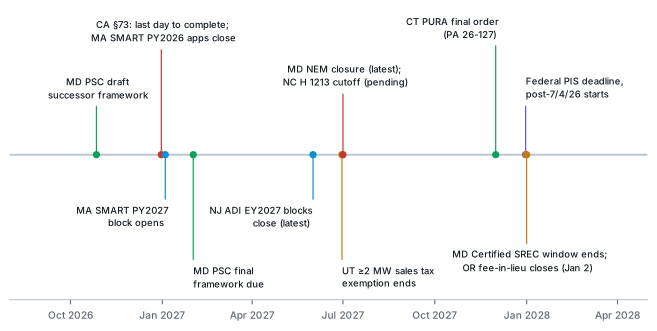
| Date | Jurisdiction | Milestone | Status |
|---|---|---|---|
| Oct 27, 2026 | Maryland | PSC draft framework for the net metering successor tariff (HB 1532) | Enacted law |
| Q4 2026 | Georgia | Georgia Power CARES CIR distributed-generation subscription window expected to open | Utility program |
| Dec 31, 2026 | California | Last day to complete a system and qualify for the R&T Code §73 new-construction exclusion; systems completed after Jan 1, 2027 do not qualify | Current law; AB 2389 held May 14, 2026 |
| Dec 31, 2026 | Massachusetts | SMART 3.0 PY2026 applications close | Program rule |
| Dec 31, 2026 | Federal | Domestic content threshold rises from 50% to 55% for later construction starts | Statute |
| Jan 4, 2027 | Massachusetts | SMART 3.0 PY2027 block (300 MW) opens | Program rule |
| Feb 1, 2027 | Maryland | PSC final net metering successor framework due | Enacted law |
| Feb–Apr 2027 | New Jersey | Annual CSI solicitation cycle (opens February, closes April, results May) | Program rule |
| June 1, 2027 | New Jersey | EY2027 net-metered ADI segments close if not filled earlier | BPU order |
| June 30, 2027 | Virginia | Solar-equipment sales tax exemption for public service corporations expires | Statute (§58.1-609.3) |
| June 30, 2027 | Utah | Sales tax exemption for alternative energy facilities of 2 MW or more (§59-12-104(55)) ends for purchases after this date | Statute |
| July 1, 2027 | Maryland | Retail net metering closes to new systems no later than this date (or earlier if the 3,000 MW cap is reached) | Enacted law (HB 1532) |
| July 1, 2027 | North Carolina | H 1213 would deny the 80% property tax exclusion to systems placed in service on or after this date | Pending: passed House Finance 12–8 (July 1, 2026); enactment not confirmed as of Oct 14, 2026 |
| 2027 session | Texas | Next legislative session; abatement and property tax bills expected to return | Calendar |
| Dec 1, 2027 | Connecticut | PURA final order on the NRES successor (Public Act 26-127); procurements and tariffs from Jan 1, 2028 | Enacted law |
| Dec 31, 2027 | Federal | Placed-in-service deadline for wind/solar facilities that began construction after July 4, 2026 | Statute (OBBBA) |
| Jan 1, 2028 | Maryland | Installation window for Brighter Tomorrow Certified SRECs ends (SB 669 / HB 990 extension not enacted) | Enacted law |
| Jan 2, 2028 | Oregon | County fee-in-lieu agreements for utility-scale solar close to new projects (Or. Laws 2015 ch. 571 repealed) | Statute |
As listed in the chart caption; state profiles in Sections 4–8.
ReferenceMethodology, Sources & Disclosures
Methodology
This guide was compiled by the SolarStock USA Research Desk from research conducted through October 14, 2026. Each fact was classified as verified — read on a primary source (statute, agency, court, IRS/Treasury, utility or program administrator) or on a named law-firm or trade publication citing the primary action, with a date — or unverified, meaning it rests only on a secondary aggregator, sources conflicted, or it is background knowledge not re-checked. Only verified items are stated as fact in this guide; unverified items are omitted or, in tables, marked n/c (not confirmed in primary sources as of October 2026). Where a value was searched for and not found, the guide says so rather than estimating.
Depth of coverage varied by state. The fifteen priority states (CA, TX, NJ, NY, MA, IL, MD, NC, FL, AZ, CO, MN, PA, VA, GA) and DC, CT, DE, OH, MI, ME, RI, WA, OR and NM were researched individually. The remaining states initially rested mainly on national datasets — DSIRE summary maps (April–May 2026), PACENation map data (page modified March 6, 2026) — and on two secondary comparison tables (one undated, one with data as of September 2024). Subsequent verification passes replaced most of those secondary items with statute or agency citations; where a line could not be confirmed it is omitted or marked n/c, and tiers that depend on unconfirmed inputs remain labelled provisional.
DSIRE per-state categories were read visually from the published summary map images; totals were verified. For states near a category boundary (NH, VT, OR, ID, NV, TX, NY), readers should confirm the classification against DSIRE program records.
Opportunity tiers
Tiers are a SolarStock USA Research assessment built on four criteria scored 0–2 — (A) state performance incentive open to C&I; (B) commercial export compensation; (C) sales and property tax relief for commercial projects; (D) market activity per SEIA/Wood Mackenzie — with Tier 1 at 6–8 points, Tier 2 at 4–5 and Tier 3 at 0–3. Tiers that depend on unverified inputs are labelled provisional. Tier badges in the profiles use green (Tier 1), blue (Tier 2), amber (Tier 3) and grey (provisional Tier 2 or 3). Tiers are editorial, not an official rating, and are not a recommendation regarding any project, jurisdiction or investment.
Sources
Primary regulatory
- Public Law 119-21 (One Big Beautiful Bill Act), signed July 4, 2025.
- IRS Notice 2025-42 (Aug 15, 2025); IRS Notice 2026-15 (Feb 2026); IRS Notice 2026-39 (June 10, 2026).
- IRS, §48E(h) Low-Income Communities Bonus Credit program page, irs.gov/node/125331 (updated July 27, 2026); DOE program summary (2024).
- IRS Publication 946 (2025), How to Depreciate Property; 26 U.S.C. §§48E(a)(2), 50(a), 168(e)(3)(B), 6417(d)(6)(D), 6662(m) (Cornell LII).
- IRS Internal Revenue Bulletins 2026-37 to 2026-42; IRS draft 2026 Form 3468 and Instructions (Sept 15, 2026).
- USDA Rural Development, REAP FAQ (Mar 31, 2026); Federal Register 91 FR 62600 (Oct 1, 2026), FR Doc. 2026-20178.
- NJ BPU, ADI Triennial Review order (May 21, 2026); NJ BPU, CSI Solicitation 3 awards order (Mar 4, 2026).
- NY Department of Taxation and Finance, TSB-A-20(46)S, TSB-M-15(5)S, RP-487 instructions; NYSERDA NY-Sun operating plan webinar (July 29, 2025).
- Massachusetts DOER, SMART 3.0 overview and PY27 draft annual report (Oct 2026); MA DLS, Clause 45 guidance (Jan 8, 2026).
- Maryland General Assembly: Tax-General §§11-207, 11-230; Tax-Property §§7-237, 7-242, 8-240; SB 669 and HB 990 (2026RS) legislation pages and fiscal note.
- Connecticut OLR report 2023-R-0214; Public Act 26-127 (HB 5340, 2026); CT DRS Special Notices SN 2007(7) and SN 2010(9.1).
- New Jersey: N.J.S.A. 54:32B-8.33 (via S1000, 2024); N.J.A.C. 18:24-26; Division of Taxation Form CRES.
- Rhode Island Gen. Laws §§44-18-30, 44-3-3, 44-5-3, 44-3-21; Maine 36 M.R.S. §1760 and MRS Property Tax Bulletin No. 29 (Dec 30, 2024); Vermont 32 V.S.A. §§9741, 3802, 3845 and 30 V.S.A. §8002; NH RSA 72:62; D.C. Code §§47-2005, 47-1508; 52 Pa. Code §75.13.
- Virginia Code §58.1-609.3 and Tax Commissioner ruling P.D. 18-112; NCDOR MEPLR 2010-0002 and SUPLR 2021-0016; SCDOR PLR 15-1 and S.C. Code Title 12 Ch. 37; KDOR KY-TAM-21-01; Tenn. Code §67-6-346 (TDEC/TDOR guidance); W. Va. Code §11-15-9; La. R.S. 47:1706; Fla. Admin. Code R. 25-6.065; GA DOR LR SUT-2020-04; ADOR 9B abatement form (2026).
- Rhode Island PUC Docket 25-52-REG prefiled testimony (Jan 2026); Maine Legislature LD 1777 summary.
- Code of Virginia §58.1-3660; NCGA fiscal note HFN1213v2 (June 30, 2026); UNC School of Government bill summary H 1213.
- Florida Statutes §196.182; UCF Florida Solar Energy Center energy policy page (Oct 14, 2025).
- Illinois Shines, Final 2026-27 REC prices and block capacity update (May–June 2026); Illinois General Assembly HB 5444 (104th GA).
- Minnesota LBO TERC solar energy systems summary (Oct 24, 2025); Minnesota Commerce community solar garden page.
- Texas Tax Code §11.27; Texas Legislature SB 1754 bill analysis (89R).
- Arizona Senate brief, Tax Incentives for Renewable Energy (2018); Arizona Commerce Authority solar sheet.
- C.R.S. 39-26-724; Colorado Division of Property Taxation renewable energy page.
- California BOE LTA 2024/031; BOE SB 710 analysis; CalMatters Digital Democracy, AB 2389.
- RCW 82.08.962 (RCW archive, 2023); Oregon Department of Energy, Solar + Storage Rebate page (2026).
- Southern Company / Georgia Power media release (June 25, 2026).
- Midwest: Ohio R.C. §§5739.02, 5727.75, 4928.64; Michigan Treasury RAB 2026-6 and MCL 211.1151 et seq.; Wis. Stat. §§77.54(56), 70.111(18), 79.04(6); Indiana DLGF memos (2022, 2025); ILGA HB 5444 bill status; Iowa Code §§423.3, 441.21, 422.11L; RSMo §§144.030, 137.100; Minn. Stat. §§272.02, 272.0295; N.D.C.C. chs. 57-02, 57-33.2, 57-39.2; SDCL 10-4-44, 10-35-17 to -19.1; Neb. Rev. Stat. §§77-202, 77-6203 and Reg-1-107; K.S.A. 79-201, 79-3606.
- Southwest, Mountain and West: Tex. Tax Code §151.318 and TLO SB 1754 history; A.R.S. §§42-5061, 42-5075, 42-14155 and ADOR code 538 notice; NM TRD 2025 Tax Expenditure Report; Utah Code §§59-12-102, 59-12-104; NRS ch. 701A; Oklahoma SB 237 (2026); I.C. 63-3502B, 63-602JJ; MCA 15-6-224; Wyoming Title 39 (2026); CDTFA Regulation 1525.4; WA DOR renewable generation excise tax (RCW 84.36.680, ch. 82.96); ORS ch. 307; Honolulu RPAD; Hawaii Act 24 (2026) and HI C-PACER; AS 29.45.050.
Market data
- SEIA/Wood Mackenzie, US Solar Market Insight 2025 Year in Review (Mar 2026), via seia.org and pv magazine USA (Mar 11, 2026).
- SEIA/Wood Mackenzie, Q3 2026 US Solar Market Insight, as reported by Mercom (Sept 11, 2026).
- DSIRE / NC Clean Energy Technology Center, detailed summary maps (Apr–May 2026).
- NC Clean Energy Technology Center, 50 States of Solar Q2 2026 executive summary (July 2026).
- PACENation, PACE programs map data (page modified Mar 6, 2026).
- SEIA, solar tax exemption counts (page modified May 9, 2025); SEIA depreciation page (modified May 14, 2026).
- S&P Global Commodity Insights, DC SREC market interview (Aug 10, 2026); Flett Exchange market specifications (DC, MD, MD-Certified).
Legal & tax analysis
- Steptoe, district court vacates IRS notice (June 9, 2026).
- Novogradac, compliance timeline for §§48E, 45Y, 45X (June 16, 2026); Novogradac court-rulings resource center.
- Clifford Chance, IRS Notice 2025-42 appeal deadline nears (Sept 4, 2026).
- Bracewell, big tax changes in the One Big Beautiful Bill Act (July 15, 2025).
- Eide Bailly, OBBB energy credits alert (2025) and transferability commentary (Feb 3, 2026).
- Holland & Knight (July 2026); Buchanan Ingersoll & Rooney; Troutman Pepper (Feb 20, 2026); Baker Tilly, Notice 2026-39.
- Whiteford, Virginia rooftop solar client alert (2026); Bricker & Eckler (2012); Greenbaum Rowe (NJ ADI); Davis Wright Tremaine (June 2010); Butler Snow (Nov 2022); Frost Brown Todd (Apr 2020); Aprio (Aug 2019); go-alliant (Aug 13, 2026); Haynes Boone (Sept 26, 2019); Stoel Rives (Feb 8, 2024); Frost Brown Todd (Indiana); Ezel (IL GIL summary).
Industry and secondary
- pv magazine USA: FEOC interim guidance (Feb 13, 2026); Dominion NEM 2.0 (May 4, 2026); NC H 1213 (July 2, 2026); Texas anti-solar bills (May 28, 2025); pv magazine, California net billing ruling (Mar 11, 2026).
- Solar Power World, Massachusetts SMART changes (June 2026); Rutgers Policy Lab, Garden State C-PACE (Aug 2026); MyChesCo (Aug 27, 2026).
- EnergySage state pages (MD; IL Sept 9, 2026; TX Sept 4, 2026; CA Oct 8, 2026); NuWatt state guides (NJ, PA, CT; 2026); SurgePV (June 30, 2026); solarips.com (Oct 12, 2026); Citizens Utility Board (2025); Michigan Chamber (June 2023); OpenEI (2015); New Project Media.
- SolarReviews state exemption table (undated) and Palmetto property tax table (data as of Sept 2024) — used for initial screening only; no item resting solely on these tables is stated as fact.
Limitations & assumptions
- Program values, capacity blocks and statuses are as of the dates cited and can be exhausted, revised or repealed without notice.
- The research budget did not allow every state to be checked against primary sources; a minority of jurisdictions still rely partly on secondary or unconfirmed sources for tax treatment (Chart 09).
- Several official pages could not be retrieved during research (NJ ADI program page, NYSERDA NY-Sun dashboard, a DSIRE program record, and one North Carolina news article); related items are omitted or marked n/c. Verification passes on October 14, 2026 checked the federal items and the tax lines for all 51 jurisdictions against statutes, revenue-department rulings and dated law-firm analysis; items that could not be confirmed are omitted or marked n/c.
- Net metering classifications refer to investor-owned utilities; municipal utilities and cooperatives often differ.
- The worked example in Section 2 is Illustrative and uses hypothetical cost and production inputs; it is not a forecast.
- Residential programs are covered only where they shape commercial economics.
About SolarStock USA Research
SolarStock USA Research is the analytical desk of SolarStock USA, the first live-inventory solar module platform in the United States, operated by Yulz Design LLC. SolarStock USA holds Tier 1 manufacturers' module inventory in U.S. warehouses in California, Georgia, New Jersey and Texas, with brands including Sunpro Power, JA Solar, Mission Solar, Waaree and ZN Shine. Research outputs reflect the desk's independent analytical view; they are not investment advice and do not constitute a solicitation.
About the Authors
Yuliani Llohis is the Founder and Chief Executive Officer of SolarStock USA. Previously, she built and led Zytech Solar USA — the US subsidiary of Spanish PV manufacturer Zytech Solar Group — for fifteen years, with full P&L responsibility for the American market across residential, commercial, and utility-scale segments. The SolarStock USA Research Desk synthesizes primary regulatory sources, third-party market data and manufacturer documentation into published research.
Disclaimer
Contact
solarstockusa.com · sales@solarstockusa.com · +1 (619) 638-5178
Republication
Short excerpts may be quoted with attribution to "SolarStock USA Research, State-by-State Solar Rebates & Incentives Guide, Q4 2026 Edition". Charts and tables may not be republished in full without prior written permission. Third-party data reproduced here remain subject to their publishers' terms.