
Domestic Content Compliance Playbook for Mid-Market Procurement
A step-by-step operational guide to documenting Domestic Content and MACR qualification for 1–20 MW projects — supplier vetting templates and audit-ready documentation patterns
Prepared for procurement officers, EPC executives, project developers and tax counsel. This guide does not constitute legal, tax, or investment advice. Readers should consult qualified counsel before making decisions based on this analysis.
Current as of 14 October 2026. Statutory and IRS guidance were read in primary form; court, trade and market items rely on named secondary sources. Nothing in this guide is legal, tax or accounting advice.
Part IExecutive Summary
For a mid-market solar buyer in late 2026, Domestic Content is no longer a stand-alone bonus calculation. Every project that begins construction in 2026 or later must also pass the Material Assistance Cost Ratio (MACR) test, which runs on the same IRS cost tables but asks a different question. The procurement file that proves one test should be built to prove the other.
This playbook is written for the 1–20 MW segment: commercial, industrial, community, municipal and small utility projects, where a single procurement officer or EPC often carries the whole documentation burden without a tax-equity investor's diligence team behind it. It sets out the rules as they stand on 14 October 2026, shows the arithmetic behind the IRS safe-harbor tables, and provides three working templates — a supplier vetting questionnaire, an audit-file checklist and an RFQ-to-return timeline — that counsel can adapt.
What changed since our Q2 2026 brief
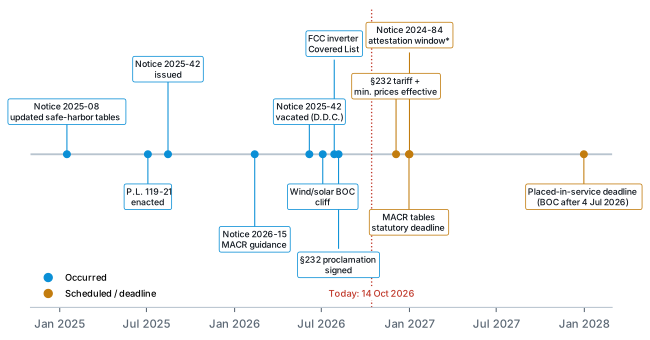
Notice 2025-42 was vacated on 6 June 2026. In Oregon Environmental Council v. IRS (D.D.C., No. 25-cv-4400), the court set aside Notice 2025-42 in full and nationwide, finding it arbitrary and capricious under the Administrative Procedure Act, and remanded it to the agency. The effect restored the Five Percent Safe Harbor for establishing beginning of construction for wind and solar projects of any size; the 1.5 MWac "low output solar facility" limit described in our Q2 brief no longer applies. The government's 60-day appeal window closed on 5 August 2026 without a notice of appeal (Clifford Chance, 4 September 2026), and as of 14 October 2026 we had identified no appeal, stay or extension. No replacement beginning-of-construction guidance appears through IRB 2026-42 or in the Federal Register through 14 October 2026, and the IRS's draft 2026 Form 3468 instructions treat the 5% safe harbor as available without a wind/solar size limit (see Section 1.4).
Notice 2026-15 (12 February 2026) is now the governing MACR guidance. It sets interim rules for the material-assistance test and three safe harbors (Identification, Cost Percentage and Certification), and it reuses the Notice 2025-08 Domestic Content tables as interim MACR tables.
Section 232 proclamation (signed 6 August 2026, effective 4 December 2026). A 15% additional tariff and minimum import prices on polysilicon and its derivatives, including $0.22/W for cells and $0.38/W for modules.
FCC inverter action (28 July 2026). Foreign-produced power inverters with remote-communication capability were added to the FCC Covered List, affecting new equipment authorizations only.
Correction to the Q2 2026 brief: its statements on the 1.5 MWac Five Percent Safe Harbor limit and the physical-work-only rule of Notice 2025-42 are superseded by the vacatur.
Conclusions
- The Domestic Content rules did not change in 2026; the threshold did. Notice 2023-38, as modified by Notices 2024-41 and 2025-08, still governs, and no proposed regulations have been published. Under §48E, the adjusted percentage is 50% for projects that begin construction during 2026 and 55% for starts after 31 December 2026. Material written in 2023–2025 that cites a 40% threshold should not be reused for current projects.
- Every 2026-start project now faces two cost-ratio tests built on one set of tables. Domestic Content is an optional bonus; the MACR test is a condition of claiming the credit at all, with a 40% facility threshold for 2026 starts and 45% for 2027 starts. Both run on the Notice 2025-08 tables, so a single bill-of-materials (BOM) file, tracking origin and producer for each listed component, should serve both.
- The 1 MWac line is the most important number for mid-market buyers. Below it, the full 10-point Domestic Content ITC bonus is available without meeting prevailing wage and apprenticeship (PWA) requirements, and the direct-pay haircut does not apply. Above it, a project that does not meet PWA earns only a 2-point bonus, and a direct-pay project that does not meet Domestic Content faces the haircut.
- For direct-pay buyers, Domestic Content is effectively mandatory at 1 MWac and above. For facilities that begin construction after 31 December 2025, the elective-payment applicable percentage for a non-compliant project of 1 MWac or more is 0%. The only alternative is the increased-cost or non-availability exception, attested under Notice 2024-84 for construction starts before the later of 1 January 2027 or further guidance.
- The Five Percent Safe Harbor is back, but the calendar has moved on. The vacatur restored the 5% method for establishing beginning of construction. Wind and solar facilities that begin construction after 4 July 2026 must be placed in service by 31 December 2027 to claim §48E, so for most new mid-market projects the operative constraint is now the placed-in-service deadline.
- A U.S.-assembled module with imported cells reaches at most about 23% of the ground-mount tracker table. That ceiling assumes every non-cell module component on the table is U.S.-made; the module's "Production" share is lost because a listed component (the cells) is foreign. Clearing 50% without U.S. cells requires U.S. trackers or racking as well, which lifts the computed maximum to 51.8%.
- A fully U.S. module with U.S. cells is worth 65.8% of the ground-mount tracker table on its own. Using the domestic-cell-and-wafer column, it is worth 73.4%. On fixed-tilt ground mounts the module carries 92.5% of the table. In these cases the module alone can clear 50% — but only if every listed module component is U.S.-made.
- Supplier paper is now regulated, and many letters in circulation do not meet the standard. MACR supplier certifications must carry the supplier's EIN, be signed under penalties of perjury and be retained for at least six years; suppliers face a §6695B penalty for inaccurate certifications provided after 31 December 2025. Manufacturer letters that disclaim tax reliance and omit the EIN and perjury statement do not satisfy that standard.
- Audit exposure has grown materially. For credits disallowed because the MACR was overstated, the substantial-understatement threshold falls from 10% to 1%; the IRS has six years to assess MACR errors; excessive direct payments and excessive credit transfers carry a 20% addition; and a 10-year, 100% recapture applies to certain effective-control payments on §48E property.
- Three dates belong on every mid-market procurement calendar. The §232 tariff and minimum import prices take effect on 4 December 2026; Treasury's statutory deadline for MACR safe-harbor tables is 31 December 2026, with interim reliance on the current tables ending 60 days after publication; and the Notice 2024-84 exception-attestation route runs to the later of 1 January 2027 or further guidance.
At a glance: thresholds and dates
| Item | 2025 starts | 2026 starts | 2027 starts | 2028 | 2029 | 2030+ |
|---|---|---|---|---|---|---|
| §48E Domestic Content adjusted % (manufactured products) | 40% before 16 Jun; 45% from 16 Jun | 50% | 55% | 55% | 55% | 55% |
| §45Y Domestic Content adjusted % | 45% (whole year) | 50% | 55% | 55% | 55% | 55% |
| Steel / iron (structural) | 100% U.S. processes | 100% | 100% | 100% | 100% | 100% |
| MACR — qualified facility (solar) | Not applicable | 40% | 45% | 50% | 55% | 60% |
| MACR — energy storage | Not applicable | 55% | 60% | 65% | 70% | 75% |
| Direct-pay applicable % (≥1 MWac, no Domestic Content, no exception) | 85% | 0% | 0% | 0% | 0% | 0% |
| Key date | Event |
|---|---|
| 4 Jul 2026 | Wind/solar construction-start cliff: later starts must be placed in service by 31 Dec 2027 |
| 4 Dec 2026 | §232 tariff (15%) and minimum import prices ($0.22/W cells; $0.38/W modules) take effect |
| 31 Dec 2026 | Statutory deadline for Treasury's MACR safe-harbor tables; interim reliance ends 60 days after publication |
| 1 Jan 2027 (or later guidance) | End of Notice 2024-84 attestation route for direct-pay cost / non-availability exceptions |
| 31 Dec 2027 | Placed-in-service deadline for wind/solar facilities that began construction after 4 Jul 2026 |
P.L. 119-21 §§70512–70513; 26 U.S.C. §§45Y(g)(11)–(12), 48E(a)(3)(B), 48E(e)(4); new §7701(a)(52); Notice 2024-84; Hunton (11 Aug 2026); Wiley (7 Aug 2026). Solar facilities that begin construction after 4 Jul 2026 must be in service by end-2027, so 2028+ MACR facility thresholds matter mainly for storage and non-solar technologies.
Section 1The rulebook in October 2026
Mid-market buyers are working under a guidance stack that is three years deep in places and nine months old in others. Knowing which document governs which question is the first compliance control.
1.1 The statutory map
The One Big Beautiful Bill Act (P.L. 119-21), enacted on 4 July 2025, rewrote the technology-neutral credits rather than repealing them. Section 70512 amended the §45Y production credit, §70513 amended the §48E investment credit and §70514 amended the §45X manufacturing credit. Three of those amendments matter most for procurement.
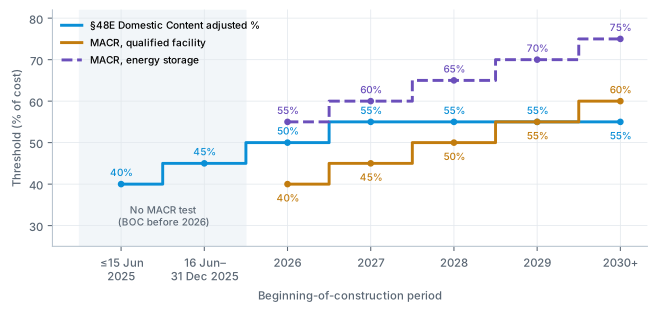
First, the Domestic Content bonus thresholds were re-stepped. Under §48E(a)(3)(B), the adjusted percentage that applies to manufactured products is 40% for projects that began construction before 16 June 2025, 45% from 16 June through 31 December 2025, 50% during 2026 and 55% thereafter. The §45Y schedule reaches the same 50% and 55% figures, but its break point between 40% and 45% is 1 January 2025 rather than 16 June 2025 — a detail worth noting for anyone reconciling legacy PTC files.
Second, a "prohibited foreign entity" (PFE) regime was added. New §7701(a)(51) defines specified foreign entities and foreign-influenced entities; new §7701(a)(52) defines the Material Assistance Cost Ratio and its thresholds. Under §48E(b), the material-assistance disallowance applies to facilities whose construction begins after 31 December 2025.
Third, wind and solar received a terminal date. Under §48E(e)(4), the credit does not apply to wind or solar facilities placed in service after 31 December 2027 if construction began more than twelve months after enactment — that is, after 4 July 2026. Energy storage placed in service at such a facility is excepted from this termination.
The underlying Domestic Content mechanics remain in §45(b)(9), incorporated by reference: the taxpayer certifies that steel, iron and manufactured products that are components of the facility at completion were produced in the United States, applying the Buy America rules of 49 CFR Part 661. Steel and iron follow the 100% standard of 49 CFR 661.5; manufactured products are deemed domestic if at least the adjusted percentage of their total cost is attributable to U.S.-mined, produced or manufactured components.
1.2 The guidance stack
| Document | Released | What it governs | Status, 14 Oct 2026 |
|---|---|---|---|
| Notice 2023-38 | 12 May 2023 | Core Domestic Content rules: steel/iron and manufactured-products requirements, adjusted-percentage rule, certification, substantiation | In force; applies until 90 days after proposed regulations (none published) |
| Notice 2024-41 | May 2024 (corrected 24 May 2024) | Renamed project types; created the first elective safe harbor (DOE-derived cost tables) | Safe harbor closed to construction starts after ~mid-April 2025 |
| Notice 2025-08 | 16 Jan 2025 | First Updated Elective Safe Harbor: ground-mount and rooftop PV tables, including domestic-cell-and-wafer columns | In force; no modification or withdrawal |
| Notices 2024-9 and 2024-84 | 2024 | Direct-pay haircut exceptions; attestation route for increased-cost and non-availability exceptions | Attestation route runs to the later of 1 Jan 2027 or further guidance |
| Notice 2025-42 | 15 Aug 2025 | Beginning of construction for wind/solar (limited the 5% safe harbor) | Vacated 6 Jun 2026; no appeal filed by the 5 Aug deadline; no appeal or replacement guidance identified as of 14 Oct 2026 |
| Notice 2026-15 | 12 Feb 2026 | Interim MACR rules; Identification, Cost Percentage and Certification safe harbors | In force (interim); proposed regulations and MACR tables still pending |
| Form 3468 instructions (2025) | Last reviewed 28 Aug 2026 | Domestic Content checkbox (Part I, line 9a–9c), certification statement contents, elective-pay Line 8 | Draft 2026 Form 3468 (created 27 Jul 2026) and draft 2026 instructions (15 Sep 2026) posted; final versions not yet released |
IRS Notices 2023-38, 2024-41, 2024-84, 2025-08, 2025-42, 2026-15; Internal Revenue Bulletins 2026-02 to 2026-42; Instructions for Form 3468 (2025); draft Form 3468 (2026) and draft instructions (15 Sep 2026); Federal Register API (to 14 Oct 2026); Clifford Chance (4 Sep 2026).
1.3 What did not happen in 2026
The absence of guidance is itself a planning fact. Our full-text scan of Internal Revenue Bulletins 2026-02 through 2026-42, and a Federal Register query of IRS documents published since 1 January 2026, found:
- No new Domestic Content notice, proposed regulation or updated table. The only 2026 IRS references to domestic content are cross-references in Notice 2026-37 (§45 inflation factors) and Notice 2026-39 (energy communities).
- No MACR-specific safe-harbor tables. The statute requires Treasury to publish them by 31 December 2026.
- No proposed PFE regulations for §§45Y, 48E or 45X. The only 2026 PFE proposed rule in the Federal Register relates to the §45Z clean fuel credit (4 February 2026).
The practical consequence is stability for the remainder of 2026: a project file built today on Notice 2023-38 and the Notice 2025-08 tables rests on guidance that has been in place since January 2025. The risk sits in 2027, when MACR tables and PFE regulations are expected and may diverge from the Domestic Content tables.
1.4 What did happen
The vacatur of Notice 2025-42. Notice 2025-42, issued on 15 August 2025 following Executive Order 14315, had removed the Five Percent Safe Harbor for wind and solar facilities except "low output" solar facilities of 1.5 MWac or less, for projects that had not begun construction before 2 September 2025. On 6 June 2026 the District Court for the District of Columbia vacated the notice nationwide. Practitioner summaries report that the court found the change in policy inadequately explained, reliance interests unconsidered and the different treatment of wind and solar unjustified. After vacatur, the prior framework — Notices 2013-29 and 2018-59, and Notice 2022-61 for §§45Y/48E — again offers either the Physical Work Test or the 5% safe harbor, plus the continuity requirement. The statutory 4 July 2026 cliff was unaffected. According to Clifford Chance (4 September 2026), no notice of appeal was filed within the 60-day window that closed on 5 August 2026, and any motion to extend the appeal deadline was due by 4 September 2026. As of 14 October 2026, we had identified no appeal, stay or extension in published reports. Treasury has not issued replacement guidance: none appears in Internal Revenue Bulletins through IRB 2026-42 or in the Federal Register through 14 October 2026, and the IRS's draft 2026 Form 3468 instructions (15 September 2026) describe the physical work test and the 5% safe harbor as available methods without a wind/solar limitation.
For projects that began construction between 2 September 2025 and 6 June 2026, many developers relied on physical work alone. Practitioners recommend documenting both tests where the facts allow.
Notice 2026-15. Released on 12 February 2026 (IR-2026-23) and published at 2026-11 I.R.B. 658, the notice supplies the working rules for MACR. It is discussed in Section 3.
Trade measures. The §232 proclamation on polysilicon and its derivatives and the FCC's inverter action are not tax rules, but both push sourcing decisions toward U.S.-made cells and inverters — the same components that carry the most weight in Domestic Content arithmetic.
Why 1–20 MW is different
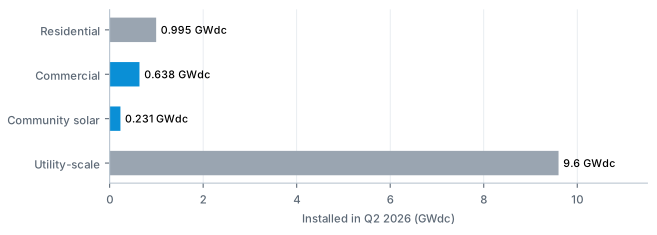
Mid-market projects sit across several statutory lines at once. A 0.9 MWac rooftop and a 1.2 MWac carport may be procured by the same buyer from the same supplier, yet face different bonus values, different labour requirements and different direct-pay outcomes.
- The 1 MWac line sets whether the 10-point bonus requires PWA, and whether the direct-pay haircut applies.
- Elective pay is common among municipal, school, tribal and non-profit buyers in this size range, which makes the 0% haircut a first-order risk.
- The restored 5% safe harbor is available regardless of size, removing the 1.5 MWac distinction that Notice 2025-42 had created.
- Thin internal teams mean the procurement officer often owns the evidence trail that, on utility projects, a tax-equity investor's counsel would build.
Section 2Thresholds, timing and what the bonus is worth
Three dates fix a project's compliance targets: the beginning-of-construction date sets the thresholds, the placed-in-service date fixes when compliance is measured, and the filing date starts the assessment clock.
2.1 The adjusted-percentage schedule
The Domestic Content test has two limbs. The steel or iron requirement is binary: every structural steel or iron construction material must be produced entirely in the United States. The manufactured products requirement is a ratio: the Domestic Cost Percentage of all manufactured products must meet the adjusted percentage for the project's construction-start year — 50% for 2026 starts under §48E, and 55% for starts after 31 December 2026.
The MACR schedule rises more steeply but starts lower. For qualified facilities, the threshold is 40% for 2026 construction starts, rising by five points each year to 60% for starts after 2029. Energy storage starts at 55% and reaches 75%. For §45X component manufacturers, the thresholds for solar components run from 50% for 2026 sales to 85% after 2029, and for inverters from 50% to 70%.
2.2 The steel and iron rule: narrower than it looks
The 100% steel/iron standard applies only to applicable project components that are construction materials made primarily of steel or iron and structural in function. Under Notice 2023-38, for a ground-mount PV system that means steel module racking (fixed tilt), piles or ground screws and reinforcing steel in foundations. It does not reach steel incorporated inside a manufactured product — the steel in a tracker's torque tube, for example, is tested as part of the tracker under the manufactured-products ratio — and non-structural items such as nuts, bolts, clamps and covers are excluded.
The steel/iron test is satisfied only if all manufacturing processes, from initial melting through coating, take place in the United States, with an exception for metallurgical processes that refine steel additives. Mill certificates and fabricator attestations are the usual evidence.
Open point: steel rooftop racking
The Notice 2025-08 rooftop tables list only "non-steel roof racking" as a manufactured product. How steel rooftop racking should be classified — as a steel/iron item or as a manufactured product outside the table — is not addressed. Buyers specifying steel rooftop systems should obtain counsel's view before relying on the safe harbor.
2.3 Beginning of construction after the vacatur
Beginning of construction (BOC) can be established by either method under the pre-2025 framework:
- Physical Work Test: physical work of a significant nature, on-site or off-site under a binding written contract.
- Five Percent Safe Harbor: paying or incurring at least 5% of the total cost of the facility.
Either way, the taxpayer must then show continuous progress. The continuity safe harbor is met if the facility is placed in service by the end of the fourth calendar year after the year construction began; a 2026 start therefore runs to 31 December 2030 — but for wind and solar, the statutory 31 December 2027 placed-in-service deadline overrides that for any start after 4 July 2026.
BOC for PFE purposes follows rules similar to Notices 2013-29 and 2018-59 as in effect on 1 January 2025, by statute. Notice 2026-15 confirms that Notice 2025-42 never applied to PFE beginning of construction.
2.4 What the bonus is worth
For the §48E investment credit, the Domestic Content bonus adds 10 percentage points if the project meets the PWA requirements of §48(a)(9)(B), and 2 points otherwise. The IRS explains that the 10-point increase applies where the project is under 1 MW, began construction before 29 January 2023, or meets PWA. For the §45Y production credit, the bonus is 10% of the credit amount.
A simple way to frame the procurement decision is to translate the bonus into dollars against the credit-eligible basis, and compare that against the price premium for compliant equipment and the cost of documentation.
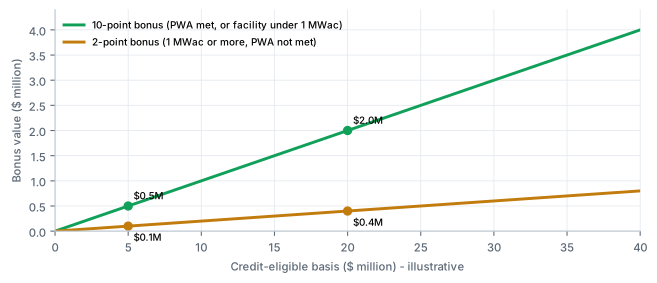
On a hypothetical $5 million eligible basis, the 10-point bonus is worth $500,000 and the 2-point bonus $100,000. On a $20 million basis, the figures are $2.0 million and $0.4 million. For a project of 1 MWac or more that does not meet PWA, the 2-point bonus rarely justifies the documentation effort on its own; the decision then turns on whether the buyer needs Domestic Content to avoid the direct-pay haircut (Section 5).
Section 3Domestic Content and MACR: same tables, different question
Domestic Content asks whether a component was made in the United States. MACR asks whether it was made by a prohibited foreign entity. A component can pass one test and fail the other — and a project must pass MACR before the Domestic Content bonus means anything.
3.1 How the Domestic Cost Percentage is calculated
Under Notice 2023-38, a manufactured product is a U.S. Manufactured Product if all of its manufacturing processes take place in the United States and all of its manufactured product components (MPCs) are of U.S. origin. An MPC is of U.S. origin if it is manufactured in the United States, regardless of where its own subcomponents came from. This is the "one level down" rule: a U.S.-made junction box counts as domestic even if its diodes are imported.
The Domestic Cost Percentage is the ratio of domestic manufactured products and components cost to total manufactured products cost. Under the actual-cost method, costs are the manufacturer's direct materials and direct labour, not the price the buyer paid, and installation labour is excluded. Notice 2023-38's own example arrives at 60% ($180 of $300). Because few module manufacturers will release direct-cost data, most mid-market buyers rely instead on the elective safe-harbor tables discussed in Section 4.
"United States" for this purpose includes the 50 states, the District of Columbia, Puerto Rico, Guam, American Samoa, the U.S. Virgin Islands and the Northern Mariana Islands.
3.2 Who is a prohibited foreign entity
A PFE is either a specified foreign entity (SFE) or a foreign-influenced entity (FIE). Notice 2026-15 summarizes the SFE categories as:
- foreign entities of concern under NDAA §9901(8);
- Chinese military companies on the DoD 1260H list;
- entities on the UFLPA Entity List;
- entities designated under FY2024 NDAA §154(b);
- foreign-controlled entities, including agencies or instrumentalities of covered-nation governments.
An entity is foreign-influenced during a taxable year if any of the following holds:
- an SFE has direct authority to appoint a covered officer;
- a single SFE owns at least 25% of it;
- SFEs in aggregate own at least 40%;
- at least 15% of its debt is issued to SFEs;
- in the previous taxable year, it made payments to an SFE under an arrangement giving the SFE effective control.
Modified rules apply to publicly traded entities.
The interim effective-control definition in Notice 2026-15 covers unrestricted contractual rights to set production, dispatch or offtake, to restrict data or site access, or to perform operations and maintenance exclusively. It also lists IP licensing indicators, including any licence entered into or modified on or after 4 July 2025. The notice illustrates that royalty payments to an SFE under such a licence for the facility can make the taxpayer itself a foreign-influenced entity.
3.3 The Clean Electricity MACR in five steps
Notice 2026-15 defines the Clean Electricity MACR as total direct costs minus PFE total direct costs, divided by total direct costs. It covers manufactured products and MPCs incorporated into the facility on completion; steel and iron items are disregarded unless they are themselves manufactured products or components. In practice:
- Identify the manufactured products and MPCs incorporated at completion.
- Assign costs, either actual direct costs or table percentages under the safe harbors.
- Determine the producer of each item — the entity that mined, produced or manufactured it, not a reseller.
- Test PFE status of each producer for its taxable year that includes the date the taxpayer paid or incurred the cost (for accrual taxpayers, when the item is provided). An item paid for in 2026 and placed in service in 2027 is tested on the producer's 2026 status.
- Compute and compare the ratio to the threshold for the facility's BOC year.
Two simplifications help mid-market buyers. A 10% de minimis rule removes the need to track individual items of the same type whose total direct costs are below 10% of the facility's total direct costs. And the safe harbors allow the Notice 2025-08 tables to stand in for actual costs.
Notice 2026-15 also notes that qualified interconnection property needs its own MACR. Failing that test removes only the interconnection costs from the credit base; a facility that fails its MACR loses the whole credit.
3.4 The three MACR safe harbors
| Safe harbor | What it does | Limits |
|---|---|---|
| Identification | Uses the "2023–2025 Safe Harbor Tables" (Notice 2025-08 tables, plus 2024-41 hydro and 2023-38 offshore wind) to define the exclusive list of items to track | Facility type must appear in the tables; unlisted and unused items and steel/iron rows disregarded; not for qualified interconnection property |
| Cost Percentage | Assigns the table percentages as costs; taxpayer tracks only whether each listed item was PFE-produced | Requires the Identification safe harbor; not for Incremental Production Rule facilities |
| Certification | Allows reliance on supplier certifications of non-PFE status or of non-PFE direct costs | Certification must meet statutory content; no reliance if the taxpayer knows or has reason to know it is inaccurate |
Notice 2026-15 §§4.01–4.03, 8.02.
A taxpayer using any of these safe harbors must attach a statement to the return for the first credit year that names the safe harbor, identifies the table used and explains how it was applied.
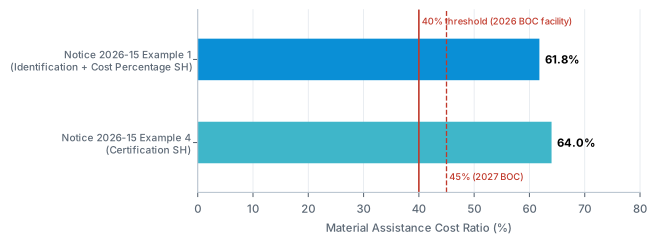
Notice 2026-15's Example 1 is instructive for buyers of imported modules. Where the only PFE-produced item is the cells (38.0% of the ground-mount tracking table) and bypass diodes are unused (0.4%, removed from the denominator), the MACR is (99.6 − 38.0) ÷ 99.6 = 61.8%. In other words, a facility can comfortably pass MACR while scoring zero on Domestic Content — the two tests are genuinely independent.
3.5 Side by side
| Dimension | Domestic Content | MACR / PFE |
|---|---|---|
| Question asked | Was the item made in the U.S.? | Was the item produced by a prohibited foreign entity? |
| Consequence | Bonus (10 or 2 points ITC; 10% PTC); avoids direct-pay haircut | Condition of the credit: fail and the whole credit is disallowed |
| Applies to | All BOC dates (thresholds vary) | Facilities beginning construction after 31 Dec 2025 |
| 2026 / 2027 threshold | 50% / 55% (§48E) | 40% / 45% (facility); 55% / 60% (storage) |
| Steel / iron | Separate 100% test for structural items | Disregarded unless an MP or MPC |
| Tables | Notice 2025-08 (elective safe harbor) | Same tables, as interim Identification / Cost Percentage safe harbors |
| Measured as of | Placed-in-service date | Producer's taxable year that includes the payment date |
| Supplier paper | No prescribed form; evidence supporting taxpayer certification | Statutory certification: EIN, penalties of perjury, 6-year retention |
| Return attachment | Domestic Content Certification Statement | Safe-harbor statement plus supplier certifications |
| Specific penalty regime | None beyond general rules (perjury declaration) | §6662(m) 1% threshold; §6501(o) 6-year assessment; §6695B supplier penalty |
Notice 2023-38; Notice 2025-08; Notice 2026-15; P.L. 119-21 §70512.
Section 4The safe-harbor tables, explained with arithmetic
For most 1–20 MW buyers, the Notice 2025-08 tables are the Domestic Content calculation. They replace manufacturer cost data with fixed percentages, so the buyer's task becomes proving origin, row by row. The arithmetic below shows where the weight sits — and how quickly a compliant-looking BOM can fall short.
4.1 How the elective safe harbor works
Notice 2025-08 (released 16 January 2025) created the First Updated Elective Safe Harbor. It provides cost-percentage tables for ground-mount PV (tracking and fixed) and rooftop PV (module-level power electronics, "MLPE", and string inverter). Each table has a standard column and a "domestic c-Si cells and domestic wafers" column. The rules that govern their use are strict:
- Exclusive and exhaustive. Only the listed applicable project components (APCs) and MPCs count. Unlisted items are disregarded and cannot add to the percentage.
- Unused rows score zero. A listed item the project does not use is valued at zero for Domestic Content.
- No partial reliance. The whole table section for the project type must be used. A taxpayer must use either the Notice 2024-41 or the Notice 2025-08 safe harbor, not a mix.
- "Production" is conditional. Each manufactured product has a "Production" row. It is not an MPC, and its percentage counts only if all listed MPCs of that product are U.S.-produced. Unlisted MPCs do not block it.
- Mixed sources are weighted by nameplate. Where an item comes partly from U.S. and partly from foreign sources, a capacity-weighted formula applies; items without nameplate (such as trackers) use the capacity of the modules directly integrated with them. If a single component has both foreign and domestic units integrated with it, all are treated as foreign.
- Election on the certification statement. The Domestic Content Certification Statement must state reliance on the safe harbor.
The safe harbor applies to construction starts from 16 January 2025 until 90 days after any modification or withdrawal; none had occurred as of 14 October 2026. Note that the notice's own examples use 100 MWdc projects tested at a 40% threshold, which predates the OBBBA schedule — the 2026 threshold is 50%.
4.2 The ground-mount table
| APC | MPC | Tracking | Tracking DCW | Fixed | Fixed DCW |
|---|---|---|---|---|---|
| PV module | Cells | 38.0 | 51.6 | 53.2 | 66.6 |
| Frame / backrail | 6.0 | 4.7 | 8.5 | 6.1 | |
| Front glass | 6.0 | 4.7 | 8.4 | 6.1 | |
| Encapsulant | 3.8 | 3.0 | 5.4 | 3.8 | |
| Backsheet / backglass | 3.8 | 3.0 | 5.4 | 3.8 | |
| Junction box | 1.0 | 0.8 | 1.4 | 1.0 | |
| Edge seals | 0.3 | 0.2 | 0.4 | 0.3 | |
| Pottants | 0.3 | 0.2 | 0.4 | 0.3 | |
| Bus ribbons | 1.5 | 1.2 | 2.1 | 1.5 | |
| Bypass diodes | 0.4 | 0.3 | 0.6 | 0.4 | |
| Production | 4.7 | 3.7 | 6.7 | 4.8 | |
| Module subtotal | 65.8 | 73.4 | 92.5 | 94.7 | |
| Inverter | PCB assemblies | 2.4 | 1.7 | 3.1 | 2.2 |
| Electrical parts | 0.8 | 0.6 | 1.1 | 0.8 | |
| Thermal management | 0.5 | 0.4 | 0.7 | 0.5 | |
| Enclosure & skids | 0.6 | 0.5 | 0.9 | 0.6 | |
| Production | 1.2 | 0.9 | 1.7 | 1.2 | |
| Inverter subtotal | 5.5 | 4.1 | 7.5 | 5.3 | |
| PV tracker | Torque tube | 11.0 | 8.6 | – | – |
| Structural fasteners | 0.4 | 0.3 | – | – | |
| Drive system | 1.9 | 1.5 | – | – | |
| Dampers | 0.5 | 0.4 | – | – | |
| Actuator | 2.8 | 2.2 | – | – | |
| Controller | 0.7 | 0.6 | – | – | |
| Rails | 2.0 | 1.6 | – | – | |
| Production | 9.4 | 7.3 | – | – | |
| Tracker subtotal | 28.7 | 22.5 | 0 | 0 | |
| Steel module racking (fixed); piles / ground screws; foundation rebar | Steel/iron items — 100% test, outside the ratio | ||||
IRS Notice 2025-08 §5.05 (extracted from the notice PDF; footnote markers removed). DCW = domestic c-Si cells and domestic wafers column. Each column sums to 100.0. Subtotals computed by SolarStock USA Research and cross-checked against Notice 2026-15 Example 1, which states 65.8% / 5.5% / 28.7% for the tracking column.
4.3 The rooftop table
| APC | MPC | MLPE | MLPE DCW | String | String DCW |
|---|---|---|---|---|---|
| PV module | Cells | 31.1 | 43.9 | 38.5 | 52.1 |
| Frame / backrail | 4.9 | 4.0 | 6.1 | 4.8 | |
| Front glass | 4.9 | 4.0 | 6.1 | 4.7 | |
| Encapsulant | 3.1 | 2.5 | 3.9 | 3.0 | |
| Backsheet / backglass | 3.1 | 2.5 | 3.9 | 3.0 | |
| Junction box; edge seals; pottants | 1.2 | 1.0 | 1.6 | 1.2 | |
| Bus ribbons; bypass diodes | 1.5 | 1.3 | 1.9 | 1.5 | |
| Production | 5.8 | 4.7 | 7.2 | 5.6 | |
| Module subtotal | 55.6 | 63.9 | 69.2 | 75.9 | |
| Inverter / MLPE | PCB assemblies (DC-DC) | 7.8 | 6.4 | 1.6 | 1.3 |
| PCB assemblies (DC-AC) | 11.8 | 9.5 | 2.4 | 1.9 | |
| Thermal mgmt; enclosure | 4.3 | 3.5 | 1.8 | 1.4 | |
| Production | 0.9 | 0.7 | 0.5 | 0.4 | |
| Inverter subtotal | 24.8 | 20.1 | 6.3 | 5.0 | |
| Non-steel roof racking | Structural fasteners | 3.5 | 2.9 | 4.4 | 3.4 |
| Rails | 15.0 | 12.2 | 18.7 | 14.6 | |
| Production | 1.1 | 0.9 | 1.4 | 1.1 | |
| Racking subtotal | 19.6 | 16.0 | 24.5 | 19.1 |
IRS Notice 2025-08 §5.06. Small rows combined for space (each listed separately in the notice; the MLPE column has no thermal-management row). Subtotals computed by SolarStock USA Research.
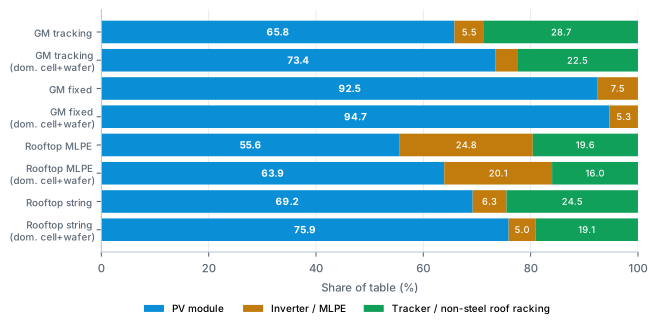
Three structural features stand out. On fixed-tilt ground mounts, the module is effectively the whole calculation (92.5%), because steel racking sits outside the ratio. On tracker projects, the tracker carries nearly 29% — more than any single module component other than cells. And on MLPE rooftops, the inverters and optimizers carry 24.8%, which makes U.S.-made MLPE a meaningful lever for commercial rooftop buyers.
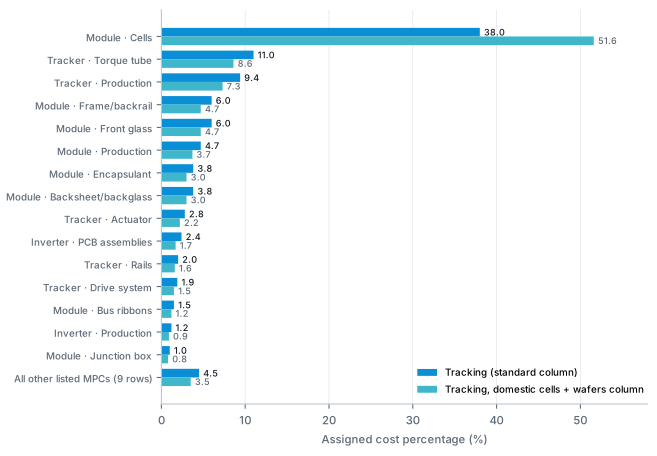
4.4 Worked arithmetic: how far a module gets you
The scenarios below apply the ground-mount tracking column. Each assumes every named item is U.S.-made and every other item is foreign. They are maximums under each scenario, not typical outcomes.
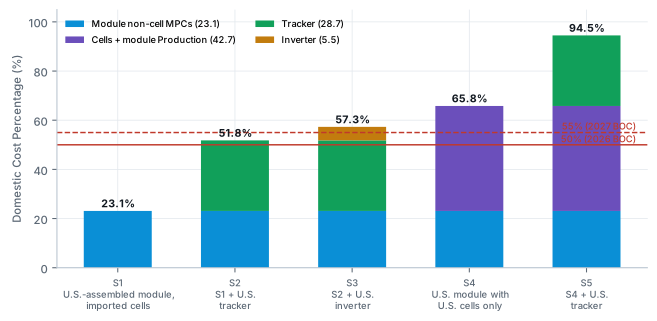
Scenario S1 — U.S.-assembled module, imported cells
Non-cell module MPCs, all assumed U.S.-made: frame 6.0 + glass 6.0 + encapsulant 3.8 + backsheet 3.8 + junction box 1.0 + edge seals 0.3 + pottants 0.3 + bus ribbons 1.5 + bypass diodes 0.4 = 23.1%.
Module "Production" (4.7) does not count, because a listed MPC — the cells — is foreign. Cells (38.0) are foreign. Result: 23.1%, well short of 50%.
Scenario S2 — S1 plus a U.S. tracker
Tracker, all MPCs U.S.-made: torque tube 11.0 + fasteners 0.4 + drive 1.9 + dampers 0.5 + actuator 2.8 + controller 0.7 + rails 2.0 + Production 9.4 = 28.7. Total: 23.1 + 28.7 = 51.8% — clears 50% for a 2026 start by 1.8 points, but not 55% for 2027.
Scenario S3 — S2 plus a U.S. inverter
51.8 + 5.5 = 57.3%.
Scenario S4 — fully U.S. module with U.S. cells (foreign wafers), nothing else U.S.
23.1 + cells 38.0 + Production 4.7 = 65.8%. With U.S. cells on U.S. wafers and the domestic-cell-and-wafer column elected, the module subtotal becomes 73.4%.
Scenario S5 — S4 plus a U.S. tracker
65.8 + 28.7 = 94.5%.
COMPUTED by SolarStock USA Research from IRS Notice 2025-08 §5.05 tracking column. Illustrative; assumes full documentation of U.S. origin for every counted row.
4.5 The same scenarios across project types
| Scenario (each assumes every named item is U.S.-made) | GM tracking | GM fixed | Roof MLPE | Roof string |
|---|---|---|---|---|
| S1: U.S.-assembled module, imported cells (no Production credit) | 23.1 | 32.6 | 18.7 | 23.5 |
| S2: S1 + U.S. tracker / roof racking | 51.8 | 32.6 | 38.3 | 48.0 |
| S3: S2 + U.S. inverter / MLPE | 57.3 | 40.1 | 63.1 | 54.3 |
| S4: fully U.S. module incl. U.S. cells (foreign wafers), nothing else | 65.8 | 92.5 | 55.6 | 69.2 |
| S5: S4 + U.S. tracker / racking | 94.5 | 92.5 | 75.2 | 93.7 |
COMPUTED by SolarStock USA Research from Notice 2025-08 standard columns. Fixed-tilt projects must separately meet the 100% steel/iron test for racking, piles and foundation steel.
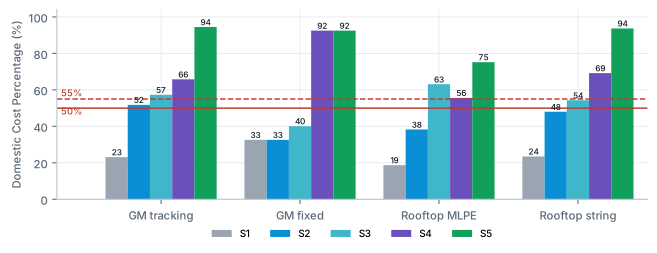
Read across, the grid gives a clear procurement rule. Without U.S. cells, a fixed-tilt ground mount cannot reach 50% under the safe harbor at all — the ceiling is 40.1% even with a U.S. inverter. A string rooftop reaches 54.3% only if module materials, racking and inverter are all U.S.-made. A tracker project can clear 50% without U.S. cells only by combining U.S. module materials with a U.S. tracker, with less than two points to spare. With U.S. cells, the module carries ground-mount projects across the line on its own.
4.6 How a compliant-looking BOM erodes
The commonest gap in real BOMs is not the cell but the commodity materials — glass, encapsulant and backsheet are often imported even for U.S.-assembled modules. Each foreign MPC subtracts its own row and removes the module's Production share.
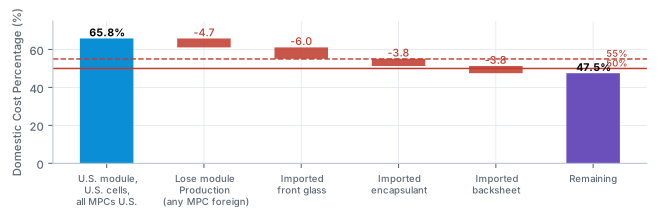
In this illustration, a module with U.S. cells but imported glass, encapsulant and backsheet scores 47.5% — below the 2026 threshold — and the project would need a U.S. tracker to recover. The lesson for the RFQ is that "U.S. cells" is a necessary question but not a sufficient one: every listed MPC needs an origin answer.
4.7 The domestic cell-and-wafer columns
The DCW columns are available only if all or part of the modules use U.S. c-Si cells made exclusively from U.S. wafers. If a project elects them, it must use them for every item, and any U.S. cells made on foreign wafers must be treated as foreign — which also strips those modules of the Production share. The DCW columns reward a fully domestic cell chain (cells rise from 38.0% to 51.6% in the tracking column). No guidance specifies the evidence standard for tracing U.S. wafers to cell lots; this is an open question (Section 13).
4.8 A note on the MACR reading of the same tables
When the same tables are used for MACR under Notice 2026-15, two conventions differ from Domestic Content. Listed-but-unused items are disregarded — removed from the denominator — rather than valued at zero, which is why Example 1 divides by 99.6 rather than 100. And steel/iron rows are disregarded entirely. A single workbook can serve both tests, but it needs two calculation tabs.
Section 5Direct pay (§6417) for public-sector and tax-exempt buyers
For a municipality, school district, tribal government or non-profit building a 2026-start project of 1 MWac or more, Domestic Content is not a bonus. Without it — or a documented exception — the direct payment is zero.
5.1 The haircut schedule
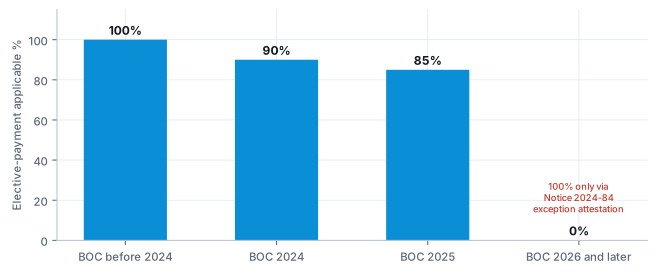
Under §45Y(g)(12), applied to §48E through §48E(d)(5), the elective-payment "applicable percentage" is 100% if the facility meets Domestic Content or has a maximum net output under 1 MWac. Otherwise the percentage steps down by construction-start year: 90% for 2024 starts, 85% for 2025 starts and 0% for facilities that begin construction after 31 December 2025.
5.2 The two exceptions
The statute sets the applicable percentage back to 100% if either exception applies:
- Increased cost: using domestic steel, iron or manufactured products would increase the overall cost of construction of the facility by more than 25%.
- Non-availability: the relevant products are not produced in the United States in sufficient and reasonably available quantities or of a satisfactory quality.
Notice 2024-84 extended the attestation route originally set out in Notice 2024-9. The applicable entity attests, under penalties of perjury, that it reviewed both exceptions and made a good-faith determination that one applies. The attestation must be signed by a person with authority to bind the entity in federal tax matters, attached to Form 3468 (or Form 8835), and supported by records kept under §6001. The route is available for facilities that begin construction before the later of 1 January 2027 or the date of further guidance.
Planning point for 2027 starts
Absent further guidance, a direct-pay entity beginning construction in 2027 may not have the attestation route. Its options would be to meet the 55% Domestic Content threshold, keep the facility under 1 MWac, or rely on the statutory exceptions without the simplified attestation. What procedure will apply is an open question (Section 13).
5.3 Illustrative outcome
| Illustrative facility (all 2026 BOC, direct pay) | Domestic Content met? | Exception attested? | Applicable % |
|---|---|---|---|
| 0.9 MWac school rooftop | No | No | 100% |
| 3 MWac municipal ground mount | Yes (≥50%) | Not needed | 100% |
| 3 MWac municipal ground mount | No | Yes (Notice 2024-84) | 100% |
| 3 MWac municipal ground mount | No | No | 0% |
Illustrative, SolarStock USA Research, applying 26 U.S.C. §45Y(g)(12) and Notice 2024-84. Facility sizes are hypothetical. MACR must be met in every case for the credit to exist at all.
5.4 Other direct-pay considerations
- Pre-filing registration. Elective payment (and transfer) requires an IRS pre-filing registration number, which goes into the Domestic Content certification and the audit file.
- Excessive payments. Under §6417(d)(6), an excessive direct payment must be repaid with a 20% addition unless reasonable cause applies; the provision now explicitly covers excessive payments arising from a MACR disallowance.
- The MACR still applies. A tax-exempt entity is not exempt from the material-assistance test. A failed MACR means no credit, and therefore no direct payment.
- Transfer is not a workaround. Taxable owners can sell credits under §6418, but transfers to specified foreign entities are prohibited, and an excessive credit transfer is recaptured from the transferee with a 20% addition.
Section 6The playbook: from RFQ to tax return
Domestic Content is certified as of the placed-in-service date, and MACR is tested on the producer's status in the year of payment. Evidence created after delivery is weaker than evidence collected at the purchase order. The sequence below front-loads it.
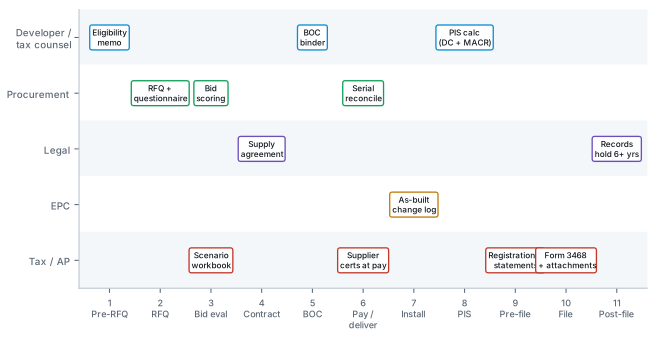
Template C — RFQ-to-return timeline (1–20 MW)
| # | When | Owner | Action | Evidence produced |
|---|---|---|---|---|
| 1 | Pre-RFQ | Developer / tax counsel | Fix project type, AC size (under or over 1 MWac), credit path (ITC/PTC; direct pay or transfer) and target BOC year, which sets the thresholds (DC 50/55; MACR 40/45) | Eligibility memo |
| 2 | RFQ | Procurement | Issue Template A with the RFQ; require row-level origin data against Notice 2025-08 and a commitment to deliver MACR certifications | Completed questionnaires |
| 3 | Bid evaluation | Procurement / tax | Run preliminary Domestic Cost % and MACR on each bid; weigh any price premium against bonus value (10 vs 2 points) and the direct-pay haircut | Scenario workbook |
| 4 | Contract / PO | Legal | Include representations, certification deliverables, change control (no substitution without consent), records cooperation (≥6 years), indemnity and §6695B acknowledgment | Executed supply agreement |
| 5 | BOC | Developer | Document physical work or the 5% safe harbor; starts after 4 Jul 2026 must be in service by 31 Dec 2027 | BOC binder |
| 6 | Payment / delivery | Procurement / AP | Collect dated supplier MACR certifications (EIN, perjury) at or before payment, because PFE status is tested in the payment year; reconcile serials to factory | Certifications; delivery logs |
| 7 | Installation | EPC | Track as-built substitutions; refresh questionnaires for any new source | Change log |
| 8 | Placed in service | Developer / tax | Final as-built BOM; final Domestic Cost % as of placed-in-service date; final MACR | Final calculations |
| 9 | Pre-filing | Tax | IRS pre-filing registration (direct pay / transfer); prepare Domestic Content statement, MACR safe-harbor statement and Notice 2024-84 attestation if needed | Registration number; signed statements |
| 10 | Return (first credit year) | Tax | File Form 3468 (or 8835 / 7211) with all attachments; signer has legal authority | Filed return |
| 11 | Post-filing (6+ years) | Tax / legal | Records hold; monitor SFE payments for 10 years (§50(a)(4)); respond to transferee or IRS requests | Records-hold memo |
6.1 The steps that most often fail
Step 3 — scoring bids on price alone. A module that is cheaper per watt but has imported glass and backsheet can cost the project the bonus entirely (Section 4.6). The scenario workbook should run both tests on every short-listed bid.
Step 4 — contracts without change control. Substitutions are the single largest source of as-built divergence. A supplier that swaps a cell source or a factory mid-delivery can move a project from 51.8% to 23.1% without anyone in procurement noticing. The supply agreement should prohibit substitution without written consent and require re-issued certifications if one occurs.
Step 6 — collecting certifications after payment. Because PFE status is tested for the producer's taxable year that includes the payment date, a certification dated in a later year may not speak to the right period. Make the certification a condition of payment.
Step 8 — certifying the design BOM rather than the as-built BOM. Domestic Content is certified as of placed in service. The final calculation must reconcile POs, invoices, delivery documents and the change log.
Section 7Supplier vetting
The supplier questionnaire is the backbone of both tests. It gathers origin data for Domestic Content and ownership, control and producer data for MACR, and it puts suppliers on notice that their answers will be relied on.
7.1 Who to vet, and when
Every supplier of a manufactured product or MPC on the applicable table should complete the questionnaire: modules, inverters or MLPE, trackers or racking. Suppliers of structural steel should complete the steel section. Issue it with the RFQ, refresh it at purchase order and again at delivery. Where the seller is a reseller or holds inventory, ask for the identity of the manufacturer of each item — the PFE test looks to the entity that produced the item, not the seller.
7.2 Template A — Supplier vetting questionnaire
Template A — Supplier vetting questionnaire (Domestic Content + MACR/PFE)
Template for adaptation by counsel. Bracketed references show the rule each question supports.
Part 1 — Supplier identity
- Legal name; address of each manufacturing site supplying this order; EIN (or foreign-government tax ID). [MACR certification must carry EIN: §7701(a)(52)(D)(iii)(IV)]
- Are you the manufacturer, or a reseller? If a reseller, name the manufacturer of each item. [PFE test looks to the producing entity: Notice 2026-15 §§3.01(5)(b), 3.02(5)]
- Your taxable year end. Confirm that the PFE status reported here applies to the taxable year that includes our payment date. [Notice 2026-15 §3.01(5)(c)]
Part 2 — Ownership, control and influence (PFE screen)
- Is your company, or any parent, within the NDAA §9901(8) FEOC categories, on the DoD 1260H list, on the UFLPA Entity List or the FY2024 NDAA §154(b) list, or an agency or instrumentality of a covered-nation government? [§7701(a)(51)(B)–(C)]
- Provide your ownership chart to ultimate beneficial owners, with percentages by vote and value. Does any single SFE own 25% or more, or do SFEs in aggregate own 40% or more? [§7701(a)(51)(D)]
- Does any SFE have authority to appoint a director or executive officer? [same]
- What percentage of your outstanding debt is held by SFEs? Is it 15% or more? [same]
- Are your securities publicly traded? On which exchange? [modified rules: §7701(a)(51)(E)]
- In your previous taxable year, did you pay any SFE under a contract giving it rights to set production quantity or timing, decide who buys output, restrict data or site access, or exclusively operate or maintain plant? [effective control]
- Do you license technology or IP used to make this product from an SFE or related party? Give the date of the licence and of any modification, especially on or after 4 Jul 2025, and state whether it lets the licensor direct sourcing or operations, limits your use of the IP, carries royalties beyond year 10, requires services longer than 2 years, or withholds full know-how. [Notice 2026-15 §5.01]
- Any changes in ownership or control since 4 Jul 2025, or planned within 12 months? [anti-circumvention: Notice 2026-15 §5.02]
Part 3 — Bill of materials and origin (both tests)
- For each item: model / SKU, factory, country of manufacture, and each listed MPC in the applicable Notice 2025-08 row. For modules: cells, frame/backrail, front glass, encapsulant, backsheet/backglass, junction box, edge seals, pottants, bus ribbons, bypass diodes — with manufacturer name, country of manufacture and PFE status of each. [Notice 2025-08 §§5.05–5.06; Notice 2026-15 §4.02]
- Cells: manufacturer, factory location, technology. Wafers: manufacturer and country. Do the cells use exclusively U.S.-made wafers? [Notice 2025-08 §8.03(4)–(5)]
- Is the manufacturing process for the finished product (transformation, not mere assembly) performed in the U.S.? Describe it. [Notice 2023-38 §3.03(1)]
- Structural steel/iron (piles, ground screws, fixed-tilt racking, rebar): confirm all manufacturing processes, from melting through coating, took place in the U.S.; provide mill certificates. [Notice 2023-38 §3.02; 49 CFR 661.5]
- If any item will come from mixed U.S. and foreign sources, give the nameplate capacity split per delivery. [Notice 2025-08 §8.03(5)]
Part 4 — Cost attestation
- Domestic Content method: (a) Notice 2025-08 safe harbor — origin evidence required, no cost data; or (b) actual-cost method — manufacturer's direct materials and direct labour for the product and each U.S. component. [Notice 2023-38 §3.03(2)]
- MACR: will you certify either (a) that the item was not produced by a PFE and you do not know or have reason to know of any upstream PFE, or (b) the total direct costs to us that were not PFE-produced — signed under penalties of perjury, retained for at least 6 years and provided to the IRS on request? [§7701(a)(52)(D)(iii)(IV); Notice 2026-15 §4.03]
- Acknowledge that suppliers face a penalty under §6695B for inaccurate certifications provided after 31 Dec 2025 that they knew or should have known were inaccurate. [Notice 2026-15 §2.03]
Part 5 — Change control
- Will you give written notice before any substitution of model, factory, cell source or listed MPC source, and reissue certifications if one occurs?
- Will you provide traceability (serial or pallet numbers mapped to cell lot or factory) on delivery documents?
- Will you cooperate with buyer, lender, tax-equity and IRS document requests for at least 6 years? (One public buyer template uses 8 years.)
SolarStock USA Research template based on P.L. 119-21 (§7701(a)(51)–(52)); IRS Notices 2023-38, 2025-08, 2026-15; Connecticut Green Bank, Exhibit C FEOC Certificate – Module (Jun 2026).
7.3 Red flags
| Red flag | Why it matters | Follow-up |
|---|---|---|
| Cell origin answered as "Asia" or "various" | Cells carry 31–53% of the standard columns; an unknown origin defaults to foreign for Domestic Content and to unknown producer for MACR | Require cell manufacturer, factory and lot traceability |
| "Made in USA" without an MPC breakdown | Assembly alone does not earn the Production share; each listed MPC needs an origin | Insist on row-level answers |
| IP licence signed or modified after 4 Jul 2025 | Any of the listed licence indicators can make the licensee a foreign-influenced entity | Counsel review of licence terms |
| Recent or planned ownership change | Treasury has signalled anti-abuse rules against temporary lapses of foreign ownership or control | Ownership chart dated at payment |
| Reseller cannot name the manufacturer | PFE status is tested on the producer; a reseller's own status does not answer the question | Obtain manufacturer-level certification |
| Inventory produced across multiple years | PFE status is tested by the producer's taxable year that includes the payment date | Date-specific certification per delivery |
| Letter disclaims reliance for tax purposes | Cannot serve as a MACR certification; weak as Domestic Content evidence | Request a compliant certification (Section 8) |
SolarStock USA Research, based on Notice 2025-08 §8.03, Notice 2026-15 §§3.01, 4.03, 5.01–5.02.
Practitioners caution that supplier attestations alone amount to a desktop exercise for FEOC purposes. Recommended additions include ownership mapping, screening against the relevant entity lists, a review of debt holders, and third-party chain-of-custody checks for high-risk components such as cells and wafers (pv magazine USA, 25 Feb 2026).
Section 8Manufacturer letters: compliant versus deficient
Most buyers receive a "domestic content letter" or a "non-PFE letter" from their module supplier. These documents vary widely. Some are certifications built to the statutory standard; many are marketing summaries that expressly disclaim reliance.
8.1 Two different documents
For MACR, the statute and Notice 2026-15 prescribe what a supplier certification must contain if the taxpayer wants the Certification Safe Harbor. For Domestic Content, there is no prescribed supplier form. The taxpayer certifies compliance itself; a manufacturer's letter is evidence supporting that certification, alongside origin documentation.
8.2 What a compliant MACR certification must contain
- The supplier's EIN, or a foreign-government taxpayer identification number.
- Signature under penalties of perjury.
- A commitment that the supplier will retain the certification for at least six years and produce it to the IRS on request; the taxpayer must retain it too.
- Issued by the supplier from whom the taxpayer actually purchased the item.
- Either (a) a statement that the item was not produced by a PFE and that the supplier does not know or have reason to know of any PFE in the prior supply chain, or (b) the total direct costs to the taxpayer that were not produced by a PFE.
- Attached to Form 3468 (or Form 7211 / 7207) for the first year of the credit claim.
§7701(a)(52)(D)(iii)(IV); Notice 2026-15 §4.03(2).
Two further rules apply. If the taxpayer knows or has reason to know that an item was PFE-produced, all of its costs are PFE costs, and a certification known to be inaccurate cannot be relied on. And the supplier is exposed to the §6695B penalty for inaccurate certifications provided after 31 December 2025.
8.3 What a strong Domestic Content letter usually contains
Because no IRS format exists, the following list is a synthesis of documents in circulation and is not a legal standard:
- Product models or SKUs, and serial or lot ranges covered.
- Factory address where the manufacturing process is performed.
- Each listed MPC with its manufacturer and country of manufacture.
- Cell and wafer origin, stated separately.
- The Notice 2025-08 table and column applied, and the percentage claimed, row by row.
- Effective date and validity period.
- Signer's name and authority.
- Reliance language — or, where the manufacturer disclaims reliance, that fact clearly stated.
8.4 Common deficient letters
A published manufacturer letter we reviewed illustrates the gap. It stated that a third-party review had verified the company's non-PFE status and that the manufacturer had received non-PFE certifications from its own suppliers. It presented a per-component table using the Notice 2025-08 columns, in which only the cells and the module "Production" row carried a percentage and every other listed module component was shown at zero, giving a total for each project type. The letter expressly disclaimed being tax advice or a certification for tax purposes and said it could not be relied on to determine eligibility. It carried no EIN and no penalties-of-perjury statement.
Several lessons follow for the buyer:
- It is not a MACR certification. Without an EIN, a perjury statement and a retention undertaking, it cannot support the Certification Safe Harbor, however accurate its content.
- Know which test a table speaks to. A table built for the PFE question does not answer the Domestic Content question. If a buyer wanted to use such a table as Domestic Content evidence, it would need to confirm the U.S. origin of every listed module component: under Notice 2025-08, the Production share counts only if all listed module MPCs are U.S.-produced.
- The disclaimer shifts the burden back to the taxpayer. The buyer must build independent evidence and, for MACR, obtain a certification from its direct supplier that meets the statutory form.
| Feature | Common deficient letter | Compliant certification / strong letter |
|---|---|---|
| Identifier | No EIN | EIN or foreign-government TIN |
| Attestation | No perjury statement | Signed under penalties of perjury |
| Reliance | "Not tax advice; may not be relied on" | Addressed to buyer; reliance by buyer, lenders, tax equity |
| Issuer | Manufacturer, generic to all customers | Direct supplier, specific to the PO |
| Scope | Model families | Models, quantities, serial / lot ranges, PO reference |
| MPC detail | Cells only, or a total percentage | Every listed MPC: manufacturer, country, PFE status |
| Production share | Shown without confirming origin of every MPC | Credited only if all listed MPCs are U.S. |
| Retention | Not addressed | ≥6 years, produced to IRS on request |
| Change control | Not addressed | Notice and reissue on any substitution |
SolarStock USA Research review of manufacturer letters and of Connecticut Green Bank's Exhibit C FEOC Certificate – Module (Jun 2026); statutory content from §7701(a)(52)(D)(iii)(IV) and Notice 2026-15 §4.03.
8.5 A buyer-drafted model
Some public buyers have stopped accepting supplier-drafted letters. The Connecticut Green Bank's module FEOC certificate (June 2026) is a buyer-drafted template that the seller completes. It asks for the seller's EIN, PO number and date, and a component table showing description, quantity, total direct costs per the Notice 2025-08 (or later) tables, country of origin and PFE status. The seller represents that it is the direct supplier, that the goods are not PFE-produced, and that it knows of no PFE involvement down to cells, wafers, polysilicon and the main module materials. The template adds reliance by the buyer, its affiliates, lenders, tax equity and auditors; a cooperation and records duty; an eight-year retention period; consent to disclosure to Treasury and the IRS; and signature by an authorized officer under penalties of perjury. Mid-market buyers can adapt this model with counsel.
Section 9The audit-ready documentation file
An audit-ready file answers three questions without anyone having to reconstruct anything: what was installed, where each listed item came from and who made it, and who signed what on which date.
9.1 The taxpayer's own certification
A Domestic Content Certification Statement is required for each applicable project and is attached to Form 3468 (ITC) or Form 8835 / 7211 (PTC) for the first year the bonus is claimed; for PTC claims, a copy is attached every year of the credit period. Under Notice 2023-38 it states the project type, specific type, geographic coordinates and address, placed-in-service date and total bonus amount, and it is signed under penalties of perjury by a person with legal authority to bind the taxpayer. The 2025 Form 3468 instructions add the facility description, owner, IRS registration number where applicable, a statement that steel, iron and manufactured products were U.S.-produced under 49 CFR 661, and a statement if the elective safe harbor is relied on. The bonus is claimed by checking box 9a or 9b on Line 9; box 9c indicates no bonus. Compliance is certified as of the placed-in-service date.
9.2 Template B — Document checklist
Template B — Audit-ready Domestic Content and MACR file, 1–20 MW project
Tab 1 — Project identity and eligibility
- Legal owner, TIN, project name, address and geographic coordinates. [Notice 2023-38 §5.01(2)(c)]
- Project type per Notice 2025-08 definitions (GM fixed / GM tracker / rooftop MLPE / rooftop string), with single-line diagram and racking drawings.
- AC nameplate determination (under or over 1 MWac).
- IRS pre-filing registration number (direct pay or transfer).
- PWA compliance file, which sets the 10-point versus 2-point bonus.
Tab 2 — Beginning of construction
- Method (Physical Work Test or 5% safe harbor) and date; binding written contracts, off-site work evidence, cost-incurred analysis, invoices and title transfer.
- Evidence for both tests if BOC fell between 2 Sep 2025 and 6 Jun 2026.
- Continuity evidence; for post-4 Jul 2026 starts, a placed-in-service plan by 31 Dec 2027.
- Note of the thresholds the BOC year fixes: adjusted percentage, MACR threshold, direct-pay percentage.
Tab 3 — Domestic Content calculation
- Election memo: actual-cost method or Notice 2025-08 safe harbor; column chosen (including DCW if applicable); confirmation that no Notice 2024-41 safe harbor is mixed in.
- As-built BOM reconciled to design BOM, POs, invoices and substitutions.
- Per-row workbook: each listed APC / MPC with U.S.-origin Y/N and evidence reference; Production eligibility check; mixed-source weighting; zeroed unused rows.
- Steel/iron: list of structural items, mill certifications, fabricator U.S.-process attestations.
- Final Domestic Cost Percentage versus the applicable threshold.
Tab 4 — Supplier evidence
- Completed Template A per supplier, refreshed at PO and delivery.
- Manufacturer Domestic Content letters, with any reliance disclaimers noted.
- Country-of-origin and transformation evidence (factory, cell and wafer origin).
- Manufacturer direct-cost data if the actual-cost method is used, with confidentiality arrangements.
- Delivery documents mapping serial or pallet numbers to factory and cell lot.
Tab 5 — MACR / PFE (BOC after 31 Dec 2025)
- Taxpayer-level PFE analysis: owners, debt holders, officer-appointment rights, SFE payments, IP licences; 10-year §50(a)(4) monitoring plan.
- Clean Electricity MACR workbook (Identification and/or Cost Percentage safe harbor, or actual method); de minimis if used.
- Supplier certifications meeting the statutory form (EIN, perjury, content, direct supplier).
- Separate MACR for qualified interconnection property if included in basis.
- Pre-16 Jun 2025 binding-contract election support, if used.
- Safe-harbor statement for attachment.
- "Knowledge" file: screening results and red-flag log showing no reason to know of PFE production.
Tab 6 — Return attachments (first credit year)
- Form 3468 with Line 9 box 9a or 9b.
- Domestic Content Certification Statement, signed by a person with authority to bind the taxpayer, with safe-harbor reliance statement if applicable.
- MACR safe-harbor statement and supplier certifications.
- Direct pay: Domestic Content met, or Notice 2024-84 exception attestation.
- PTC path: copy of the Domestic Content statement each year of the credit period.
Tab 7 — Post-filing
- Transfer: buyer diligence package, indemnities, §6418(g)(2) 20% exposure analysis.
- Direct pay: §6417(d)(6) 20% exposure note.
- Records-hold memo and custodian; six-year MACR assessment period calendared from the filing date.
SolarStock USA Research template based on IRS Notices 2023-38, 2024-84, 2025-08, 2026-15 and the 2025 Form 3468 instructions. For adaptation by counsel.
9.3 One workbook, two tests
The most efficient pattern is a single BOM register with one row per listed APC / MPC and, for each, the producer's legal name, factory location, country of manufacture, PFE status in the payment year, evidence reference, and delivery quantities. Two calculation tabs then read from it: one applies the Domestic Content conventions (unused rows at zero; Production conditional; steel/iron tested separately), the other the MACR conventions (unused rows and steel/iron disregarded; de minimis if elected). Because the producer and the country of manufacture are different facts, the register should never collapse them into a single "origin" field.
Section 10Record retention, penalties and exposure
The Domestic Content regime itself carries no special penalty. The MACR regime does — and for 2026-start projects, both sit in the same return.
10.1 How long to keep records
For Domestic Content, the general §6001 rule applies: records must be kept for as long as they may be material. Neither Notice 2023-38 nor Notice 2025-08 sets a fixed number of years. For MACR, supplier certifications must be retained by both supplier and taxpayer for at least six years, and the IRS has six years from filing to assess deficiencies arising from MACR errors under §6501(o).
A practical retention rule for mid-market buyers is the later of six years after filing the return that first claims the credit and the end of the period in which the records may become material. Recapture periods may extend that further: under §50(a)(1) the general investment-credit recapture period is five full years from placed in service, with the recapture percentage stepping down from 100% in year one by 20 points a year (100/80/60/40/20), and this applies to §48E property. For §48E property, the separate 10-year §50(a)(4) window for payments to prohibited foreign entities (below) is the longer horizon.
10.2 Penalty and exposure map
| Provision | Trigger | Consequence |
|---|---|---|
| §6662(a), (b), (d) | Substantial understatement: more than the greater of 10% of correct tax or $5,000 | 20% accuracy-related penalty |
| §6662(m) | Credit disallowed under §§45X/45Y/48E because MACR was overstated (tax years beginning after 4 Jul 2025) | Understatement threshold falls to 1% |
| §6501(o) | Deficiency attributable to §7701(a)(52) errors | Six-year assessment period from filing |
| §6695B (supplier) | Supplier certification it knew or should have known was inaccurate, causing a disallowance and an understatement above the lesser of 5% of tax or $100,000; certifications after 31 Dec 2025 | Greater of 10% of attributable underpayment or $5,000; reasonable-cause defence; six-year assessment period |
| §6417(d)(6) | Excessive direct payment, including from a MACR disallowance | Repayment plus 20%, unless reasonable cause |
| §6418(g)(2) | Excessive credit transfer | Recapture from transferee plus 20%, unless reasonable cause |
| §50(a)(1) | Investment credit property disposed of or ceasing to qualify within 5 full years of placed in service (applies to §48E) | Recapture of 100%, 80%, 60%, 40% or 20% of the credit, by year |
| §50(a)(4) | "Specified taxpayer" makes an effective-control payment to an SFE within 10 years of placing §48E property in service | Tax increased by 100% of prior §48E credits |
| Domestic Content statement | Signed under penalties of perjury | General rules; no Domestic Content-specific regime |
Notice 2026-15 §2.03; 26 U.S.C. §§50(a)(1), 6417(d)(6), 6418(g)(2); P.L. 119-21 §70513(b)(3); Notice 2023-38; draft 2026 Instructions for Form 3468. Under §50(a)(4), a specified taxpayer is one allowed a §48E credit for tax years beginning after 4 Jul 2027.
10.3 What this means for a 1–20 MW buyer
The 1% threshold changes the economics of error. On a mid-market project, a disallowed credit will almost always exceed 1% of the taxpayer's correct tax, so any MACR overstatement that leads to disallowance is likely to attract the 20% penalty unless reasonable cause can be shown. The best evidence of reasonable cause is a contemporaneous file: questionnaires issued before purchase, certifications dated at payment, a red-flag log, and a signed calculation. For transfer buyers, the 20% addition falls on the transferee, which is why credit purchasers increasingly ask for the full supplier file during diligence.
Section 11The U.S. manufacturing landscape and sourcing in practice
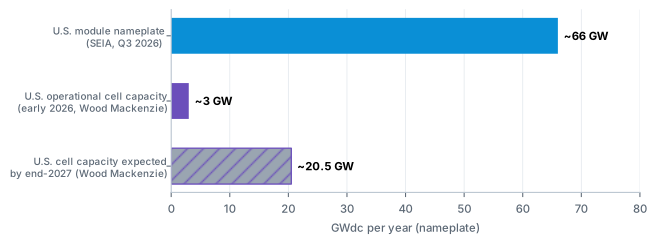
The arithmetic in Section 4 shows that U.S. cells are the decisive input. The supply picture in October 2026 is one of ample U.S. module assembly and still-thin U.S. cell output, with substantial cell capacity scheduled to come online through 2027.
11.1 The module–cell gap
SEIA's Q3 2026 Solar Market Insight puts U.S. module nameplate capacity at about 66 GWdc; a June 2026 report citing SEIA gave 69.9 GW, so published figures differ. By contrast, Wood Mackenzie estimated U.S. operational cell capacity at about 3 GW earlier in 2026 and expects it to reach 20.5 GW by the end of 2027. Nameplate is not output, and cell capacity under construction is not yet supply.
11.2 Selected U.S. factories, October 2026
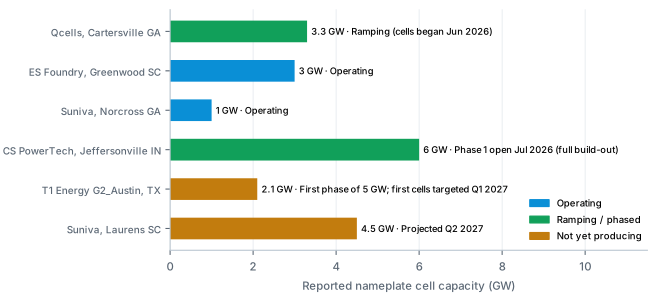
The table lists only facilities whose details we could source during this research cycle. Capacities are nameplate as reported by the named source, not production. It is not a complete census of U.S. manufacturing.
| Company / site | Stage | Reported capacity | Status and notes |
|---|---|---|---|
| Qcells (Hanwha), Dalton GA | Modules | 5.1 GW | Operating |
| Qcells, Cartersville GA | Ingot, wafer, cell, module | ~3.3 GW cell; 3.5 GW module | Cell production began Jun 2026; module line at full capacity; company targets 3.3 GW each of ingot, wafer and cell by Q3 2026; ingot/wafer output n/c |
| ES Foundry, Greenwood SC | Cells (PERC, bifacial) | 3 GW | 2 GW expansion completed Jul 2026; wafer source not stated |
| Suniva, Norcross GA | Cells | ~1 GW | Operating; wafer partnership with Corning announced Mar 2025 |
| Suniva, Laurens SC | Cells | 4.5 GW | Announced; projected opening Q2 2027 |
| Corning / Hemlock, Michigan | Polysilicon; ingots and wafers | ~2.5 GW wafers (estimate) | Ingot/wafer production began Q3 2025; most output reported as contracted |
| Heliene, Minnesota (two sites) | Modules | 1.3 GW | Operating; markets domestic-cell or domestic-wafer options |
| CS PowerTech (Canadian Solar), Jeffersonville IN | Cells (HJT) | >6 GW at full build-out | Phase 1 opened Jul 2026; phase 1 capacity not disclosed |
| CS PowerTech, Mesquite TX | Modules | n/d | Operating; to receive Jeffersonville cells |
| T1 Energy G1, Wilmer TX | Modules | 5 GW | Operating; 683.3 MW produced in Q1 2026 and 935 MW in Q2 2026; imported cells until G2 |
| T1 Energy G2_Austin, TX | Cells | 2.1 GW first phase (5 GW planned) | Under construction; T1 targets first cell production in Q1 2027 (Q2 2026 results, Aug 2026) |
| Silfab, Burlington WA | Modules | n/d | Operating |
| Silfab, Fort Mill SC | Cells and modules | n/d | Chemical incidents Mar 2026; cell-line commissioning planned from 19 Oct 2026 after third-party safety review |
| First Solar (OH, AL, LA) | CdTe thin-film modules | n/d (U.S. split) | Operating; vertically integrated, not c-Si; SC finishing plant scheduled end-2026 |
| Illuminate USA, Pataskala OH | Modules | n/d | LONGi reduced its stake below 24.9% (Jul 2026) |
| Waaree Solar Americas, Brookshire TX | Modules | 1.6 GW | Commercial production since Jan 2025; board-approved expansion to 3.2 GW announced Apr 2025 (status n/c) |
| Mission Solar Energy (OCI Holdings), San Antonio TX | Cells | 2 GW announced | Announced Mar 2025 with commercial production targeted for H1 2026; production status n/c |
| Meyer Burger, Goodyear AZ | Modules | 1.4 GW | Closed 29 May 2025 |
pv magazine USA (9 Jun, 10 Jul, 24 Jul 2026); pv magazine (8 Jul 2026); Business Wire (14 Apr 2026); HSC / PV Tech (13 Nov 2025); Utility Dive (11 Mar 2025); TaiyangNews (14 May 2026); PV Tech (14 Aug 2026); T1 Energy G2_Austin page; Hanwha/Qcells press release (11 Jun 2026); Solar Power World (9 Jun 2026); pv magazine (24 Jan 2025); Mercom (15 Apr 2025); Manufacturing Dive (26 Mar 2025); pv magazine USA (21 Mar 2025); GreenLancer (8 Oct 2026); York County SC (4 Aug 2026); Solar Power World via Now.Solar (30 Sep 2026); Solar Power World (Mar 2026); Solar Builder (2 Jun 2025); Heliene product information (Oct 2025). n/d = not disclosed in the sources read; n/c = not confirmed in public sources as of 14 Oct 2026. Inclusion does not imply that any product meets Domestic Content or MACR requirements.
11.3 What the landscape means for a 1–20 MW buyer
- Module assembly is not the constraint; cells are. A U.S.-assembled module with imported cells is widely available but, as Section 4 shows, contributes at most about 23% on a tracker project and 32.6% on a fixed-tilt project.
- Domestic cells are contracted early. Much of the U.S. cell and wafer capacity that is running is tied to integrated or long-term offtake arrangements. Mid-market buyers should expect to ask early and to receive allocation rather than spot availability.
- Thin-film follows different rows. The DCW columns are defined for c-Si cells. Buyers considering CdTe modules should rely on the manufacturer's own row mapping rather than extrapolate from c-Si arithmetic.
- Trade measures will reprice imports. From 4 December 2026, the §232 minimum import prices of $0.22/W for cells and $0.38/W for modules apply in addition to existing AD/CVD duties. For context, Anza reported a median U.S.-assembled module price of $0.30/W in data released in July 2026.
11.4 Sourcing DC-eligible modules in practice
In practice, sourcing for Domestic Content means sourcing evidence as much as hardware. A module's country of assembly is the starting point, not the answer. The buyer needs, for each candidate module: the cell manufacturer and factory; the wafer origin; the origin of every other listed MPC; a factory address for the manufacturing process; and a supplier willing to issue a MACR certification to the statutory standard.
U.S.-assembled modules are available through several channels, including manufacturers' direct sales teams and inventory platforms. SolarStock USA's platform, for example, lists U.S.-assembled modules among its inventory, including Sunpro Power modules assembled in Georgia. U.S. assembly alone does not establish Domestic Content qualification or MACR compliance. Nothing in this guide states or implies that any product available on SolarStock USA's platform qualifies for the Domestic Content bonus or meets the MACR threshold; that determination depends on the full bill of materials, the supplier documentation described in Sections 7 and 8, and the buyer's own certification.
Section 12Decision matrix for 1–20 MW buyers
The right Domestic Content strategy depends on four facts: AC size, PWA status, credit monetization route and mounting type. The matrix below is a SolarStock USA Research assessment, not tax advice.
12.1 Should we pursue the Domestic Content bonus?
| Buyer profile (2026 BOC) | Bonus at stake | Direct-pay haircut | SolarStock USA Research assessment |
|---|---|---|---|
| Under 1 MWac, taxable owner | 10 points (no PWA needed) | Not applicable | Pursue if economic. Full bonus without PWA; weigh premium and documentation cost against 10% of basis. |
| Under 1 MWac, direct pay | 10 points | None (under 1 MWac) | Optional. Bonus is upside only; MACR still required. |
| 1–20 MWac, taxable owner, PWA met | 10 points | Not applicable | Pursue where the BOM can clear 50%. Typically requires U.S. cells, or U.S. module materials plus U.S. tracker. |
| 1–20 MWac, taxable owner, PWA not met | 2 points | Not applicable | Usually deprioritize. 2 points rarely covers premium plus documentation; focus effort on MACR. |
| 1–20 MWac, direct pay, PWA met | 10 points | 0% without DC or exception | Treat as mandatory unless a documented Notice 2024-84 exception is available and BOC precedes the end of that route. |
| 1–20 MWac, direct pay, PWA not met | 2 points | 0% without DC or exception | Treat as mandatory to preserve the payment; consider whether meeting PWA is feasible. |
SolarStock USA Research assessment. Criteria: bonus rates per §48(a)(12); direct-pay applicable percentage per §45Y(g)(12); MACR required for all 2026+ starts per §48E(b). Not tax advice.
12.2 Which BOM strategy?
| Mounting type | Without U.S. cells (max, standard column) | With U.S. cells | Practical route to 50% / 55% |
|---|---|---|---|
| Ground-mount, fixed tilt | 40.1% (module materials + inverter); cannot reach 50% | 92.5% (module alone) | U.S. cells required; steel racking and piles must also meet the 100% steel test |
| Ground-mount, tracker | 51.8% (module materials + tracker); 57.3% with inverter | 65.8% (module alone) | U.S. tracker plus fully U.S. module materials, or U.S. cells |
| Rooftop, string | 54.3% (module materials + racking + inverter) | 69.2% (module alone) | Everything U.S. except cells, or U.S. cells |
| Rooftop, MLPE | 63.1% (module materials + racking + MLPE) | 55.6% (module alone) | U.S. MLPE is a major lever (24.8%); combine with U.S. racking and module materials |
Computed by SolarStock USA Research from IRS Notice 2025-08 §§5.05–5.06 (see Section 4.5). Maximums assume full documentation of every counted row. The 2027 threshold is 55%.
12.3 MACR is not optional
Whatever the Domestic Content decision, every 2026-start project must pass MACR. Notice 2026-15's Example 1 shows that a project whose only PFE-produced item is the cell can still reach 61.8%. The practical risk for mid-market buyers is therefore less the ratio itself than the evidence: identifying the producer of every listed item, testing its status in the payment year, and holding certifications that meet the statutory form.
Section 13Open questions: what to watch, Q4 2026 to 2027
The rules for 2026 starts are stable. The rules for 2027 starts are not. These are the items we are tracking.
| # | Open question | Why it matters for 1–20 MW buyers | Timing |
|---|---|---|---|
| 1 | MACR safe-harbor tables | May differ from the Domestic Content tables; interim reliance on Notice 2025-08 tables ends 60 days after publication. Industry sources have flagged possible delay. | Statutory deadline 31 Dec 2026 |
| 2 | PFE proposed regulations | Will define effective control, licensing, ownership look-through, debt and anti-stockpiling rules; questionnaires may need revision. | Not scheduled |
| 3 | Certifying entity status | The Certification safe harbor covers items, not whether a taxpayer or supplier is itself an SFE or FIE. | Awaiting guidance |
| 4 | Domestic Content proposed regulations | Promised since 2023; publication starts a 90-day reliance clock for Notice 2023-38 rules. | Not scheduled |
| 5 | Notice 2025-42 after 4 Sep 2026 | No appeal and no replacement BOC guidance had been identified as of 14 Oct 2026. Watch whether Treasury reissues BOC guidance addressing the court's reasoning. | Monitor |
| 6 | Notice 2024-84 window | What procedure applies to direct-pay entities starting construction in 2027. | 1 Jan 2027 or later guidance |
| 7 | Steel rooftop racking | Rooftop tables list only non-steel racking; classification of steel systems is unresolved. | Counsel review |
| 8 | Wafer-to-cell traceability | No evidence standard for proving U.S. wafers at lot level for the DCW columns. | Awaiting guidance |
| 9 | Inventory held by resellers | How direct-supplier certifications work for stock produced across multiple years, given payment-year PFE testing. | Awaiting guidance |
| 10 | Thin-film mapping | DCW columns are defined for c-Si; CdTe row mapping depends on manufacturer documentation. | Ongoing |
| 11 | §232 and FCC interaction | Not tax rules, but will push sourcing toward U.S. cells and inverters; the FCC's Buy American 65% test is distinct from the IRS adjusted percentage. | 4 Dec 2026 (§232) |
| 12 | Final 2026 Form 3468 and instructions | The IRS's draft 2026 Form 3468 keeps the Domestic Content question at Part I, line 9 (boxes 9a/9b/9c) and adds no dedicated MACR line or schedule; the draft instructions address material assistance by cross-reference to Notice 2026-15. Whether the final form changes before the 2027 filing season remains to be seen. | Filing season 2027 |
SolarStock USA Research; McGuireWoods (6 Mar 2026); SEIA Solar Market Insight Q3 2026; Clifford Chance (4 Sep 2026); IRS draft 2026 Form 3468 and instructions; Troutman (FCC); Notice 2025-08; Notice 2026-15; Notice 2024-84.
Five actions for Q4 2026
- Re-baseline any Domestic Content memo that cites a 40% threshold for 2026 or 2027 starts.
- Issue the supplier questionnaire on every open RFQ and make MACR certifications a condition of payment.
- For direct-pay projects of 1 MWac or more starting before the end of the Notice 2024-84 route, decide now whether to rely on Domestic Content or the exception attestation.
- Review supply agreements for change-control, records-cooperation and certification clauses before the 4 December 2026 tariff date reprices imports.
- Build one BOM register with two calculation tabs, ready to swap in the MACR tables when they are published.
Section 14Methodology, Sources & Disclosures
Methodology
This guide reflects law, guidance and market information available to the SolarStock USA Research Desk as of 14 October 2026. Primary texts — IRS Notices 2023-38, 2024-9, 2024-41, 2024-84, 2025-08, 2025-42 and 2026-15; P.L. 119-21; current text of 26 U.S.C. §§45, 45Y, 48, 48E, 6417 and 6418; the 2025 Instructions for Form 3468; and IRS web guidance on Domestic Content and elective pay — were read in full or in the relevant parts. We scanned the full text of Internal Revenue Bulletins 2026-02 through 2026-42 for Domestic Content, material-assistance, PFE and beginning-of-construction guidance, and queried the Federal Register API for IRS documents published since 1 January 2026.
The Notice 2025-08 cost-percentage tables were extracted from the notice PDF and each column was checked to sum to 100.0. Component subtotals and scenario percentages in Sections 4 and 12 are SolarStock USA Research computations on those tables; the tracking-column subtotals were cross-checked against Notice 2026-15 Example 1. Court developments, trade measures, factory data and market figures rely on the named secondary sources. Where sources conflict, both figures are shown.
Sources
Primary regulatory
- Public Law 119-21 (One Big Beautiful Bill Act), 139 Stat. 72, 4 Jul 2025 — govinfo.gov
- 26 U.S.C. §§45, 45Y, 48, 48E, 6417, 6418 — Cornell Legal Information Institute (accessed 14 Oct 2026)
- IRS Notice 2023-38 (12 May 2023), 2023-22 I.R.B. 872 — irs.gov/pub/irs-drop/n-23-38.pdf
- IRS Notice 2024-9 — irs.gov/pub/irs-drop/n-24-09.pdf
- IRS Notice 2024-41 (May 2024, corrected 24 May 2024), 2024-24 I.R.B. 1615 — irs.gov/pub/irs-drop/n-24-41.pdf
- IRS Notice 2024-84 — irs.gov/pub/irs-drop/n-24-84.pdf
- IRS Notice 2025-08 (16 Jan 2025), 2025-8 I.R.B. 800 — irs.gov/pub/irs-drop/n-25-08.pdf
- IRS Notice 2025-42 (15 Aug 2025) — irs.gov/pub/irs-drop/n-25-42.pdf
- IRS Notice 2026-15 (12 Feb 2026), 2026-11 I.R.B. 658; IR-2026-23 — irs.gov/pub/irs-drop/n-26-15.pdf
- IRS Notices 2026-37 and 2026-39 (cross-references) — IRBs 2026-26 and 2026-27
- Internal Revenue Bulletins 2026-02 through 2026-42 (IRBs 2026-37 to 2026-42 re-scanned 14 Oct 2026) — irs.gov/pub/irs-irbs
- IRS, Instructions for Form 3468 (2025), last reviewed 28 Aug 2026 — irs.gov/instructions/i3468
- IRS, Form 3468 (2026), early-release draft (created 27 Jul 2026) — irs.gov/pub/irs-dft/f3468--dft.pdf
- IRS, Instructions for Form 3468 (2026), early-release draft (15 Sep 2026) — irs.gov/pub/irs-dft/i3468--dft.pdf
- 26 U.S.C. §50(a)(1) and (a)(4) — Cornell Legal Information Institute (accessed 14 Oct 2026)
- IRS, Domestic content bonus credit (updated 23 Jan 2026) — irs.gov/credits-deductions/domestic-content-bonus-credit
- IRS, Elective pay FAQs (updated 7 Mar 2026) — irs.gov
- Federal Register API, IRS documents since 1 Jan 2026, including 1 Sep–14 Oct 2026 (queried 14 Oct 2026) — federalregister.gov
Legal & tax analysis
- Clifford Chance, "IRS Notice 2025-42 Appeal Deadline Nears", 4 Sep 2026
- go-alliant, "Notice 2025-42 Is Vacated…", 13 Aug 2026
- Troutman Pepper Locke, "District Court Vacates IRS Notice 2025-42…", 12 Jun 2026
- Miller & Chevalier, federal district court vacates IRS notice on wind and solar beginning of construction, 10 Jul 2026
- Plante Moran, "IRS Notice 2025-42 vacated", 9 Jun 2026
- Morgan Lewis / Law360, solar and wind credits after safe harbor revived, 15 Jun 2026
- Mayer Brown, interim guidance on material assistance (Notice 2026-15), 25 Feb 2026
- KPMG TaxNewsFlash, Notice 2026-15, Feb 2026
- McGuireWoods, initial FEOC guidance, 6 Mar 2026
- Clean Energy Counsel, Notice 2026-15 and interim safe harbors, 2026
- Hunton Andrews Kurth, §232 tariffs and minimum import prices on polysilicon and solar products, 11 Aug 2026
- Wiley Rein, §232 tariffs and minimum import prices on polysilicon and derivatives, 7 Aug 2026
- Troutman Pepper Locke, FCC bars foreign-produced power inverters, 2026
Market data
- SEIA / Wood Mackenzie, Solar Market Insight Q3 2026, 10 Sep 2026
- pv magazine USA, U.S.-assembled module prices (Anza data) and Illuminate USA stake, 10 Jul 2026
- pv magazine, U.S. cell capacity and ES Foundry expansion, 8 Jul 2026
- Cumulant, "The Cliff That Moved", 5 Jul 2026 (citing Wood Mackenzie)
Industry
- pv magazine USA, Qcells Cartersville cell production, 9 Jun 2026
- pv magazine USA, Canadian Solar subsidiary opens Indiana cell factory, 24 Jul 2026
- Business Wire, Suniva announces South Carolina cell facility, 14 Apr 2026
- TaiyangNews, T1 Energy Q1 2026 results, 14 May 2026
- PV Tech, "T1 Energy reports US$250 million Q2 sales", 14 Aug 2026
- T1 Energy, G2_Austin factory page (accessed Oct 2026)
- Hanwha / Qcells, press release on Cartersville cell manufacturing, 11 Jun 2026
- Solar Power World, Qcells starts production of solar cells in the United States, 9 Jun 2026
- pv magazine USA, Corning–T1 Energy supply agreement, 15 Aug 2025
- HSC / PV Tech, Corning U.S. wafer supply, 13 Nov 2025
- Utility Dive, Corning, Suniva, Heliene and Hemlock supply chain, 11 Mar 2025
- GreenLancer, U.S.-manufactured solar panels (8 Oct 2026) and domestic content requirements (24 Sep 2026)
- York County, SC, information on Silfab Solar (updated 4 Aug 2026)
- Solar Power World via Now.Solar, Silfab Fort Mill commissioning, 30 Sep 2026
- Solar Power World, "What's next for First Solar", Mar 2026
- Solar Builder, Meyer Burger closes Arizona site, 2 Jun 2025
- pv magazine, "Waaree's 1.6 GW solar factory in Texas starts commercial production", 24 Jan 2025
- Mercom, Waaree to double Texas module capacity to 3.2 GW, 15 Apr 2025
- Manufacturing Dive, OCI Holdings / Mission Solar Energy cell expansion in San Antonio, 26 Mar 2025
- pv magazine USA, Mission Solar announces 2 GW cell manufacturing in Texas, 21 Mar 2025
- Heliene product information sheet, Oct 2025
- Connecticut Green Bank, Exhibit C FEOC Certificate – Module, Jun 2026
- SolarEdge, domestic content guide for solar developers (blog), Nov 2025
- pv magazine USA, "Supplier attestations alone won't satisfy FEOC scrutiny", 25 Feb 2026
- Manufacturer Domestic Content and non-PFE letters reviewed by SolarStock USA Research (not individually cited)
Limitations & assumptions
- The status of Oregon Environmental Council v. IRS is based on published practitioner reports (Clifford Chance, 4 September 2026) and on IRS and Federal Register publications through 14 October 2026; we did not review the court docket directly.
- Draft 2026 versions of Form 3468 (27 July 2026) and its instructions (15 September 2026) were reviewed; final versions had not been released as of 14 October 2026.
- Factory capacities are nameplate figures as reported by third parties and may not reflect output, allocation or availability. The factory table is selective, not a census.
- Scenario percentages are maximums that assume every counted row is documented as U.S.-made; real BOMs typically score lower.
- Illustrative calculations use hypothetical basis values and facility sizes and do not represent any actual project, product or price.
- Manufacturer statements were read as published and were not audited.
- Guidance is interim in several areas (Notice 2026-15) and may change with MACR tables, proposed regulations or court action.
About SolarStock USA Research
SolarStock USA Research is the analytical desk of SolarStock USA, the first live-inventory solar module platform in the United States, operated by Yulz Design LLC. SolarStock USA holds Tier 1 manufacturers' module inventory in U.S. warehouses in California, Georgia, New Jersey and Texas, with brands including Sunpro Power, JA Solar, Mission Solar, Waaree and ZN Shine. Research outputs reflect the desk's independent analytical view; they are not investment advice and do not constitute a solicitation.
About the Authors
Yuliani Llohis is the Founder and Chief Executive Officer of SolarStock USA. Previously, she built and led Zytech Solar USA — the US subsidiary of Spanish PV manufacturer Zytech Solar Group — for fifteen years, with full P&L responsibility for the American market across residential, commercial, and utility-scale segments. The SolarStock USA Research Desk synthesizes primary regulatory sources, third-party market data and manufacturer documentation into published research.
Disclosure
SolarStock USA sells solar modules, including U.S.-assembled products, and has a commercial interest in the market described in this guide. Brands available on its platform are named in the About section above. References to products or manufacturers are informational and do not state or imply that any product qualifies for the Domestic Content bonus, meets the MACR threshold or is free of PFE involvement.
Disclaimer. This guide is provided for informational purposes only. It does not constitute legal, tax, accounting or investment advice, and it should not be relied on as such. Tax credit eligibility, Domestic Content qualification, MACR compliance and PFE status are fact-specific and depend on circumstances this guide cannot assess; readers should consult qualified tax counsel and other advisors before making any decision or claiming any credit. Information is current as of 14 October 2026 and may change as guidance, regulations and court decisions evolve. Third-party data, documents and analysis remain the property of their respective publishers. SolarStock USA and Yulz Design LLC do not provide tax or legal advice and make no representation or warranty as to the completeness or accuracy of third-party information.
Contact. solarstockusa.com · sales@solarstockusa.com · +1 (619) 638-5178
Republication
Excerpts may be quoted with attribution to "SolarStock USA Research, Domestic Content Compliance Playbook for Mid-Market Procurement, Q4 2026 Edition". The templates in Sections 6, 7 and 9 may be adapted for internal use with counsel's review. Charts and tables may not be republished in full without written permission.